




Forge published its August Private Market Update on August 19. Its headline finding was that the median secondary trade on its platform priced at par to the last primary round in June, the first time that had happened since early 2022. The median slipped to a 7% discount in July. Forge’s read is that “investors are underwriting growth again instead of demanding a valuation markdown just to transact.”
The same report offers a clue about how the median got there. SambaNova’s Forge Price rose 142.9% in July, making it the biggest mover in Forge’s private-market index. That one company added 6.5 percentage points to an equal-weighted index that rose 9.3% for the month. SambaNova had also just raised a new round, resetting the price against which its secondary trades would be measured.
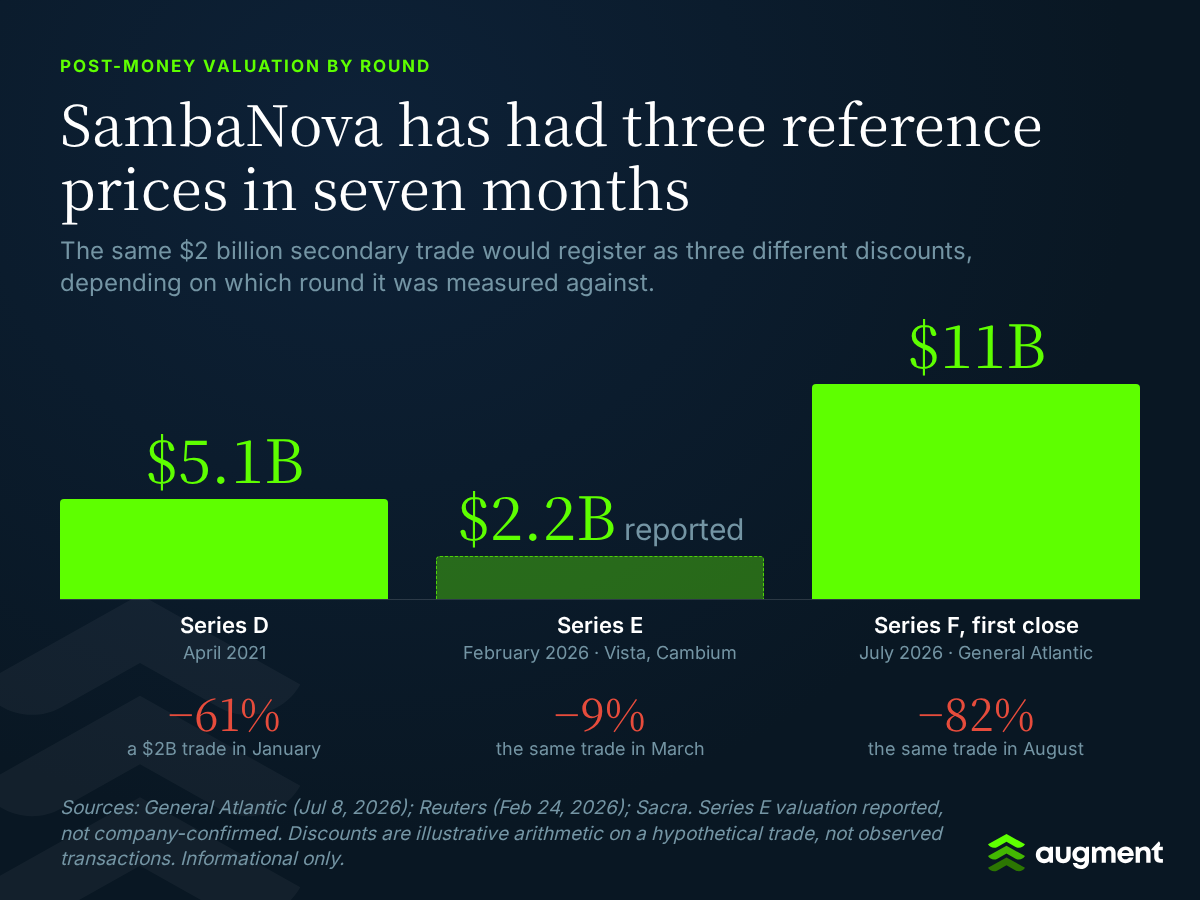
SambaNova’s Series D in April 2021 valued it at $5.1 billion. In December 2025, Bloomberg reported Intel was near a deal to buy the company for about $1.6 billion. The talks stalled. In February, the company closed a $350 million Series E led by Vista Equity Partners and Cambium Capital, at a reported valuation of roughly $2.2 billion according to Sacra. Five months later, on July 8, it announced the first close of a $1 billion Series F led by General Atlantic at an $11 billion post-money valuation. T. Rowe Price, Capital Group, BlackRock and the Qatar Investment Authority were among the participants.
Apply the statistic Forge and PitchBook both use, discount to the last primary round, to that sequence. In January, a secondary trade at, say, $2 billion would have registered as a 61% discount to the 2021 round. In March, the same $2 billion trade would have registered as a 9% discount to the Series E. In August, it would register as an 82% discount to the Series F. The example uses the same $2 billion secondary price each time. Only the reference round changes.
Forge Price, which the index uses, rose 142.9% in the month the Series F closed. Forge’s disclosure says the price is a model that incorporates primary-round pricing and secondary transactions, including indications of interest, and that it “may rely on a very limited number of trade and/or IOI inputs.” Because Forge states that its model incorporates primary-round pricing, a new financing round may affect the model, although the relative weighting and impact of individual inputs may not be publicly available. A $1 billion round at an $11 billion valuation is the kind of input that can move the model sharply.
Reported private-company financials and secondary-market indications may be unaudited, incomplete, non-standard, or based on limited transaction activity. They should not be relied upon as fair value, executable pricing, or a basis for any investment decision.
Four weeks ago, we wrote about the vintage table in PitchBook’s Q2 valuations report. On Forge, companies whose last primary round was in 2026 traded at no discount. The median discount was 4.7% for companies last priced in 2025, 54.1% for 2022 and 59.1% for 2021. That edition treated the discount partly as an information problem. Buyers of old-vintage shares have no fresh price and often no financials, so they mark the shares down.
Forge’s August distribution fills in more of the picture. The median trade sat at par in June and 7% below the last round in July. But the 25th-percentile trade was at a 34% discount, and the 10th-percentile trade was at a 57% discount. The median and the bottom of the distribution describe very different groups of companies.
Emily Zheng, the PitchBook analyst who wrote the valuations report, told Fortune why: “Companies that cannot raise on strong terms right now generally are not raising at all.” When a company raises, its reference price resets and it moves into the 2026 bucket, where the discount is zero because the reference is new. A company that cannot raise keeps its 2021 reference and stays in the tail. PitchBook reported that megadeals of $100 million or more took 87.5% of the $412.7 billion deployed in the first half, while AI companies took 86% of the dollars. The resets are heavily concentrated in one sector.
The median at par is accurate, but it answers a narrower question than it may appear to. Among the companies whose shares traded, the typical company had a recent round and traded near it. The statistic does not show that the 2021 cohort recovered. Companies that raised again moved into a newer vintage.
Forge’s July percentiles moved differently at the top and bottom. The 75th percentile fell from a 23% premium to the last round to a 7% premium. The 90th percentile fell from a 79% premium to 27%. At the bottom, the 10th-percentile discount widened from 50% to 57%. The median barely moved.
That pattern is consistent with AI names that had been trading well above their rounds cooling in July while old-vintage names continued to slide. Most of Forge’s July detractors did not have a 2026 primary round: Airtable fell 24.5%, Postman fell 24.9% and Tanium fell 12.8%. Airtable’s last priced round was in December 2021. Postman’s was in August 2021. Airtable’s July decline came before Bending Spoons agreed on August 4 to buy it at an estimated $2.25 billion in equity value, according to media reports. The index move and the sale were separate events, and we are not claiming that one caused the other. These companies differ in sector, growth and disclosure, and a Forge Price move based on limited inputs is not a record of a completed transaction.
Forge also reported that buy-side indications of interest made up 48% of new and updated IOIs on its marketplace in July, down from 57% in June. It was the first month since late 2023 in which buyers were not a majority. Forge interprets that as shareholders becoming more willing to explore liquidity as sentiment improves. The same number could also reflect holders responding to recent repricing: those with a fresh reference price have a new level to sell against, while those with old-vintage shares may be using the rally to look for liquidity.
There are three things to keep in mind when reading a secondary indication.
First, every discount has a vintage attached, and the vintage is often more informative than the discount alone. A 5% discount for a company that raised in March and a 55% discount for one that last raised in 2021 may describe similar businesses. Or they may not. The discount alone cannot tell you.
Second, the reference price can reset in either direction. SambaNova’s February round moved its reference down from $5.1 billion to a reported $2.2 billion. Its July round moved the reference up fivefold. A shareholder who bought in March at a small discount to the Series E and one who bought in January at a deep discount to the Series D own the same stock. Their recorded discounts look different because each trade is compared with a different primary round.
Third, aggregate recovery statistics are built from the companies that trade, and that activity is concentrated. On Hiive, according to PitchBook, the 20 most active companies accounted for 86% of second-quarter value. PitchBook’s secondary market watch estimates that $107 billion in direct secondaries traded in the 12 months through June. It also notes that the market’s three largest names by recent volume — SpaceX, which went public in June, and OpenAI and Anthropic — may see reduced secondary-market activity going forward. A median drawn from that mix describes a smaller and more recently priced group than the 945 unicorns PitchBook counts.
Augment and/or its affiliates hold a position in Anthropic.
Forge’s interpretation may still be right. A median at par means buyers paid round prices for shares in June, which they were not willing to do in 2023, when the median discount sat near 50%. Whatever the composition of the sample, that is a change in behavior. Trading at or near a recent financing price indicates that secondary participants were willing to transact around that reference level. PitchBook’s reported 6.6x Series D-and-later step-up for AI companies also illustrates the magnitude of valuation changes occurring in some recent AI financings. The deepening tail may also reflect real repricing. CNBC reported in June that more than 220 former unicorns had fallen below $1 billion on PitchBook’s estimates, including 75 SaaS companies.
Some companies last priced in 2021 are cheaper because the business changed, not only because the reference is stale. Airtable’s sale price was approximately 81% below its 2021 financing valuation, according to media reports, despite reported ARR of approximately $480 million and reported revenue growth above 20%, illustrating that company operating metrics and transaction valuations may move differently.
Reference prices are supposed to change when companies raise. Carrying a 2021 mark indefinitely created the information problem that the vintage discount was pricing in the first place. SambaNova’s July round gave the market a new price after five years of ambiguity. The secondary market now trades against that number, and Forge’s model reflected the reset with a 142.9% move.
The median and the tail still measure different groups of companies. If Forge continues publishing monthly distributions, the next few reports should show whether the tail narrows as more companies reset their reference prices or widens as companies unable to raise remain there.
For more company information, visit SambaNova on Augment.
Buy-side indications of interest made up 48% of new and updated IOIs on Forge’s marketplace in July, down from 57% in June, according to Forge’s August Private Market Update. It was the first month since late 2023 in which buyers were not a majority of marketplace interest. Forge notes that the figure remains above the 2022 downturn, when the buy-side share routinely sat below 40%.
Reported private-company financials and secondary-market indications may be unaudited, incomplete, non-standard, or based on limited transaction activity. They should not be relied upon as fair value, executable pricing, or a basis for any investment decision.
What is an indication of interest?
An indication of interest, or IOI, is a non-binding expression from a prospective buyer or seller stating the price and quantity at which they may be willing to transact. On private-market platforms, IOIs are posted before any trade and may never result in one. Because completed private-share trades are scarce, some pricing models use IOIs alongside transactions. An indicative price may therefore reflect what participants said they would do, rather than a completed trade.
Augment Markets Inc. is a technology company offering software and data services. Brokerage services are offered through Augment Capital LLC, an affiliated broker-dealer and member FINRA/SIPC. Investment advisory services are offered through Augment Advisors LLC, an SEC-registered investment adviser.
Important Disclosures: This material has been prepared for informational purposes only. None of the information provided represents a recommendation, an offer or the solicitation of an offer to buy or sell any security. The information provided does not constitute investment, legal, tax, or accounting advice. You should consult with qualified professionals before making any investment decisions. Investing in private securities involves substantial risk, including the potential loss of principal. Private securities are typically illiquid, have limited pricing transparency, and often require longer holding periods. These investments are available exclusively to qualified accredited investors and offer no guarantee of returns. An IPO or other liquidity event is not guaranteed. Additionally, past performance of private securities does not indicate or predict future results. Share price data are estimates only, based on proprietary data from Caplight and Augment Markets Inc. and its affiliates.

Paul leads editorial at Augment, building Pulse into the private markets' go-to intelligence source. He also develops editorial content strategies for startups and venture capital firms. Previously, he spent 15 years as a business and opinion journalist at The New York Times, Fortune, Fast Company, Reuters, and more. He believes transparency creates liquidity—and that someone should actually publish what private shares are trading for. He lives in Marin with his wife and two rescue dogs, and wishes he had more time to surf.
Learn more