


Bending Spoons agreed to buy Airtable on August 4 at about $2.25 billion of equity value, roughly 81% below its 2021 Series F. Six days later, PitchBook priced every company that last raised in 2021 at an average 59.1% discount. Airtable, Brex, and Gong show how far negotiated deal values can sit from prior rounds and reported secondary marks.
Deep Dive: What Airtable and Brex Actually Sold For
Bending Spoons agreed to buy Airtable on August 4, all cash, at an enterprise value of $1.285 billion. Counting Airtable's cash on hand, Bending Spoons put the value of the equity at about $2.25 billion. The deal is expected to close later this year, subject to regulatory approvals and the usual closing conditions.
Airtable last raised money at a set price in December 2021, when a $735 million Series F valued it at $11.8 billion, per Augment's company page. In January of this year, Sacra reported Airtable shares changing hands privately at a valuation of roughly $4 billion.
That is three prices for the same company in under five years: $11.8 billion, then about $4 billion, then about $2.25 billion.
PitchBook says companies that last raised in 2021 sell at a 59.1% discount
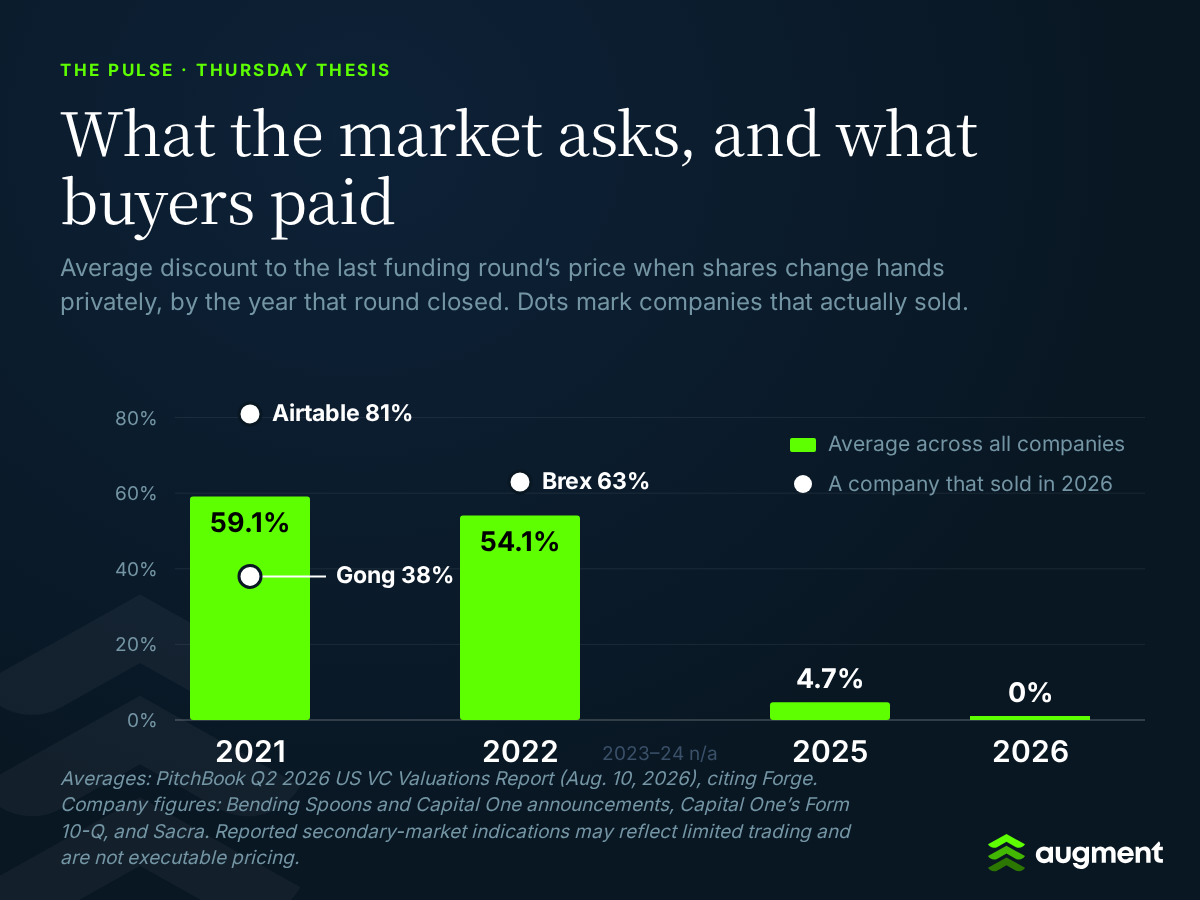
PitchBook published its Q2 2026 US VC Valuations Report on August 10. Using data from the trading platform Forge, it found that companies whose last funding round was in 2021 change hands privately at an average of 59.1% below that round's price. For companies that last raised in 2022, the average discount is 54.1%. For 2025, it is 4.7%. For companies that raised this year, there is no discount at all.
One factor highlighted by the data is the age of the last financing round and the limited information available to many secondary buyers. A funding round sets a price, and once that round is a few years old, there is no recent price to point to. Most buyers of private shares also have no right to see the company's financials. With no fresh price and no numbers, a buyer has little to push back with.
The result is a market where the age of a company's last funding round appears to matter as much as how the company is doing. Two companies with similar revenue can sell at very different prices, and the difference you can see is when each last raised. Revenue is only one input, and companies that raised in the same year still differ in growth, spending, debt, and how much they disclose. But the gap runs from nothing for companies that raised this year to 59.1% for companies that raised in 2021, which is wide enough that something beyond company performance appears to be driving it.
Airtable last raised in 2021. Against its $11.8 billion Series F price, the roughly $2.25 billion equity value is about 81% lower. Against the $4 billion private-market valuation reported in January, it is about 44% lower. Airtable's annual recurring revenue was about $480 million as of June 2026, growing more than 20% year over year, per Bending Spoons.
Reported private-company financials and secondary-market indications may be unaudited, incomplete, non-standard, or based on limited transaction activity. They should not be relied upon as fair value, executable pricing, or a basis for any investment decision.
Browse private-company pages on Augment for company information, recent coverage, and available market data.
Capital One's Brex filing shows the same pattern
Brex is the second company from that era to sell this year, and it last raised in 2022 rather than 2021. Its final priced round closed January 11, 2022: $300 million co-led by Greenoaks and TCV at a $12.3 billion valuation. The average discount for companies that last raised in 2022 is 54.1%.
Capital One announced the deal on January 22, 2026 at $5.15 billion and closed it on April 7. That announced figure is about 58% below the $12.3 billion price.
Capital One's Form 10-Q describes the closing differently. Brex shareholders received approximately $4.5 billion: $2.6 billion in cash plus 10.6 million Capital One shares worth $1.9 billion, subject to the usual post-closing adjustments. The filing also says that right after the deal closed, Capital One paid off Brex's $1.1 billion of outstanding debt.
Those are three separate numbers measuring three separate things, and none is a correction of another. An announced deal value, the money that reached shareholders, and a debt payoff are different items. The figure that compares to a $12.3 billion valuation is the money shareholders received, because that valuation was a price on the equity. At roughly $4.5 billion, Brex shareholders got about 63% less than the 2022 round implied, against an average discount of 54.1% for companies from that year.
Reported private-company financials and secondary-market indications may be unaudited, incomplete, non-standard, or based on limited transaction activity. They should not be relied upon as fair value, executable pricing, or a basis for any investment decision.
Both transactions were negotiated control acquisitions following buyer diligence, and the agreed equity values were below certain previously reported private-market valuation indications.
There is a tidy way to read PitchBook's discount data: buyers of private shares cannot see the financials, so they demand a discount for flying blind. A buyer who can see everything should therefore be willing to pay closer to the last round's price.
Two deals this year point the other way. Capital One did full diligence, bought the whole company, and kept Pedro Franceschi on as CEO. Bending Spoons agreed to buy all of Airtable's shares. Both are operating companies with complete access to the books. Neither paid the discount the private market was quoting for a company of that age. Both paid more of one.
Buying a whole company and buying a small stake in one are different transactions, and the prices may not compare given differences in control, access to information, how the payment is structured, and how cash and debt are treated. Control acquisitions can involve economics that differ materially from minority secondary transactions, which makes the direction of these two outcomes the opposite of what you would expect.
Gong sold shares at a much smaller discount
The counterexample comes from the same year. Gong last raised at a set price in 2021, a Series E at $7.25 billion, and Sacra reported shares changing hands at roughly a $4.5 billion valuation through Nasdaq Private Market in November 2025. That is about 38% below the 2021 price, well short of the 59.1% average.
The wider exit numbers also argue against reading any of this as distress. Flat and down rounds fell to 13.1% of deals, the lowest share since 2022. Companies sold for a combined $375.4 billion, a ten-year high. The median sale price doubled to $200 million, and the typical acquisition now goes for 1.9 times the company's last private valuation, up from 1.2 times. Companies from 2021 and 2022 are selling at steep discounts inside an exit market that is getting better for anyone who finds a buyer.
Hiive's top 20 companies accounted for 86% of second-quarter value
On the trading platform Hiive, the 20 most active companies accounted for 86% of second-quarter volume, per the PitchBook report, and the top five accounted for 50.3%. There were a record 945 active unicorns in the second quarter, worth $5.3 trillion on paper.
Those two figures describe the same problem from opposite ends. Most companies that raised in 2021 and 2022 carry a steep discount and barely trade. A discount on a company whose shares almost never change hands is a number nobody has actually paid, and Airtable and Brex illustrate that negotiated transaction values can differ materially from both prior financing valuations and reported secondary-market indications.
Reported private-company financials and secondary-market indications may be unaudited, incomplete, non-standard, or based on limited transaction activity. They should not be relied upon as fair value, executable pricing, or a basis for any investment decision.
📊 Data Point of the Day
945
Active unicorns in the second quarter of 2026, a record, up 9.4% since the end of 2025, worth $5.3 trillion on paper, per PitchBook's Q2 2026 US VC Valuations Report. That counts companies carrying a valuation. It does not measure what any of them would sell for, and most have never been tested by a sale.
Reported private-company financials and secondary-market indications may be unaudited, incomplete, non-standard, or based on limited transaction activity. They should not be relied upon as fair value, executable pricing, or a basis for any investment decision.
🎓 Manual
Information rights
A contract term giving a shareholder the right to receive financial statements, ownership details, or other company information on a regular schedule. Investors who buy preferred stock in a funding round often negotiate for them. Someone buying common stock from an employee usually does not get them. A buyer with no information rights and no recent funding round to reference may have very little to price against.
Augment Markets Inc. is a technology company offering software and data services. Brokerage services are offered through Augment Capital LLC, an affiliated broker-dealer and member FINRA/SIPC. Investment advisory services are offered through Augment Advisors LLC, an SEC-registered investment adviser.
Important Disclosures: This material has been prepared for informational purposes only. None of the information provided represents a recommendation, an offer or the solicitation of an offer to buy or sell any security. The information provided does not constitute investment, legal, tax, or accounting advice. You should consult with qualified professionals before making any investment decisions. Investing in private securities involves substantial risk, including the potential loss of principal. Private securities are typically illiquid, have limited pricing transparency, and often require longer holding periods. These investments are available exclusively to qualified accredited investors and offer no guarantee of returns. An IPO or other liquidity event is not guaranteed. Additionally, past performance of private securities does not indicate or predict future results. Share price data are estimates only, based on proprietary data from Caplight and Augment Markets Inc. and its affiliates.

Paul leads editorial at Augment, building Pulse into the private markets' go-to intelligence source. He also develops editorial content strategies for startups and venture capital firms. Previously, he spent 15 years as a business and opinion journalist at The New York Times, Fortune, Fast Company, Reuters, and more. He believes transparency creates liquidity—and that someone should actually publish what private shares are trading for. He lives in Marin with his wife and two rescue dogs, and wishes he had more time to surf.
Learn more