





Deep Dive: What VCX’s Shrinking Premium Says About Anthropic
Anthropic’s IPO reportedly moved from October to November as we covered on Tuesday. VCX is one publicly traded vehicle that includes Anthropic exposure.
Investors who want exposure through a brokerage account already have an option: Fundrise’s Innovation Fund, which trades on the NYSE as VCX and counts Anthropic as its largest disclosed company exposure. The price of that option has been falling.
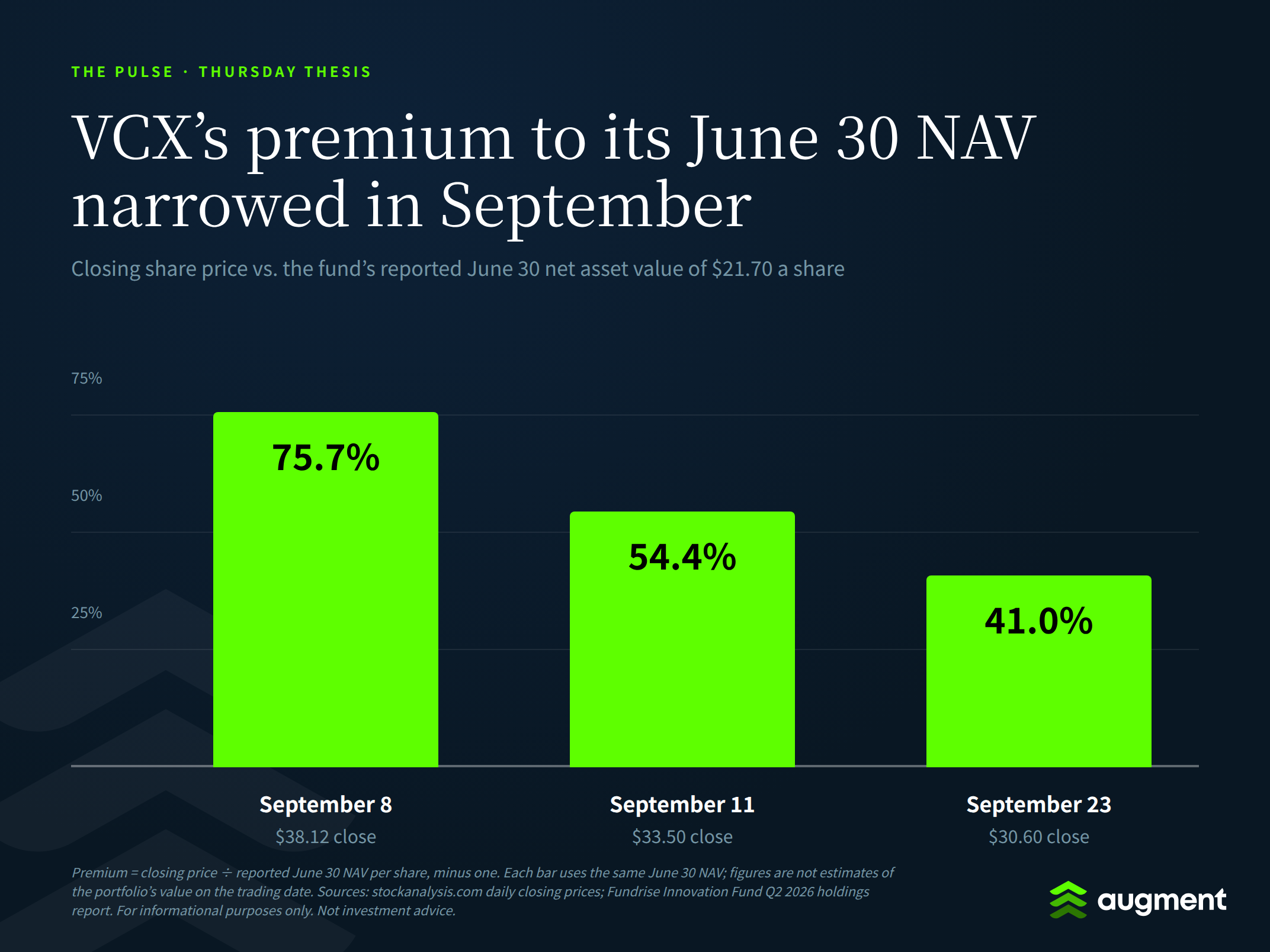
VCX closed Wednesday at $30.60, down from $38.12 on September 8. Both prices sit above the fund’s reported June 30 net asset value of $21.70 a share. But the extra amount investors paid for each dollar of stated assets fell from about 76 cents to 41 cents over that stretch, based on daily closing prices and the fund’s holdings report.
Augment and/or its affiliates hold a position in Anthropic.
The premium covers the whole portfolio
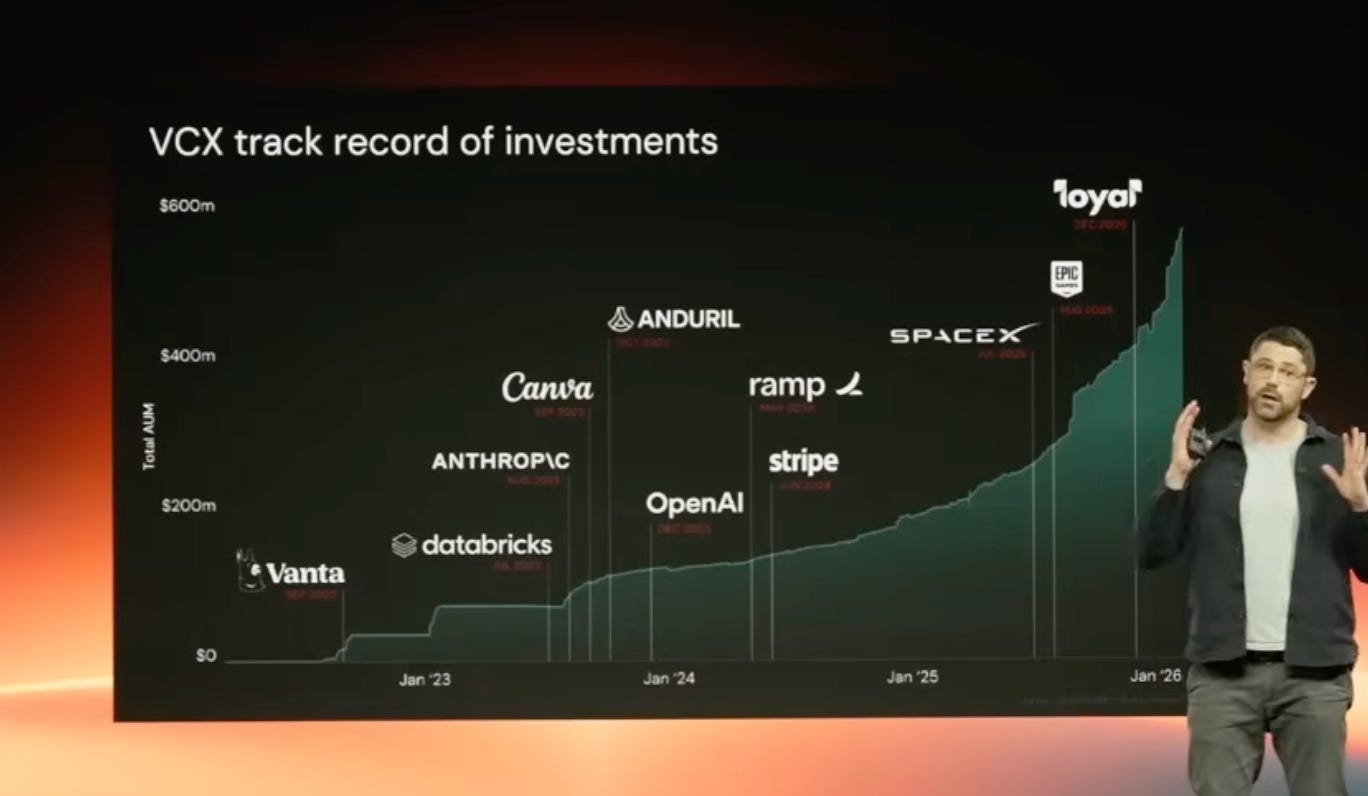
VCX began trading publicly on March 19. Its June report puts Anthropic at more than 20% of net assets, with OpenAI and Databricks each between 10% and 20%. Fundrise includes indirect holdings in those figures, an important detail when some investments appear in the accounts under the names of special-purpose vehicles rather than the companies themselves.
That makes Anthropic a substantial part of VCX. It still leaves most of the fund exposed to other investments. The portfolio includes other technology companies, debt securities and short-term holdings, all of which contribute to the net asset value that shareholders buy at a premium or discount.
The comparison is straightforward as long as the reference date stays visible:
Calling this an “Anthropic premium” gives a single holding too much credit for the fund’s price. An investor seeking Anthropic exposure through VCX also takes on the other holdings, fund expenses and the possibility that the premium changes. A brokerage account makes the purchase easier. It doesn’t let the buyer choose which parts of the portfolio come with it.
Reported private-company financials and secondary-market indications may be unaudited, incomplete, non-standard, or based on limited transaction activity. They should not be relied upon as fair value, executable pricing, or a basis for any investment decision.
More shares became available before the IPO news
VCX’s own trading conditions changed over the summer. Fundrise accelerated the lockup expiration for pre-listing shareholders from September 14 to August 13, making their shares eligible to trade on August 14. That created a larger pool of potential sellers without requiring a change in any portfolio company’s value.
It also complicates any attempt to read the recent decline as a verdict on Anthropic. The share price was already down to $33.50 by September 11, a week before the September 18 report of the revised IPO timetable. The decline wasn’t a steady daily slide, either; there were rallies along the way.
The lockup change offers one possible explanation for the fund’s trading, but it doesn’t establish who sold or why. Buyers may also have changed their views about the underlying businesses, the value of holding them through a fund, or both. The closing price records where buyers and sellers met. It doesn’t separate those motives.
The fund can rise in value while its shares fall
A closed-end fund adds a second pricing decision to the investment. Its manager estimates the value of the holdings, while buyers and sellers set the price of the fund’s shares. Shareholders generally cannot redeem those shares on demand at NAV, so there is no promise that the two prices will meet. The SEC’s explanation of closed-end funds treats this gap as a separate source of risk.
A hypothetical example shows how much that can matter. Suppose a fund has $100 of NAV per share and trades at $140, a 40% premium. Its NAV then rises to $110, while the premium falls to 10%. The share price would be $121. The underlying assets gained 10%, but someone who paid $140 would have a price loss of about 14%, before any distributions, transaction costs or taxes. This illustrates fund arithmetic; it is not a forecast for VCX or any of its holdings.
The reverse can happen if the premium expands. Either way, the change in the underlying portfolio is only part of what determines the shareholder’s result. Even a correct assessment of a portfolio company may be offset by changes in the premium or discount at which the fund trades.
A June valuation isn’t a September valuation
There is a reasonable objection to the 41% figure: it compares a current share price with an older estimate of asset value. If the portfolio is worth more now, that calculation overstates the premium to its current value. If it is worth less, it understates it. The published number alone cannot settle which is true.
Nor does the lack of a new funding round mean a private holding’s valuation must stay fixed. Fundrise’s valuation policy, in the June report, allows it to consider operating results, company information, private-market transactions, transfer restrictions and other factors. A financing round is one input. It is not the only occasion on which a valuation can change.
The reporting calendar creates a gap in either case. An October IPO and a November IPO would both fall after September 30 and within the quarter ending December 31. Moving between those months does not, by itself, push a public-market valuation into a later quarterly reporting period.
The September 30 valuation cannot use a public trading price from a listing that has yet to happen. It can, however, take account of information available at the measurement date, potentially including a revised timetable. When that report arrives, its publication date won’t make the holdings a current snapshot. It will describe what the fund owned and how it valued those investments at September 30.
An IPO could change what investors pay for access
The reported delay still matters. The Wall Street Journal reported that some advisers favored November to give Anthropic time to present third-quarter financial results. The timing remains a reported plan, and an offering is not guaranteed.
If Anthropic does list, investors would gain a public price for its shares and another way to own them. Someone seeking only Anthropic exposure could buy the listed stock without also buying the rest of VCX’s portfolio. That could reduce one reason for paying a premium for the fund, even if the fund’s Anthropic holding increased in value. It is a possible effect of broader access, not evidence that investors are already pricing it in.
There are reasons the fund could retain appeal. It would still offer a managed portfolio and exposure to other private companies. Fundrise also says its strategy includes holding companies after their IPOs. A listing need not prompt a sale, and the fund’s own holdings may remain subject to restrictions after public trading begins.
For private shareholders, this makes VCX useful but limited evidence. It shows the price people will pay for a traded fund containing Anthropic exposure. A sale of private Anthropic shares involves a different security, ownership structure and set of transfer terms. Applying VCX’s premium, or its decline, directly to those shares would skip all of those differences.
Reported private-company financials and secondary-market indications may be unaudited, incomplete, non-standard, or based on limited transaction activity. They should not be relied upon as fair value, executable pricing, or a basis for any investment decision.
The next holdings report can narrow some of the uncertainty by showing updated company exposures and values. Comparing that NAV with the fund’s share price on the same date would give a more consistent measure of the premium. The holdings and accounts would then help explain how much of the NAV change came from revaluations, purchases, sales, expenses or distributions.
For more company information, recent coverage, and available market data, visit Anthropic on Augment.
📈 Data Point of the Day
41%
VCX’s premium to its reported June 30 NAV of $21.70 a share, using the September 23 closing price of $30.60. That compares with about 76% on September 8, using the same NAV; neither calculation establishes the premium to the portfolio’s current value. Sources: closing prices and Fundrise’s June report.
Reported private-company financials and secondary-market indications may be unaudited, incomplete, non-standard, or based on limited transaction activity. They should not be relied upon as fair value, executable pricing, or a basis for any investment decision.
🎓 Manual
Premium (or discount) to net asset value
A listed closed-end fund trades at a premium when its share price exceeds its net asset value per share, and at a discount when the price is lower. Because shareholders generally cannot redeem on demand at NAV, the gap may widen or narrow independently of the underlying investments. When private holdings are involved, the comparison also depends on the date and assumptions behind the reported valuation. Source: SEC.
For informational purposes only. Not investment advice or a recommendation to buy or sell any security. Private securities are speculative, illiquid, subject to transfer restrictions and valuation uncertainty, and may result in loss of principal. Estimated returns are unrealized and based on current marks that may not reflect actual exit proceeds.
Augment Markets Inc. is a technology company offering software and data services. Brokerage services are offered through Augment Capital LLC, an affiliated broker-dealer and member FINRA/SIPC. Investment advisory services are offered through Augment Advisors LLC, an SEC-registered investment adviser.
Important Disclosures: This material has been prepared for informational purposes only. None of the information provided represents a recommendation, an offer or the solicitation of an offer to buy or sell any security. The information provided does not constitute investment, legal, tax, or accounting advice. You should consult with qualified professionals before making any investment decisions. Investing in private securities involves substantial risk, including the potential loss of principal. Private securities are typically illiquid, have limited pricing transparency, and often require longer holding periods. These investments are available exclusively to qualified accredited investors and offer no guarantee of returns. An IPO or other liquidity event is not guaranteed. Additionally, past performance of private securities does not indicate or predict future results. Share price data are estimates only, based on proprietary data from Caplight and Augment Markets Inc. and its affiliates.

Paul leads editorial at Augment, building Pulse into the private markets' go-to intelligence source. He also develops editorial content strategies for startups and venture capital firms. Previously, he spent 15 years as a business and opinion journalist at The New York Times, Fortune, Fast Company, Reuters, and more. He believes transparency creates liquidity—and that someone should actually publish what private shares are trading for. He lives in Marin with his wife and two rescue dogs, and wishes he had more time to surf.
Learn more