




OpenAI reportedly wants $1 trillion. A 1949 theory of why civilizations destroy their own wealth explains the number.
Deep Dive: The Bonfire Economy
OpenAI added two financial-services veterans to its board this week, David Vélez of Nubank and Robin Vince of BNY, the kind of appointments a company makes when it is building the plumbing for a public listing. It confidentially filed a draft S-1 last month, is valued at a reported $852 billion, and is reportedly willing to wait for a $1 trillion IPO, with Sam Altman reportedly calling anything below that a "nonstarter." Around it, the wider AI buildout is spending at a pace current revenue does not explain, with hyperscaler capex estimates running into the hundreds of billions for 2026 and at least one frontier lab reportedly paying a competitor more than a billion dollars a month for compute it will burn training a model that may be obsolete before the contract ends. The consensus reads all of this as investment racing ahead of returns. There is an older way to read it, and it starts in Canada.
On a winter beach on the British Columbia coast, a chief fed his own wealth into a fire and watched his rivals sit through the heat. Thousands of wool blankets went onto the flames. Canoe-loads of fish oil followed, and the fire threw heat the front rows could not stand. The most valuable things he owned were engraved coppers, shield-shaped plaques that carried the history of every feast they had survived. Some he broke in front of the room. Some he threw into the sea, where no one would get them back. He was not being careless. He was winning. In the potlatch, status went to the one who could destroy the most and appear to miss it the least. Giving wealth away put your rivals in your debt. Burning it in front of them said you did not even need the debt.
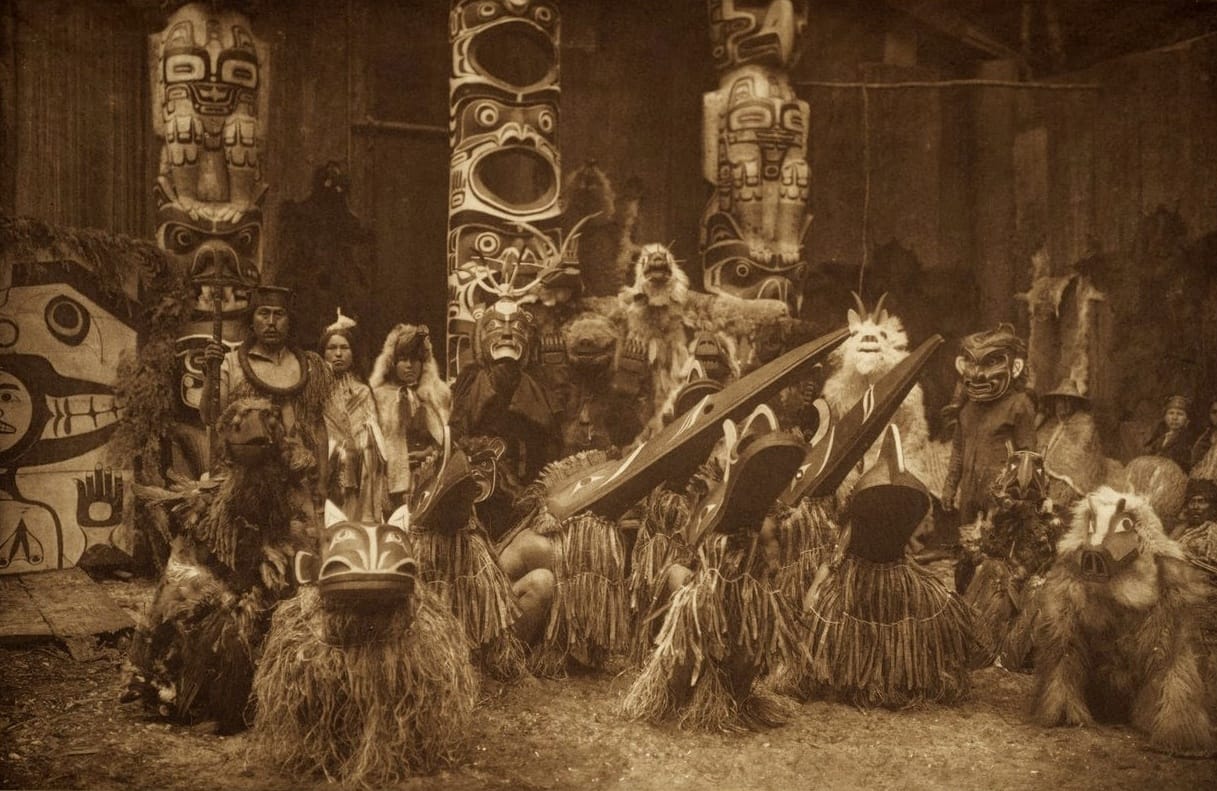
A generation later, a French librarian named Georges Bataille looked at that fire and built an economics around it. His argument, in a 1949 book almost no one in finance reads, cuts against what a spreadsheet assumes. Most economics begins with scarcity: there is never enough, so the work is allocation. Bataille began from the opposite fact. A living system takes in more energy than it can use to grow, and the surplus does not wait politely to be reinvested. It builds, it presses, and at some point it has to be spent. Not invested. Expended, with no expectation of return. The only real choice is the manner of the spending. You do it on purpose, in monuments and ritual, or it does itself to you, in crisis. He called the surplus (and his book) The Accursed Share: the part you cannot keep.
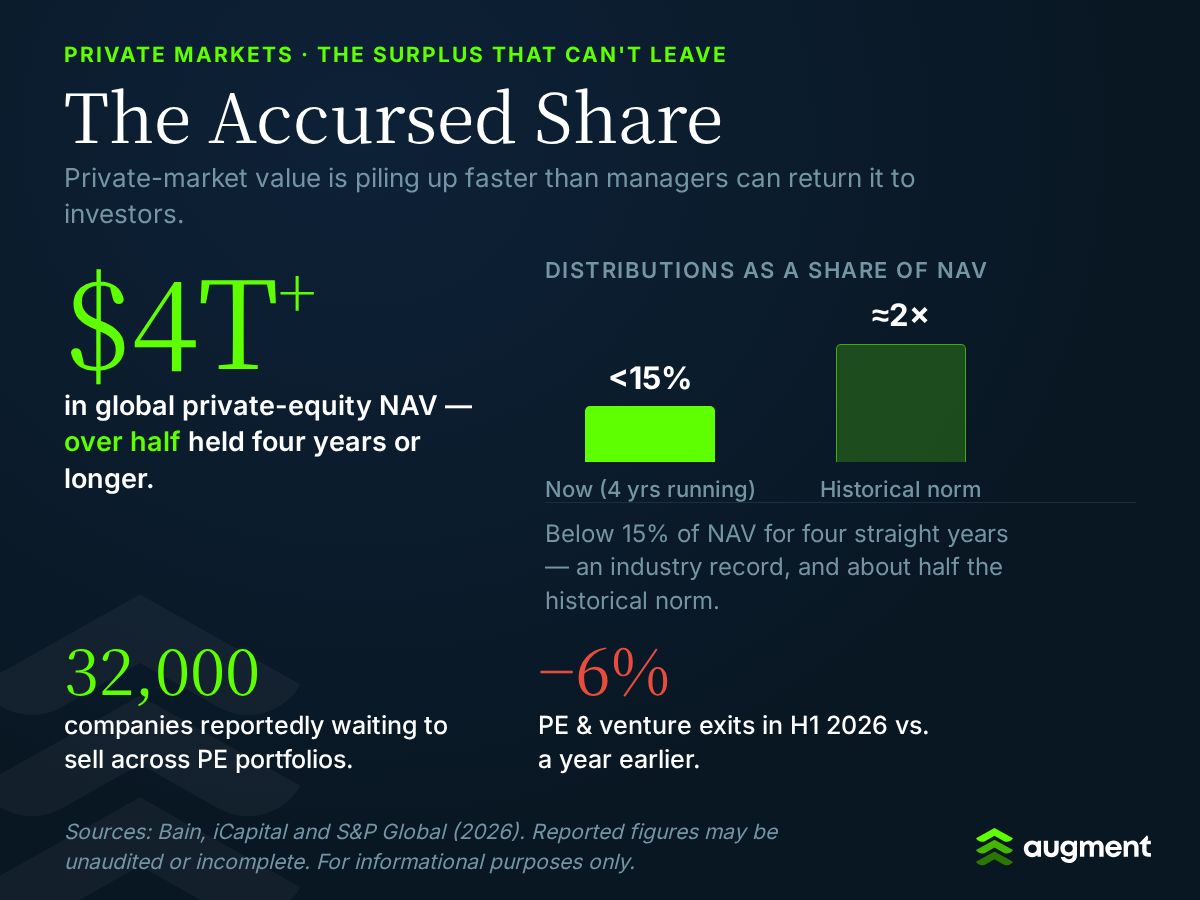
Read the private-capital glut through that lens and it stops looking like a scarcity problem. Third-party market reports estimate that more than $4 trillion of value remains in private equity and venture portfolios beyond typical exit timing, though definitions, methodologies, and time periods vary. This capital has been held years past the point when, historically, it would have been realized by now. On top of that pile, the AI spend has come loose from any near-term return, and the people making the bets do not seem troubled. Look at how the largest numbers get built. A trillion-dollar target does not fall out of a discounted cash flow; it comes out of scale offered as proof. The size of the raise is the argument. A company marked in the tens of billions before it ships a product is not a pricing error so much as a monument, put up fast so everyone can see who can build the tallest one.
Bataille argued the surplus gets spent one of two ways. Gloriously, in things that outlast the spending, the cathedral, the moon shot that leaves the ground. Or catastrophically, when a society refuses to choose and the pressure finds its own exit through ruin. War. Waste. Luxury beyond reason. Burning wealth in front of rivals. In his telling, the spending itself is never the question; the spending is fixed. What is open is whether anything gets built on the way to the fire, or whether the fire is the whole event.
The honest critique here would be that every general-purpose technology looks like this early, and the bonfire read can be too cynical by half. The railway boom bought steel from mills that shipped on rails, financed by capital that torched itself in duplicate lines to nowhere, and what survived the wreck was a continent wired for commerce. Telecom did it again with dark fiber a century later. Circular, wasteful, faith-priced spending is often just what capital formation looks like from inside, before the useful part is visible. By that reading, the compute a lab burns this year is the track being laid, and calling it a sacrifice mistakes the scaffolding for the building.
But both can be true. Some of this capital is pouring foundations, the data centers and power and models that may compound into things we cannot picture yet. Some of it is oil on a fire, heat thrown to prove it could be thrown. From inside the feast the two can look identical, and a rising mark does not separate them. That matters for anyone pricing these names because it reframes the question a buyer is actually asking. For secondary-market participants, part of the current debate is how much of today’s private-market pricing reflects durable fundamentals, how much reflects strategic option value, and how much reflects scarcity, signaling, or market structure. Those components may behave differently if market sentiment changes.
So the question for anyone weighing these companies is not whether the spending is rational. A surplus this size was never going to spend itself rationally. It only has to go somewhere, and it will. The more useful question is what it leaves standing, and that is a question about durability, not valuation. Price alone will not answer it. You find out by walking the beach after the fire is out and seeing what is left. Most of the argument for these companies is being made in the language of scale, almost none of it in the language of what survives the burn.
📈 Data Point of the Day
🎓 Manual
Burn Multiple 🔥
A measure of spending efficiency: net cash burned divided by net new annual recurring revenue added over the same period. A burn multiple of 1 means a company spends roughly one dollar to add one dollar of new recurring revenue; higher multiples mean it is spending more to buy each unit of growth. The metric is useful precisely where today's thesis lives, because it may separate spending that builds a durable revenue base from spending that mostly performs scale. It is a reported, often unaudited figure and may be calculated inconsistently across companies.
Augment Markets Inc. is a technology company offering software and data services. Brokerage services are offered through Augment Capital LLC, an affiliated broker-dealer and member FINRA/SIPC. Investment advisory services are offered through Augment Advisors LLC, an SEC-registered investment adviser.
Important Disclosures: This material has been prepared for informational purposes only. None of the information provided represents a recommendation, an offer or the solicitation of an offer to buy or sell any security. The information provided does not constitute investment, legal, tax, or accounting advice. You should consult with qualified professionals before making any investment decisions. Investing in private securities involves substantial risk, including the potential loss of principal. Private securities are typically illiquid, have limited pricing transparency, and often require longer holding periods. These investments are available exclusively to qualified accredited investors and offer no guarantee of returns. An IPO or other liquidity event is not guaranteed. Additionally, past performance of private securities does not indicate or predict future results. Share price data are estimates only, based on proprietary data from Caplight and Augment Markets Inc. and its affiliates.

Paul leads editorial at Augment, building Pulse into the private markets' go-to intelligence source. He also develops editorial content strategies for startups and venture capital firms. Previously, he spent 15 years as a business and opinion journalist at The New York Times, Fortune, Fast Company, Reuters, and more. He believes transparency creates liquidity—and that someone should actually publish what private shares are trading for. He lives in Marin with his wife and two rescue dogs, and wishes he had more time to surf.
Learn more