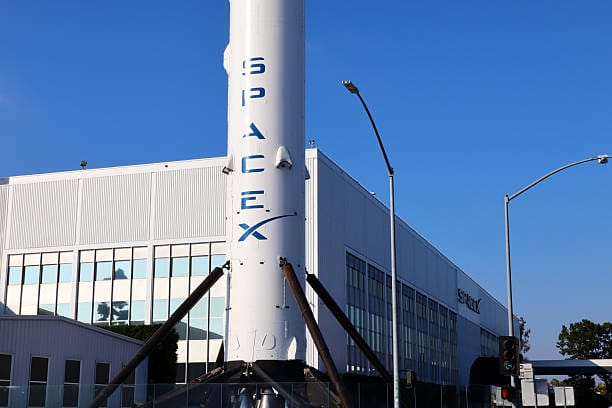




SpaceX reports its first quarterly results as a public company on August 4. Two days later, restrictions lift on roughly 911.5 million shares worth about $116 billion, with the stock currently trading well below its $135 IPO price. Separately, Nvidia has reportedly committed $5 billion to Safe Superintelligence, a lab with no product in the marketplace and a reported $32 billion valuation. In that deal, the supplier is also reported to be helping set the price.
SpaceX gets 48 hours to find out what it is worth
SpaceX reports its first quarterly results as a public company on August 4. On August 6, lock-up restrictions lift on roughly 911.5 million shares, worth about $116 billion at recent prices. Another 455.8 million shares could become eligible under certain conditions. Musk and a small group of insiders remain locked up until mid-2027. (CNBC) (Bloomberg)
The stock has been trading around $113.50, roughly 16% below its $135 IPO price, after touching a post-listing low of $110.85 on July 23. (Axios) Six weeks after the largest IPO on record, investors who waited for the public exit are behind those who sold in the private market.
Every pre-IPO valuation carries an assumption: the listing will be the liquidity event, and the private market is where investors wait for it. SpaceX is about to test that assumption over 48 hours, with an earnings report on one end and $116 billion of newly sellable stock on the other. Shareholders will get one fresh data point and two days to decide what to do with it.
For private-market investors, the useful signal is not the stock's direction on August 6. It is who sells, how much, and what that reveals about late-stage holders once the exit they waited for finally arrives.
Shein offers the inverse case. It disclosed a $99 million quarterly loss on July 26 ahead of a Hong Kong listing reportedly targeting a $40 billion to $50 billion valuation, down from its $98.2 billion private mark in 2022. (CNBC) SpaceX priced high and traded down. Shein is reportedly coming to market far below its private mark. The companies differ in geography, business model, capital structure, and disclosure regime. But on one narrow point, they rhyme: a public listing does not necessarily validate the last private valuation.
Reported private-company financials and secondary-market indications may be unaudited, incomplete, non-standard, or based on limited transaction activity. They should not be relied upon as fair value, executable pricing, or a basis for any investment decision.
When the chip supplier helps set the price
Nvidia has committed to invest $5 billion in Safe Superintelligence, Ilya Sutskever's research lab, according to reporting that cites Bloomberg. Nvidia called the investment “substantial” but did not disclose a figure. SSI will also get access to Nvidia's next-generation Vera Rubin systems, which the company says would increase its available compute tenfold. SSI was reportedly valued at $32 billion in its last round and has not released a product. (Bloomberg) (TechCrunch) (WSJ)
For private markets, who produced the $32 billion mark matters as much as the number itself. A financial investor is expressing a view on the company. A chip supplier investing alongside a compute agreement is also negotiating a commercial relationship. Both deals produce a valuation, but the signals are different.
That distinction gets murkier as strategic investors move further up the AI stack. When a company's largest vendor leads a round, the valuation may reflect supply terms that a later buyer will not inherit. Nvidia's investments vary in structure, and none maps neatly onto a conventional venture round. Anyone evaluating an AI-lab position in the secondary market should study the identity of the last lead investor as closely as the headline valuation.
Reported private-company financials and secondary-market indications may be unaudited, incomplete, non-standard, or based on limited transaction activity. They should not be relied upon as fair value, executable pricing, or a basis for any investment decision.
📈 Data Point of the Day
7 of 20
Of the 20 companies Forge has tracked since their listings in Q1 2025 or later, seven were trading above their offer price through Q2 2026, according to Forge's July pipeline update. The same report puts the tech IPO pipeline at $2.1 trillion in cumulative valuation.
Figma is the starkest example. It priced at $33, closed its first day at $115.50, and stood at $18.09 as of Q2 2026. For late-stage private companies whose valuations assume an IPO will settle the question, the recent record suggests that listing often reopens it. (Forge)
💨 Quick Takes
- DeepSeek paused its second fundraise after a founder's private remarks went viral. The company reportedly told prospective investors it would not sign agreements as planned, weeks after closing a record $7 billion first round. (Fortune) Founder communication risk is now a pricing input that few investors underwrite.
- CXMT closed up 466% in its Shanghai debut, giving the Hefei memory chipmaker a market capitalization of roughly $487 billion, the largest of any China-listed company.
- Multiverse Computing raised a $570 million Series C at a $1.7 billion valuation. The Spanish company compresses large models to cut inference costs, selling picks and shovels for the AI buildout rather than competing at the model layer.
- Antares raised $370 million in equity and $100 million in debt. Paradigm and Caffeinated co-led the financing, which will fund 1-megawatt reactors for US military bases.
- Securities class actions piled up against EquipmentShare last week. The complaints allege that related-party transactions netting founder-affiliated entities at least $77 million were not disclosed around its January IPO, following a June short-seller report. (PR Newswire) These remain allegations at the complaint stage. Public shareholders have a class to join; pre-IPO buyers who relied on the same disclosures generally do not.
Financing rounds and valuations are included for market context only and are not recommendations or valuation opinions.
🎓 Manual
Staggered lock-up release
A conventional IPO lock-up bars insiders from selling for a fixed period, often 180 days, and then expires all at once. A staggered lock-up releases shares in tranches, each with its own date or trigger. Those triggers can include a share-price threshold, an earnings report, or a set number of trading days after listing.
Issuers use staggered releases to spread new supply over several weeks instead of concentrating it in one session. SpaceX's structure includes an initial tranche in August, a conditional tranche behind it, and restrictions on Musk and selected insiders until mid-2027.
For anyone holding or pricing pre-IPO stock, “the lock-up expires” rarely tells the whole story. The tranche schedule determines when shares can reach the market, and that may be months after the headline expiration date.
👀 What We're Watching
- Where Shein's Hong Kong listing prices against its private marks.The company is reportedly targeting a $40 billion to $50 billion valuation, below the $98.2 billion mark reported from its 2022 round. Final pricing and demand will depend on market conditions and the offering process. If the deal prices in that range, secondary desks will have a public reference for a company that has traded on private marks for years. (CNBC)
- The open-weights fight moving into Washington. Anthropic published a formal position on open-weight models and chip export policy on July 27, drawing industry responses the same day. Sam Altman is reportedly meeting US officials and lawmakers this week to preview OpenAI's next model family. (Anthropic) (CNBC) Augment or its affiliates may hold positions in Anthropic securities. Policy decisions here will shape assumptions embedded in many frontier-lab private valuations.
- China's move into domestic DUV lithography. A Chinese state-backed company has reportedly begun manufacturing deep-ultraviolet chipmaking machines. ASML fell more than 7% on the report, while Lam Research fell more than 7% and Applied Materials more than 6.5%. (Bloomberg) (The Information) Private semiconductor-equipment and materials companies have been priced against a Western-controlled toolchain. That assumption now bears watching.
Augment Markets Inc. is a technology company offering software and data services. Brokerage services are offered through Augment Capital LLC, an affiliated broker-dealer and member FINRA/SIPC. Investment advisory services are offered through Augment Advisors LLC, an SEC-registered investment adviser.
Important Disclosures: This material has been prepared for informational purposes only. None of the information provided represents a recommendation, an offer or the solicitation of an offer to buy or sell any security. The information provided does not constitute investment, legal, tax, or accounting advice. You should consult with qualified professionals before making any investment decisions. Investing in private securities involves substantial risk, including the potential loss of principal. Private securities are typically illiquid, have limited pricing transparency, and often require longer holding periods. These investments are available exclusively to qualified accredited investors and offer no guarantee of returns. An IPO or other liquidity event is not guaranteed. Additionally, past performance of private securities does not indicate or predict future results. Share price data are estimates only, based on proprietary data from Caplight and Augment Markets Inc. and its affiliates.

Paul leads editorial at Augment, building Pulse into the private markets' go-to intelligence source. He also develops editorial content strategies for startups and venture capital firms. Previously, he spent 15 years as a business and opinion journalist at The New York Times, Fortune, Fast Company, Reuters, and more. He believes transparency creates liquidity—and that someone should actually publish what private shares are trading for. He lives in Marin with his wife and two rescue dogs, and wishes he had more time to surf.
Learn more