


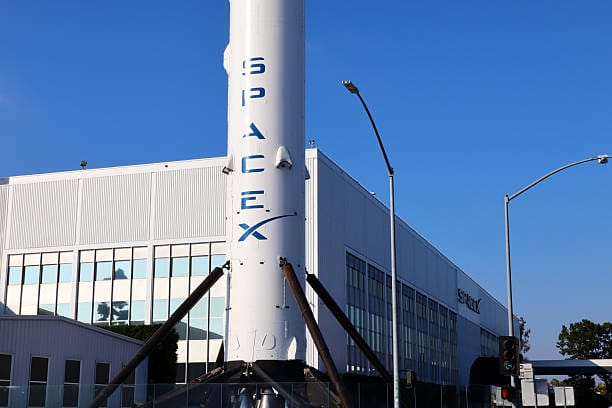

SpaceX's float went from 4.9% to 11.8% in a single day, and the market reacted.
SpaceX more than doubled its public float
Roughly 911.5 million SpaceX shares became eligible to trade on Thursday, the first tranche of a staggered release. That is about 43% more stock than the 638.9 million shares floated in the June IPO. The freely tradable portion of the company moved from 4.9% of shares outstanding to 11.8%.
The stock closed up 6.1% at the end of the day, August 6. The stock entered Thursday below its June offer price of $135 a share. Added supply did not push it lower on the first day of the first tranche. At publication time today, August 7th, it’s up nearly 15% to more than $131 per share.
Tuesday's Manual entry laid out the standard argument against a thin float: SpaceX sold about 4% of itself in June, so the screen price was being discovered by 4% and multiplied across the other 96%. The same objection applies to a secondary-market indication. Too few shares may have changed hands for the number to mean much. The float has now more than doubled, and the first day did not follow a simple supply-overhang story.
One day is not a finding. Only the first 20% of eligible shares could be sold. Roughly another 319 million may become available as soon as August 12, further tranches are reportedly expected in September and October, and shares held by Elon Musk and a selected group remain restricted until the middle of 2027. Nobody has seen what this holder base does across a full release.
The earnings sat underneath all of it. SpaceX reported second-quarter revenue of $7.8 billion, up 92% year over year, against roughly $6.9 billion of consensus, with a net loss of $541 million narrowing from about $1 billion a year earlier and Starlink subscriptions doubling to 12 million. Shares fell more than 7% after hours on capital spending. Two days later they rose into the unlock. Taken together, the earnings response and the unlock show how hard it is to isolate a single driver of price.
Reported private-company financials and secondary-market indications may be unaudited, incomplete, non-standard, or based on limited transaction activity. They should not be relied upon as fair value, executable pricing, or a basis for any investment decision.
Hadrian raised $1.37 billion to build machine shops
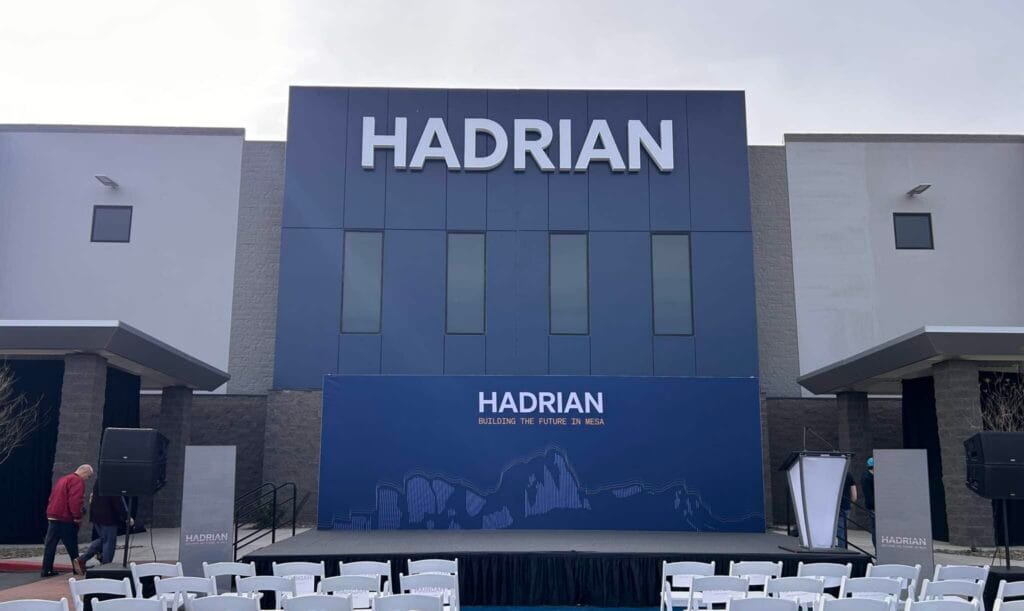
Hadrian raised $1.37 billion on Thursday at a reported $7.87 billion valuation. The company builds automated factories that mass-produce precision parts for existing defense hardware. It sells machined components, faster.
The company was valued at about $1.6 billion in January. Seven months later, the reported price was roughly five times higher.
The investor list explains the structure of the round. WCM Investment Management, Washington Harbour Partners, Valor Equity Partners, 137 Ventures and Baillie Gifford are named as leads, and JPMorgan Chase's Strategic Investment Group anchored as co-lead through the firm's Security and Resiliency Initiative. Two are public-market managers. Another is a bank's balance sheet operating under a policy mandate. The mix includes capital without a standard ten-year venture-fund clock.
This is the second week running in which a capital-intensive private company has been funded by money that does not appear to nor plan to behave like venture money. Commonwealth Fusion raised $1 billion last week from pension funds, sovereign wealth funds and industrial partners and disclosed neither a lead nor a valuation. Hadrian's March facility in Alabama, which makes submarine parts, was structured as a public-private partnership, with the state package valued at $2.4 billion.
For a later buyer of private shares, the cap table may shape liquidity. Investors with long horizons and no traditional fund life may be less likely to sell on a typical venture-fund timetable.
Reported private-company financials and secondary-market indications may be unaudited, incomplete, non-standard, or based on limited transaction activity. They should not be relied upon as fair value, executable pricing, or a basis for any investment decision.
For more company information, recent coverage, and available market data, visit Hadrian on Augment.
Canva reportedly cut its growth forecast as AI costs rose

Canva has reportedly cut its annual revenue growth forecast to around 20%, down from roughly 30% set at the start of the year. The Information reported the change on Thursday, with Australian trade press following the same day. The reporting attributed the change to the cost of serving the product rather than demand.
According to those reports, Canva slowed the broader rollout of its AI suite after finding that the economics of answering AI requests at scale did not hold. It has been rebuilding the architecture to bring per-request costs down. The company reported passing $4 billion in annualised revenue in February, with LLM referral traffic among its faster-growing channels. ChatGPT is both a distribution channel for Canva and a substitute for parts of what Canva sells. The reported forecast change does not separate the two.
The private-market issue is often the disclosure gap. A public company that revises guidance files the change on a set date against a prior number. A private company's forecast may live in an investor update, which can become an input to secondary pricing. When that forecast moves, no rule requires a secondary mark to move with it or sets a deadline for broader disclosure.
Reported private-company financials and secondary-market indications may be unaudited, incomplete, non-standard, or based on limited transaction activity. They should not be relied upon as fair value, executable pricing, or a basis for any investment decision.
📊 Power 20 Watch
Last week this section framed the market's next phase as a succession question: the three most-traded venture secondary names leaving that market, with no obvious cohort to replace them. That question is further along than we described.
SpaceX listed in June and, as of Thursday, has more than doubled its float. Anthropic confirmed on June 1 that it had confidentially submitted a draft registration statement on Form S-1. OpenAI is reported to have submitted its own confidential draft in early June. A confidential submission does not provide a public filing, price, share count or date. No offering has been scheduled, and none may occur. Still, submitting a draft to the SEC would put a company further along than merely exploring a listing. The venture secondary market may have to absorb that transition.
The nearer-term calendar sits with a company outside the Power 20. Nscale has told prospective investors it holds roughly $51 billion of total contracted revenue ahead of a potential US listing that Bloomberg reported could come as soon as September, with Goldman Sachs and JPMorgan reportedly working on it. Reported revenue was more than $100 million in the second quarter, against roughly $37 million in the first and roughly $33 million across all of 2025. Contracted revenue and recognised revenue are different measurements. A public filing, if one is made, could provide more detail on the gap between $51 billion in contracts and $33 million in recognised revenue last year.
The replacement cohort question from last week still stands. A company needs employee tenure long enough to produce sellers, enough shares to absorb size, an issuer that permits transfers, and enough disclosure for two strangers to agree on a number. The reported listing activity makes that question more immediate.
"Power 20" refers to Augment's internal ranking of selected private-market activity based on Augment's proprietary methodology combining reported financing activity, secondary indications, and public disclosures. It may not represent the broader private market and should not be treated as a valuation benchmark. Inclusion does not constitute a recommendation, endorsement, valuation opinion or indication that a company is more likely to generate investment returns or complete a liquidity event. The methodology involves judgment and may change without notice.
💨 Quick Takes
- SpaceX and Tesla said they will invest an initial $16.8 billion to build Terafab, a semiconductor plant in Grimes County, Texas, with at least 3,000 workers. The companies have estimated total investment as high as $119 billion. SpaceX's capital commitments now arrive on a disclosure calendar. Its two closest peers by secondary volume have no such obligation yet.
- DeepSeek has reportedly resumed a funding round seeking $8 billion at a $74 billion valuation, after pausing talks earlier this year. The round is reported and not closed. The reported mark comes from a separate liquidity pool from US secondary-market activity.
- DeepSeek also invested roughly $20.8 million in Unitree Robotics' Shanghai IPO, taking 2.31% of allocated shares alongside an agreement to jointly develop models for humanoid robots. Unitree priced at about $22 a share to raise $904 million. US private robotics companies now have a public comparable that did not exist a week ago, though market, disclosure and ownership structures differ.
- AMD acquired Taalas for an undisclosed sum. The Toronto company etches model weights directly into silicon. It is another strategic-acquirer exit in inference hardware, with no disclosed price to compare against the last private round.
- Hackers spent the past month targeting dozens of US private equity firms and other businesses using phone calls and phishing sites, according to Google researchers. Operational risk at the fund level is not usually a market-structure story. A campaign aimed specifically at the firms holding the positions comes closer.
💰The Funding Lineup
The following financing rounds are included for market context only and are not recommendations or valuation opinions.
- Lumilens: more than $700M at a reported $5.51B valuation (August 6).Atreides Management, Bain Capital Ventures, Meritech, Seligman Ventures and Spark Capital co-led, bringing total funding above $900 million. The company builds optical interconnects to replace copper inside AI data centers and emerged from stealth already shipping into production sites. At two years old, it is selling against the bandwidth constraint between accelerators rather than the accelerators themselves.
- Moove: $250M Series C at a $2.1B valuation (August 5). Mubadala led, with Woven Capital, Toyota's growth fund, and Ion Pacific co-leading. BlackRock, Franklin Templeton, MUFG and Uber also participated. Founded in Nigeria in 2019 and now headquartered in Dubai, Moove owns and services the fleets that autonomy companies operate, including through a Waymo partnership. The round drew sovereign and strategic capital rather than traditional venture firms.
- Panthalassa: reportedly raising $225M at about a $2B valuation (August 6). The company aims to power data centers at sea using wave energy. The round is reported and not confirmed closed. Its prior reported mark was roughly $1 billion in May. The new figure, if confirmed, would double that valuation in three months while the company remains pre-revenue.
- WindBorne: $37M Series B at a $250M post-money valuation (August 5).The company flies long-duration weather balloons to collect the atmospheric data used to train its forecasting models. It owns that data collection rather than licensing it, an expensive distinction.
- Aurelius Systems: $40M Series A (August 5). Draper Associates and KAS Venture Partners co-led, with General Catalyst and Hanwha Defense USA among the participants. The San Francisco company builds an autonomous directed-energy system for small drone threats. A defense prime on the cap table may create a different path to an eventual exit than venture capital alone.
- Yellow Card: $40M strategic round (August 4). SC Ventures, Standard Chartered's venture arm, led, with Sony Innovation Fund, Polychain and Blockchain Capital participating. The Lagos company runs stablecoin rails for banks and enterprises moving dollars across Africa and, now, Latin America and Asia-Pacific. Total funding is above $120 million. A bank leading a stablecoin infrastructure round would have looked unusual two years ago.
📈 Data Point of the Day
48%
That is how fast Figma grew revenue year over year in the second quarter, to $370.1 million, reported Wednesday. The company also raised its annual revenue guidance. The stock fell more than 15% on the day. Revenue growth alone did not explain the price response. Public and private design-software companies also differ in liquidity, disclosure and capital structure.
🎓 Manual
Supply overhang
A supply overhang is a known quantity of stock expected to become available for sale, often on a schedule. Lock-up expirations create one. So do large holders with a stated intention to exit, as do escrow releases after an acquisition.
It matters because those shares are already counted in a company's market value but were not available for sale. Releasing them changes the pool of shares through which the price is discovered without changing the underlying business. The effect may depend on how much is released at once, how concentrated the holders are, what alternatives they have, and what the market has already assumed. Some releases pass without a visible effect. The private-market equivalent is less legible because there is no published schedule for when an employee base becomes able to sell.
👀 What We're Watching
- The August 12 tranche. Roughly another 319 million SpaceX shares may become available as soon as next Wednesday, with further releases reportedly expected in September and October. One tranche is an observation. A sequence could show how a very large pre-IPO holder base behaves across a staggered release.
- Nscale's reported September window. Bloomberg reported the potential timing and the banks, and no registration statement is public. A public filing, if one is made, could put the composition of that $51 billion contracted figure on the record for the first time.
- AI costs at other private software companies. Canva's reported forecast change was attributed to serving costs rather than demand. Public reporting has not established how widely that cost problem is shared. Additional disclosures, if they occur, may provide context.
- Industrial rounds led by crossover and bank balance sheets. Hadrian's round was anchored by public-market managers and a bank's strategic group rather than by a traditional growth fund. If that composition repeats across defense and manufacturing rounds, it could change who the eventual sellers are.
Augment Markets Inc. is a technology company offering software and data services. Brokerage services are offered through Augment Capital LLC, an affiliated broker-dealer and member FINRA/SIPC. Investment advisory services are offered through Augment Advisors LLC, an SEC-registered investment adviser.
Important Disclosures: This material has been prepared for informational purposes only. None of the information provided represents a recommendation, an offer or the solicitation of an offer to buy or sell any security. The information provided does not constitute investment, legal, tax, or accounting advice. You should consult with qualified professionals before making any investment decisions. Investing in private securities involves substantial risk, including the potential loss of principal. Private securities are typically illiquid, have limited pricing transparency, and often require longer holding periods. These investments are available exclusively to qualified accredited investors and offer no guarantee of returns. An IPO or other liquidity event is not guaranteed. Additionally, past performance of private securities does not indicate or predict future results. Share price data are estimates only, based on proprietary data from Caplight and Augment Markets Inc. and its affiliates.

Paul leads editorial at Augment, building Pulse into the private markets' go-to intelligence source. He also develops editorial content strategies for startups and venture capital firms. Previously, he spent 15 years as a business and opinion journalist at The New York Times, Fortune, Fast Company, Reuters, and more. He believes transparency creates liquidity—and that someone should actually publish what private shares are trading for. He lives in Marin with his wife and two rescue dogs, and wishes he had more time to surf.
Learn more