




Four weeks after SpaceX became a public company, Blue Origin is reportedly raising outside capital for the first time since it was founded in 2000, at a reported $130 billion pre-money valuation. Meta began charging for its frontier model at roughly a quarter of what OpenAI and Anthropic advertise. Grubhub's parent is reportedly raising at $9 billion with an IPO ratchet attached.
🚀 Blue Origin, for the first time, is asking
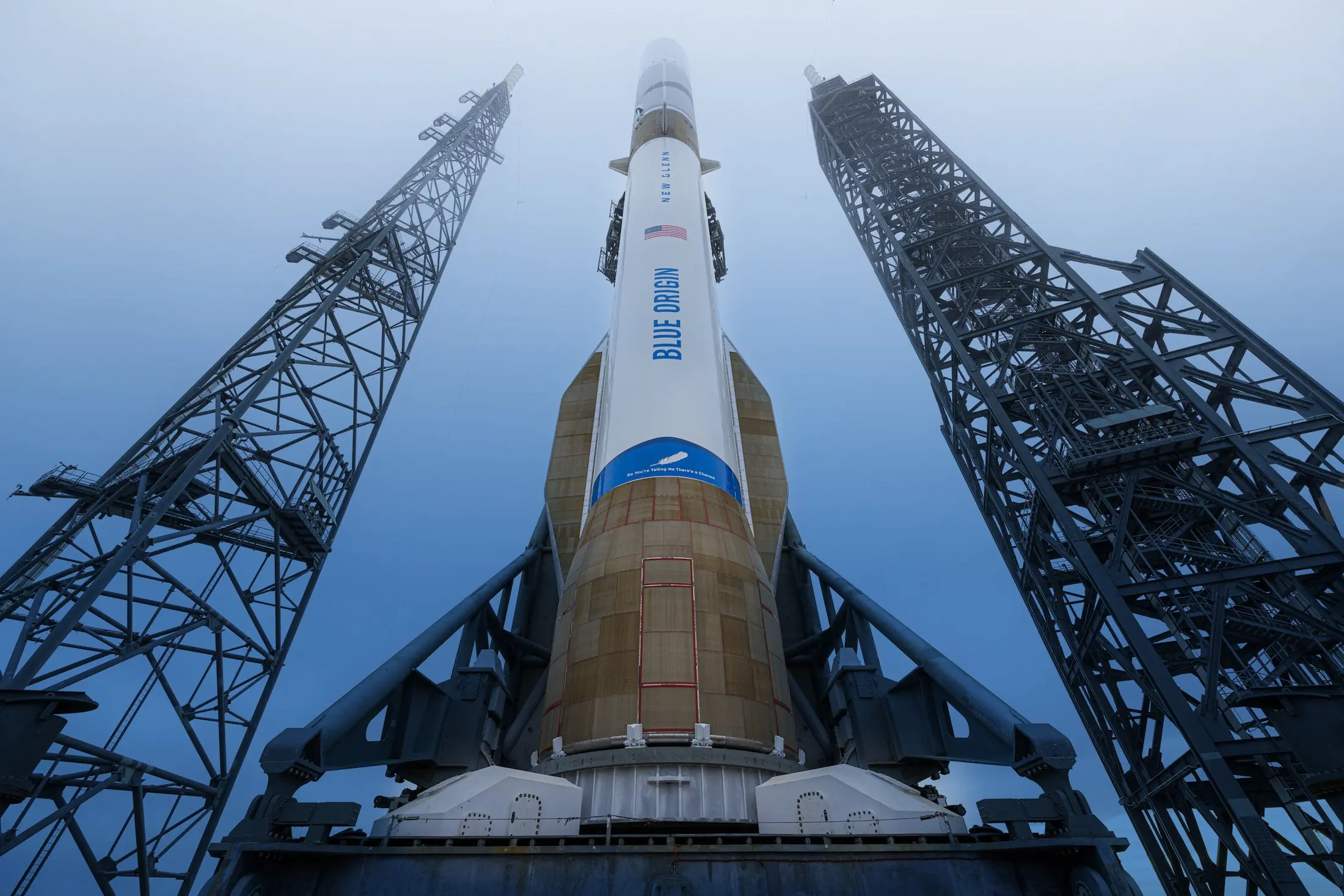
Blue Origin is reportedly seeking roughly $10 billion at a $130 billion pre-money valuation, in what would be the company's first external fundraise (CNBC, TechCrunch). Coatue is reportedly committing about $4 billion and Jeff Bezos about $2 billion, with other investors taking the balance (Bloomberg). Terms are reported, not closed.
Founded in 2000, Blue Origin has been financed almost entirely by Bezos selling Amazon stock. The absence of an outside cap table was, for two decades, the whole point. No investors, no board pressure, no clock. Gradatim ferociter.Step by step, ferociously.
So the interesting fact isn't the number. It's that the number exists at all.
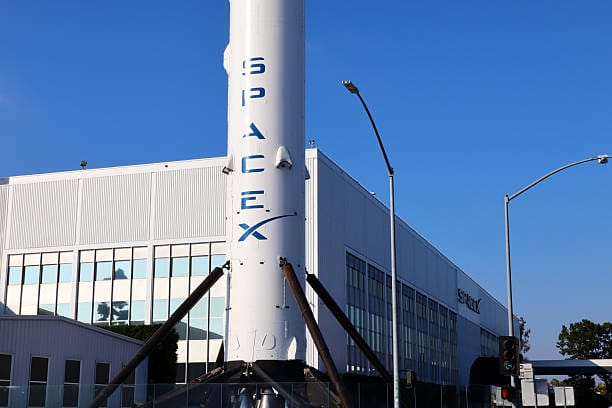
The timing is what makes it a private-markets story. SpaceX priced its IPO on June 11 at a reported $1.77 trillion valuation and left the private market. Twenty-eight days later, its closest competitor went looking for private capital at a reported $130 billion. Any direct comparison should be read carefully: the two companies differ materially in revenue scale, launch cadence, business mix, government contract exposure, and disclosure quality. And the asking price arrives six weeks after a New Glenn vehicle was destroyed in a ground-test explosion on May 28, damaging the company's only operational launch complex. The comparison is one of position in the capital stack, not of company.
One observation worth tracking: a company that never needed the private market appears to be entering it precisely as the private market's largest name exits. Whatever the venture-backed space book loses to the SpaceX listing, a $130 billion private mark — if the round closes on reported terms — would restore some of it. The direction of that flow is unusual. Private capital does not often get a reported opportunity to invest in a large private competitor shortly after the category’s largest name has listed publicly.
Whether investors will pay a first-round premium for a company with a 25-year operating history and no prior external mark is a question the round itself will answer.
Reported private-company financials and secondary-market indications may be unaudited, incomplete, non-standard, or based on limited transaction activity. They should not be relied upon as fair value, executable pricing, or a basis for any investment decision.
💸 Meta put a price on the two biggest private companies in the world

Meta released Muse Spark 1.1 on Thursday and, for the first time, began charging developers for a non-open-weights model. The pricing: $1.25 per million input tokens, $4.25 per million output (Axios, Meta). Mark Zuckerberg described the Meta Model API as running at roughly 25% of what OpenAI and Anthropic advertise, and said the pricing would be "aggressive and attractive" (Bloomberg).
The same day, OpenAI published GPT-5.6 pricing: $5 and $30 per million tokens for Sol, its top tier; $1 and $6 for Luna, its cheapest (OpenAI).
Put those side by side and the shape of the week appears. A public company with a balance sheet, distribution across WhatsApp and Instagram, and no need for the revenue is pricing directly against the two largest private companies on the board — OpenAI at a reported $852 billion post-money, Anthropic at a reported $965 billion.
Two caveats, both real. Token price is not the product; enterprise switching costs, model quality on specific tasks, and reliability are not captured in a per-million rate, and Meta has limited history in developer tools. And the labs are not standing still on cost: OpenAI's own framing of GPT-5.6 emphasized dollars-per-task rather than dollars-per-token, which is a different denominator and may move in the other direction.
What is not in dispute is the cost side. Anthropic signed a 20-year lease with TeraWulf this week for roughly $19 billion of contracted compute (SiliconANGLE). Long-dated fixed compute obligations on one side of the ledger, and a well-capitalized competitor moving price on the other, is a combination private-market observers may weigh when they look at how a frontier lab's economics compound. It is one input among many, and neither company's reported valuation moved this week.
(Augment and/or its affiliates hold a position in Anthropic.)
Reported private-company financials and secondary-market indications may be unaudited, incomplete, non-standard, or based on limited transaction activity. They should not be relied upon as fair value, executable pricing, or a basis for any investment decision.
🥡 Wonder's $9 billion comes with a clause
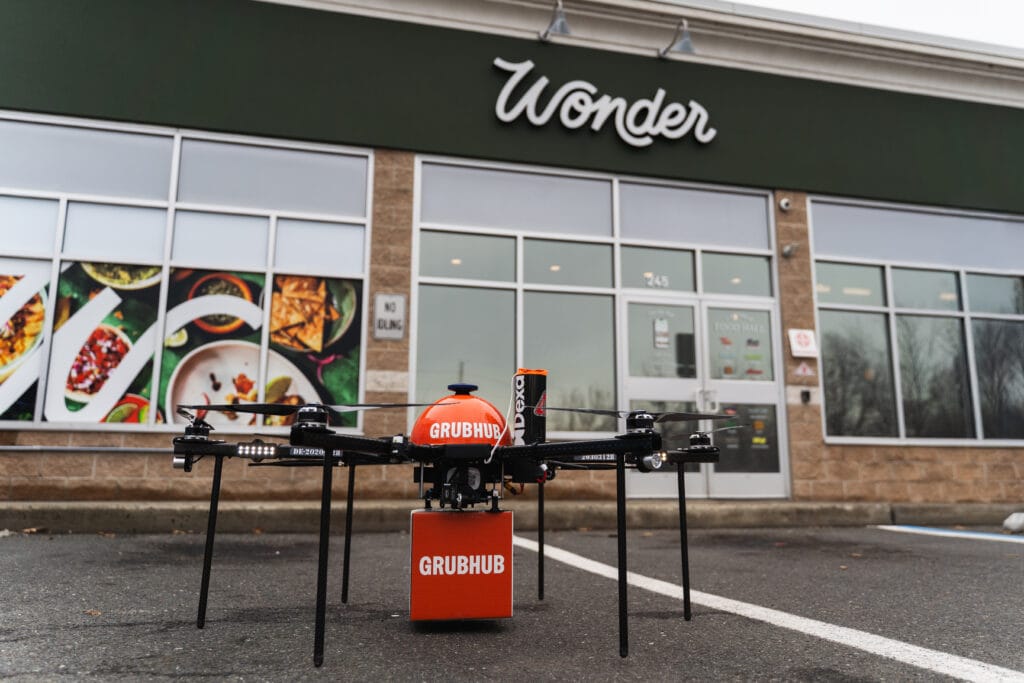
Wonder — the Marc Lore holding company that owns Grubhub and Blue Apron — is reportedly raising hundreds of millions of dollars at a $9 billion valuation, in what may be its last private round before a listing. Lore has reportedly indicated he will put in $200 million himself (The Information).
The number under the number is the interesting one. Per the same reporting, investors in this round would receive additional shares if Wonder's IPO price came in below 1.5 times the price they paid. That provision is called an IPO ratchet. It transfers listing risk from the new money to everyone already on the cap table.
One expert quoted by Inc. estimated the downside protection could be worth roughly a third of the listed price, and that because most existing shareholders and employees don't hold it, the company's economic value to them may be meaningfully below the $9 billion headline — the estimate cited was under $6 billion (Inc.). That is one analyst's estimate, not a reported term, and it depends on assumptions about listing price and timing that nobody has.
The reason this matters beyond one company: a headline valuation is a single number describing a security that may carry very different rights depending on which round you bought in. Employees holding common stock and investors holding ratcheted preferred are not holding the same instrument, and a secondary quote referencing "Wonder at $9 billion" does not distinguish between them. Structure lives in the documents, not in the headline.
Reported private-company financials and secondary-market indications may be unaudited, incomplete, non-standard, or based on limited transaction activity. They should not be relied upon as fair value, executable pricing, or a basis for any investment decision.
📊 Power 20 Watch
"Power 20" refers to Augment's internal ranking of selected private-market activity. It may not represent the broader private market and should not be treated as a valuation benchmark.
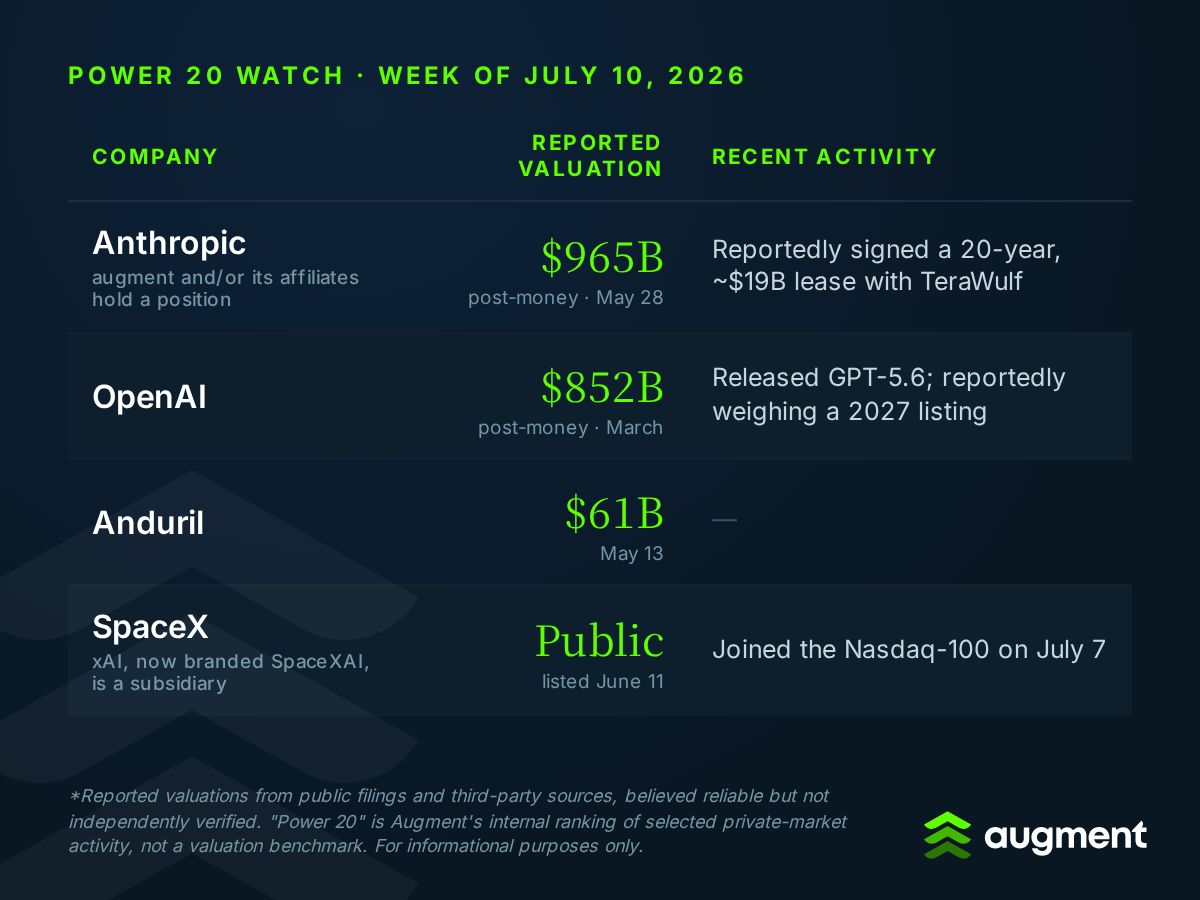
Reported private-company financials and secondary-market indications may be unaudited, incomplete, non-standard, or based on limited transaction activity. They should not be relied upon as fair value, executable pricing, or a basis for any investment decision.
💨 Quick Takes
- SK Hynix raised $26.5 billion in the largest-ever U.S. debut by a foreign company — 177.9 million ADRs at $149, trading on Nasdaq as SKHY (CNBC). The book was reportedly more than seven times oversubscribed (Reuters via Investing.com), yet the raise came in below the roughly $28 billion the company was targeting when the sale launched. Demand and proceeds are not the same variable.
- Hong Kong had its own week — Apple supplier Luxshare closed down 1.6% in its debut after raising roughly $3.1 billion, the city's biggest listing of 2026. Meanwhile Shanghai GPU maker Iluvatar CoreX pulled $902 million out of a follow-on, its stock up 257% since a January IPO that raised about $475 million (Bloomberg, New Straits Times). Three AI-hardware offerings, two venues, three different outcomes in one week.
- The Federal Reserve named Marc Andreessen to co-lead a task force on AI's economic impact — alongside Stanford economist Charles I. Jones and Microsoft's Asha Sharma, with recommendations expected by year end (CNBC). Andreessen Horowitz co-led Anduril's $5 billion round at a reported $61 billion valuation in May. The task force is advisory and its recommendations are not policy. The appointment itself is the fact worth recording.
- Micron committed $250 billion of U.S. capex through 2035 — adding $50 billion for New York, Idaho, and Virginia, plus $500 million into GlobalWafers. Memory is where the AI buildout meets a factory floor, and factory floors take a decade.
💰The Funding Lineup
The following financing rounds are included for market context only and are not recommendations or valuation opinions.
- Mercor — reportedly ~$500M at a ~$20B valuation (July 9). The AI-training marketplace reportedly told investors it received at least one term sheet at that number, roughly nine months after raising $350 million at $10 billion (Forbes). Talks are reported as early and terms could change. Tuesday's caution applies: the $2 billion run rate underneath this mark is a gross number, before contractor payouts.
- SambaNova — $1B at an $11B valuation (July 8). First close of a Series F led by General Atlantic. An AI-chip company that was reportedly the subject of an Intel acquisition rumor around $1.6 billion is now marked at eleven. Silicon that isn't Nvidia's is being repriced.
- Kraken Technology — $175M Series B at a $1B valuation (July 9). Led by DTCP, with the British Business Bank, the NATO Innovation Fund, and Rheinmetall participating. The UK's newest defense-tech unicorn builds uncrewed surface and subsurface vessels. Sovereign-adjacent capital is now a standard line on a European defense cap table.
- Databento — $97M Series B led by NEA (July 9). The market-data company says it is profitable every month, with 24 employees, and that the round drew over $300 million in demand. Twenty-four people building a market-data business against incumbents with tens of thousands is the kind of number that makes headcount a lagging indicator.
- Prime Intellect — $130M Series A at a $1B valuation (July 8). Led by Radical Ventures, joined by Nvidia Ventures, Intel Capital, Dell Technologies Capital, and Iconiq. Three strategic chip and hardware investors on one Series A cap table is its own signal about where the compute bottleneck sits.
- Ollama — $65M Series B led by Theory Ventures (July 9). The open-weight local-model runner has grown to nearly nine million users, following a $15 million Series A led by Benchmark. A tool for running models on your own hardware, funded in the same week Meta cut the price of running them on someone else's.
- Nscale — $900M revolving credit facility, not an equity round (July 7). Syndicated by a dozen banks including JPMorgan, Goldman, Morgan Stanley, and MUFG. The Nvidia-backed U.K. company raised $2 billion in equity in March at a reported $14.6 billion valuation; this is its fourth major financing of 2026. Included here deliberately, because it isn't a round: AI infrastructure at this scale is increasingly financed with bank debt, and the venture cap table is no longer where the whole capital story sits.
📈 Data Point of the Day
86%
Of the $412.7 billion of U.S. venture capital deployed in the first half of 2026, $355.9 billion — 86 cents of every dollar — went to AI companies, per the Q2 PitchBook-NVCA Venture Monitor released Wednesday night (SiliconANGLE, PitchBook). The half's total is nearly 30% more than investors deployed in all of 2025. Rounds of $100 million or more accounted for 87.5% of every dollar.
Yesterday's edition looked at concentration by name. This is concentration by sector, measured on the primary side, and it runs higher.
Reported private-company financials and secondary-market indications may be unaudited, incomplete, non-standard, or based on limited transaction activity. They should not be relied upon as fair value, executable pricing, or a basis for any investment decision.
🎓 Manual
IPO Ratchet
A contractual provision granting late-stage investors additional shares if a company lists below a specified multiple of the price they paid — in Wonder's reported case, 1.5x. The mechanism protects the newest money at the expense of everyone senior to it, since the extra shares come out of existing holders' ownership. A ratchet may allow a company to print a higher headline valuation than the market would otherwise support, which is why the number in a press release and the economics on a common shareholder's cap table can differ, sometimes substantially.
👀 What We're Watching
- SKHY begins trading. SK Hynix's ADRs are expected to open on Nasdaq following Thursday's pricing at $149 (CNBC). Pricing and trading are different facts. The second one arrives today.
- Whether Blue Origin's round closes on reported terms. Coatue's reported $4 billion is roughly 40% of the raise (TechCrunch). Additional reporting on final size, price, and syndicate, if it emerges, may provide context on how a first outside round gets priced for a company with no prior external mark.
- Whether Meta's pricing shows up anywhere but Meta. The Model API opened at roughly a quarter of the advertised rates at OpenAI and Anthropic (Bloomberg). Developer adoption, published benchmarks, and any change to competitors' published rates are all things to monitor over the coming weeks. (Augment and/or its affiliates hold a position in Anthropic.)
- Banks positioning around OpenAI. Bank of America reportedly reversed course on a $520 million credit line to OpenAI, with Bloomberg framing the move as securing a role in an eventual listing (Bloomberg). Lending relationships forming ahead of a listing that has not been announced is one thing to monitor.
Augment Markets Inc. is a technology company offering software and data services. Brokerage services are offered through Augment Capital LLC, an affiliated broker-dealer and member FINRA/SIPC. Investment advisory services are offered through Augment Advisors LLC, an SEC-registered investment adviser.
Important Disclosures: This material has been prepared for informational purposes only. None of the information provided represents a recommendation, an offer or the solicitation of an offer to buy or sell any security. The information provided does not constitute investment, legal, tax, or accounting advice. You should consult with qualified professionals before making any investment decisions. Investing in private securities involves substantial risk, including the potential loss of principal. Private securities are typically illiquid, have limited pricing transparency, and often require longer holding periods. These investments are available exclusively to qualified accredited investors and offer no guarantee of returns. An IPO or other liquidity event is not guaranteed. Additionally, past performance of private securities does not indicate or predict future results. Share price data are estimates only, based on proprietary data from Caplight and Augment Markets Inc. and its affiliates.

Paul leads editorial at Augment, building Pulse into the private markets' go-to intelligence source. He also develops editorial content strategies for startups and venture capital firms. Previously, he spent 15 years as a business and opinion journalist at The New York Times, Fortune, Fast Company, Reuters, and more. He believes transparency creates liquidity—and that someone should actually publish what private shares are trading for. He lives in Marin with his wife and two rescue dogs, and wishes he had more time to surf.
Learn more