


Six Anthropic investors told the Financial Times they expect the company to list in October at $2 trillion or more, a figure the company itself has reportedly not set. Databricks closed $5 billion at a $190 billion valuation, its second round of the year, six months after raising at $134 billion. Vantage Data Centers is weighing a listing at about $100 billion, one of three data-center operators reportedly headed the same way. And PitchBook reported first-half AI funding above $407 billion, more than half of it going to two companies, which makes this week's ten priced rounds a useful look at the rest of the market.
Six Anthropic backers told the FT they expect a $2 trillion October listing
The Financial Times reported Thursday that six Anthropic investors expect the company to go public in October at a valuation of $2 trillion or more. Anthropic reached a reported $965 billion valuation in May. Those same backers reportedly expect annualized revenue of $100 billion to $120 billion by the end of 2026, against a reported $47 billion in May.
The figure came from investors, not from the company. CNBC reported the same day that CFO Krishna Rao is leading early meetings with investors and has not discussed valuation, and that senior executives have not set an internal target.
SpaceX priced its June listing at a $1.77 trillion valuation and closed its first day up 19%. A listing at $2 trillion would be larger than that.
The FT also reported the counterweights: competition from lower-cost Chinese models, regulatory pressure, an ongoing dispute with the US government, and a flagship model that reportedly costs more than two and a half times as much to run as OpenAI's. Any comparison between the two companies may not hold — they differ in business mix, cost structure, capital commitments, and what they disclose.
Ramp's August AI Index, published Thursday, found that 43.5% of US businesses in its corporate-spend dataset paid for Anthropic subscriptions or tokens in July, up 1.1 points month over month and 2.9 points ahead of OpenAI.
Reported private-company financials and secondary-market indications may be unaudited, incomplete, non-standard, or based on limited transaction activity. They should not be relied upon as fair value, executable pricing, or a basis for any investment decision.
For more company information, recent coverage, and available market data, visit Anthropic on Augment.
Databricks raised $5 billion at a $190 billion valuation
Databricks said Thursday that it closed $5 billion at a $190 billion valuation. Coatue Management led. Blackstone, MGX, T. Rowe Price Investment Management and accounts advised by T. Rowe Price Associates joined, along with Sixth Street Growth, BOND, Clearlake Capital, Point72, Premji Invest and TPG.
The company said it crossed a $7 billion revenue run rate, with second-quarter growth above 80% year over year. Its Lakehouse warehousing business passed $1.5 billion annualized, and Lakebase, its database for AI agents, passed $100 million.
The round closed six months after Databricks raised $5 billion at $134 billion. TechCrunch reported that the company set out to raise $1 billion and that investors wanted to put in $15 billion.
Both announcements landed Thursday. Databricks has raised $10 billion across two rounds in the past six months and has announced no listing plans.
Reported private-company financials and secondary-market indications may be unaudited, incomplete, non-standard, or based on limited transaction activity. They should not be relied upon as fair value, executable pricing, or a basis for any investment decision.
Vantage Data Centers is exploring a listing at about $100 billion
Reuters reported Thursday that Vantage Data Centers is weighing a sale or an IPO at a valuation of roughly $100 billion as soon as next year, and could raise around $10 billion in a listing. The hyperscale developer is backed by Silver Lake and DigitalBridge. Reuters reported the talks are preliminary: Vantage has met informally with financial advisers, and no formal process has begun.
A listing at that price would reportedly rank among the largest data-center IPOs to date. Vantage recently partnered with Oracle and OpenAI on a Wisconsin campus tied to Stargate, the joint venture with SoftBank building AI data-center capacity of up to $500 billion and 10 gigawatts.
Vantage is one of at least three. Data Center Dynamics reported that CyrusOne and DayOne are also planning listings. The infrastructure the model companies rent is arriving at public markets on roughly the same timetable as the model companies. The two are not comparable as listings — data-center developers carry heavy debt against long-lived physical assets, and their disclosure, capital structure and cash-flow profile differ substantially from a software or model business.
Reported private-company financials and secondary-market indications may be unaudited, incomplete, non-standard, or based on limited transaction activity. They should not be relied upon as fair value, executable pricing, or a basis for any investment decision.
🔋 Power 20 Watch: the top of the list is where the listing activity is
"Power 20" refers to Augment's internal ranking of selected private-market activity. It may not represent the broader private market and should not be treated as a valuation benchmark.
The names at the top of Augment's Power 20 produced most of this week's public-market news. SpaceX listed in June. Anthropic's backers are talking about October. Bloomberg reported OpenAI's revenue run rate under an IPO headline. Databricks raised privately.
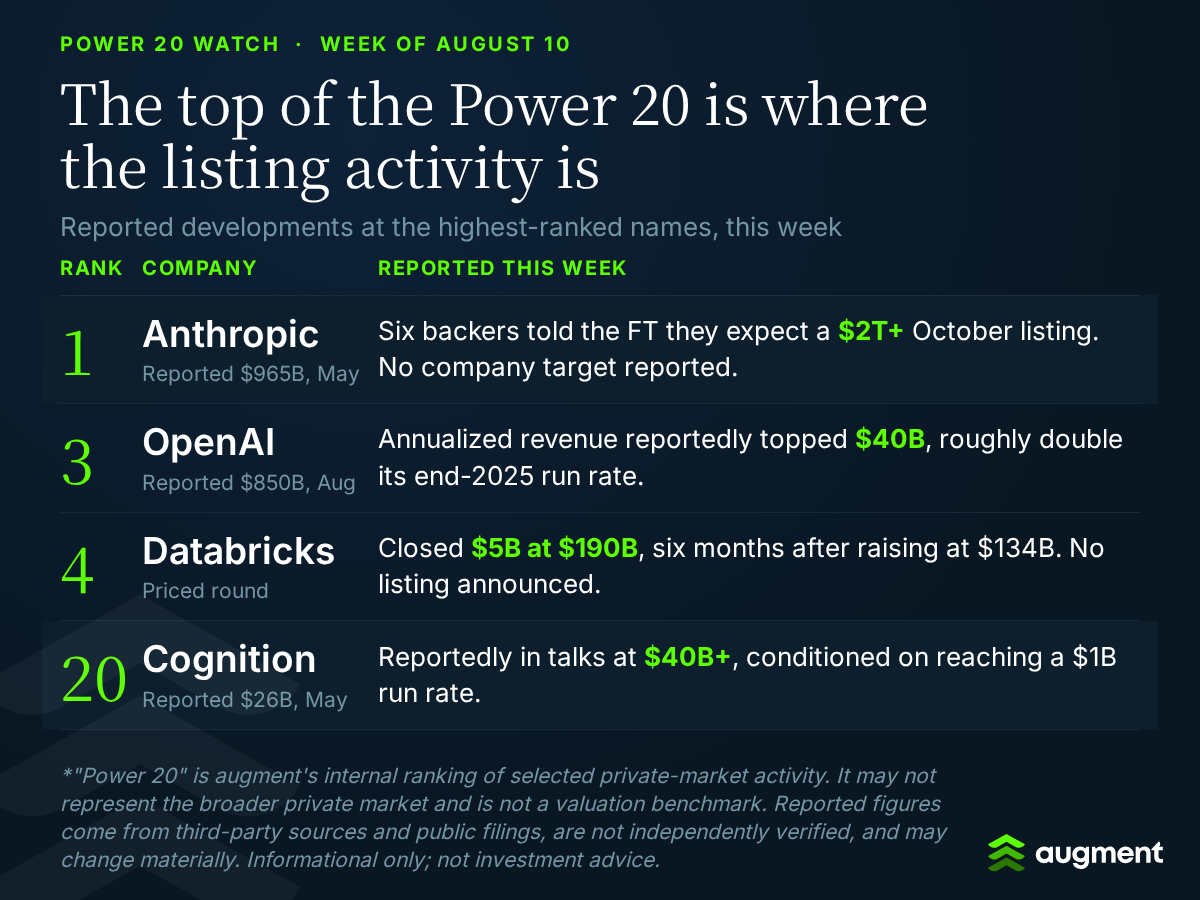
A ranked list of private companies changes composition when its largest members list. SpaceX left it in June. If Anthropic follows in October, the two names that have driven the most private-market attention over the past year would both price on public exchanges inside five months, and the companies ranked below them would move up.
That is a description of what the list would look like, not a prediction that either event occurs on that schedule. Reported IPO timing changes, and no listing is guaranteed.
Reported private-company financials and secondary-market indications may be unaudited, incomplete, non-standard, or based on limited transaction activity. They should not be relied upon as fair value, executable pricing, or a basis for any investment decision.
⚡ Quick Takes
- Silver Lake is in talks to buy Workday — Reuters reported Thursday that the private equity firm has held discussions in recent months about acquiring the HR and financial software company, which carried a market value of about $43 billion before the report. Workday closed up nearly 18% at $206.45. The talks are ongoing, and Reuters reported there is no guarantee of a deal.
- Anthropic is reportedly in talks to acquire Decart for about $6 billion — Bloomberg reported the talks Thursday. Decart, an Israeli company, builds world models and GPU optimization technology aimed at cutting training costs, and raised $300 million in May led by Radical Ventures at a reported $4 billion valuation. If the reported price holds, it would be roughly a 50% premium to a round set three months earlier.
- Wealth managers are cutting fees to reach AI employees before the listings — The Financial Times reported Thursday that advisers across Silicon Valley are cutting fees and hiring staff to reach OpenAI and Anthropic employees ahead of any offering. The FT put OpenAI's equity grants at nearly $11 billion across 2024 and 2025, an average of about $1.5 million across roughly 5,000 employees.
- OpenAI hired Wiz COO Dali Rajic as chief revenue officer — Rajic replaces Denise Dresser, the former Slack CEO hired in December 2025. It is OpenAI's second CRO in under a year. Bloomberg framed the change as an effort to strengthen enterprise sales ahead of a potential listing.
- A judge ordered Kalshi to stop offering most prediction contracts in Washington state — The court found the prediction market likely violated state gambling law. Kalshi has contested similar rulings in other states.
💰 The Funding Lineup
The following financing rounds are included for market context only and are not recommendations or valuation opinions.
PitchBook's Q2 AI report, published August 10, put first-half venture funding to AI startups above $407 billion, against $264 billion for all of 2025. OpenAI and Anthropic took more than half of it, about $217 billion, across three rounds. Deal count moved the opposite way: roughly 3,500 AI deals in the first half, down from 8,290 in all of last year. Vertical application companies accounted for 62.9% of deal count and 12.9% of capital.
Ten priced rounds were announced this week. Three more were reported in progress.
Closed and priced
Form Energy — $750M Series G (Aug. 12) — T. Rowe Price led again, with Sequoia, Franklin Templeton and Janus Henderson new to the cap table. Form makes 100-hour iron-air batteries for multi-day grid storage and says its commercial backlog has grown roughly fourfold this year, to about 80 gigawatt-hours. The company attributes the increase to data-center demand, which puts a battery manufacturer downstream of the same buildout driving the Vantage story above. Valuation was not disclosed.
Lovable — $400M Series C at a reported $13.3B valuation (Aug. 12) — Menlo Ventures led, co-led by the Scaleup Europe Fund managed by EQT, with Balderton, Tencent and Salesforce Ventures among the new investors. The Stockholm company said it reached $500 million in annualized run-rate revenue in June, and that apps built on it see more than 900 million visits a month. Menlo also led its $330 million round at $6.6 billion in December, which puts the valuation at roughly double eight months later.
Cambridge Aerospace — $300M Series C at a reported $3.4B valuation (Aug. 10) — DFJ Growth led, with Lux Capital, Accel, Lakestar and Elad Gil. The UK company builds low-cost interceptors for air defense. It raised a $200 million Series B at $1.3 billion in April, which puts two priced rounds four months apart at a 2.6x step-up.
Neros Technologies — $250M Series C at a reported $2.5B valuation (Aug. 11) — Sequoia Capital and the American Strategic Technology Fund co-led, with Valor Equity, Thiel Capital and Spark Capital participating. The Torrance, California company mass-manufactures small strike and counter-drone aircraft for the US military and allies. The valuation is roughly triple its reported prior financing valuation. Two counter-drone companies raised $550 million between them inside 48 hours.
Vaderis Therapeutics — $152M Series B (Aug. 11) — Life Sciences at Goldman Sachs Alternatives and TCGX co-led, with Omega Funds, EQT Life Sciences and Perceptive. The Basel company is starting a global Phase 3 study of an AKT inhibitor for hereditary hemorrhagic telangiectasia, a vascular bleeding disorder. The round was reported as oversubscribed.
CodeRabbit — $143M Series C at a reported $1.5B valuation (Aug. 12) — Atomico and Smash Capital co-led, with Datadog and BMW i Ventures joining. The AI code-review company reports 17,000 customers and more than two million reviews a week, and plans to double its European headcount and expand into Japan and Singapore. The round came less than a year after a $60 million Series B.
MarginEdge — $80M Series D (Aug. 11) — Schooner Capital and Ten Coves Capital jointly led, bringing total funding to $162 million. The Arlington, Virginia company runs invoice processing and back-office software for more than 13,000 restaurants, covering roughly $28 billion in purchasing volume. The company described the round as a mix of debt and equity and did not disclose the split or a valuation.
Corma — $60M seed (Aug. 10) — Sequoia led, with Khosla Ventures and Coatue. Founded in 2025 by former DeepMind researchers and Israeli Unit 8200 veterans, Corma is building foundation models for defensive security operations. A $60 million seed is unusual outside the frontier-model layer.
Yuno — $45M Series B (Aug. 12) — Global PayTech Ventures led, with a16z, Tiger Global and Kaszek participating. The Bogotá company runs payment orchestration, offering one API into more than 1,000 payment methods across 190 countries, for customers including McDonald's and Rappi.
Mindgard — $30M Series A (Aug. 12) — Album VC led, with Karma Ventures new and .406 Ventures, Atlantic Bridge, IQ Capital and Lakestar returning. The London- and Boston-based Lancaster University spinout does red-teaming and runtime protection for AI systems, and says it has found more than 150 vulnerabilities in AI products, including a zero-day code-execution flaw in Cursor.
Reported in talks, not closed
The three below are reported discussions. No round has been confirmed as priced or closed, and terms may change or fall through.
Cognition AI — reportedly in talks at $40B or more (Aug. 12) — Bloomberg reported the discussions. Cognition, which sells the Devin coding agent, closed $1 billion at a $26 billion post-money valuation in May, when it reported a $492 million annualized run rate. TechCrunch reported the $40 billion figure is conditioned on reaching a $1 billion run rate. No investors have been named.
Legora — reportedly in early talks above $10B — The Financial Times reported the Stockholm legal-AI company is discussing a raise that could combine new primary capital with secondary share sales. Legora extended its Series D in April at $5.6 billion, four months earlier. Rival Harvey is separately reported to be in talks at $15.5 billion, up from $11 billion in March. Legora declined to comment.
Discovery Loop — reportedly in talks for $1B at about $10B — Jeff Dean left Google after 27 years as chief scientist to launch the company on August 5, with co-founders Sanjay Ghemawat, Quoc Le and Oriol Vinyals. Its initial financing was co-led by Radical Ventures and Khosla Ventures, with Lightspeed, Kleiner Perkins, Doerr Capital and Alphabet participating; Alphabet is also a compute partner. Business Insider reported this week that the company is discussing $1 billion at a valuation near $10 billion, roughly a week after launch, and that terms could change.
📈 Data Point of the Day
43.5%
The share of US businesses in Ramp's corporate-spend dataset that paid for Anthropic subscriptions or tokens in July, per the August 2026 Ramp AI Index. That is up 1.1 points from June and 2.9 points ahead of OpenAI. Ramp's index measures paid adoption among businesses using its card and bill-pay products, which is a specific population and not the whole market.
Reported private-company financials and secondary-market indications may be unaudited, incomplete, non-standard, or based on limited transaction activity. They should not be relied upon as fair value, executable pricing, or a basis for any investment decision.
🎓 Manual
Crossover investor
A fund that invests in both private and public companies, often taking a late-stage private position and continuing to hold the shares after a listing. T. Rowe Price, Coatue and Fidelity are common examples, and three of them appear in this week's rounds. Their presence on a cap table is sometimes read as a signal about listing timing, though a crossover fund may hold a private position for years without one.
👀 What We're Watching
Thoma Bravo's $4 billion-plus take-private of Accelerant. The insurance data-analytics company agreed Thursday to be acquired at $20.25 per share, a reported 49% premium. It landed the same day as the Silver Lake–Workday report. Additional sponsor bids for listed software and insurance-tech names, if they occur, may provide context on how buyout firms are pricing that cohort.
Crossover funds' pace of late-stage private commitments. T. Rowe Price appeared in two large rounds this week, leading Form Energy's $750 million Series G and joining Databricks at $190 billion. Coatue led Databricks and also backed Corma's seed. Additional rounds with the same names, if they occur, may provide context on how public-market managers are sizing private positions ahead of a possible listing window.
Government-linked capital on the lead line of priced venture rounds. The American Strategic Technology Fund, which has Defense Department ties, co-led Neros's Series C alongside Sequoia. A government-affiliated vehicle co-leading rather than following is a different arrangement from a defense contract or a grant. Additional rounds structured that way, if they occur, may provide context on how procurement and venture pricing interact in the sector.
Silver Lake's capacity for a second large take-private. Reuters reported the firm may bring in additional investors to finance a Workday deal, following its roughly $55 billion Electronic Arts take-private last year with Saudi Arabia's Public Investment Fund and Affinity Partners. The composition of any consortium is worth tracking for what it says about where large-cap software buyout capital is coming from.
Augment Markets Inc. is a technology company offering software and data services. Brokerage services are offered through Augment Capital LLC, an affiliated broker-dealer and member FINRA/SIPC. Investment advisory services are offered through Augment Advisors LLC, an SEC-registered investment adviser.
Important Disclosures: This material has been prepared for informational purposes only. None of the information provided represents a recommendation, an offer or the solicitation of an offer to buy or sell any security. The information provided does not constitute investment, legal, tax, or accounting advice. You should consult with qualified professionals before making any investment decisions. Investing in private securities involves substantial risk, including the potential loss of principal. Private securities are typically illiquid, have limited pricing transparency, and often require longer holding periods. These investments are available exclusively to qualified accredited investors and offer no guarantee of returns. An IPO or other liquidity event is not guaranteed. Additionally, past performance of private securities does not indicate or predict future results. Share price data are estimates only, based on proprietary data from Caplight and Augment Markets Inc. and its affiliates.

Paul leads editorial at Augment, building Pulse into the private markets' go-to intelligence source. He also develops editorial content strategies for startups and venture capital firms. Previously, he spent 15 years as a business and opinion journalist at The New York Times, Fortune, Fast Company, Reuters, and more. He believes transparency creates liquidity—and that someone should actually publish what private shares are trading for. He lives in Marin with his wife and two rescue dogs, and wishes he had more time to surf.
Learn more