





Valor Equity Partners, one of SpaceX's largest shareholders, distributed about $8.5 billion of SpaceX stock to its limited partners this week rather than selling it. It was one of the first large publicly disclosed in-kind distributions following the June IPO. The same firm co-led Crusoe's $3.9 billion Series F on Thursday, tripling the data-center builder's valuation to $30.9 billion in ten months. The two moves bracketed the Federal Reserve's first rate increase since 2023, while Zipline, Shield AI, Spear Street Technology and Emulate were all reportedly raising at large step-ups. Cohere also signed its merger agreement with Aleph Alpha at a combined value of about $20 billion.
Valor handed its LPs $8.5 billion of SpaceX stock instead of selling it
Valor Equity Partners disclosed in a Form 4 filed Tuesday evening that it had distributed about 8.5% of its SpaceX holdings to its limited partners, worth roughly $8.5 billion at Tuesday's close, per Bloomberg. The shares went to LPs in kind: Valor handed over stock rather than selling it and distributing cash. Afterward, the firm still held about 3.4% of SpaceX, or more than 460 million shares, according to TechCrunch's reading of the filing. Bloomberg valued the remaining position at nearly $92 billion. Antonio Gracias, Valor's founder, sits on SpaceX's board and first backed the company in 2008. He told CNBC in June that he planned to hold his own stake “as long as I possibly can.”
SpaceX listed in June at a $1.75 trillion valuation, the largest IPO on record, per Dealogic. Its shares rose about 5% to around $151 on Wednesday after the company set September 22 for Starship's first attempt at orbit, per TipRanks. They remained about 7% below their opening level.
For anyone tracking SpaceX's supply after the listing, the distribution changes the question. A fund selling a block is one decision by one seller. An in-kind distribution gives each LP that decision, on its own tax position and timetable. Some may sell on receipt; endowments and family offices may hold for years. The shares are now spread across many accounts rather than concentrated in one, and later sales by those holders may not appear in public filings.
Valor is one of the first large pre-IPO SpaceX holders to disclose a distribution of this size. The other large holders have not disclosed their plans. Each faces different fund-life and liquidity constraints, so Valor's decision may say little about what the others will do.
Browse private-company pages on Augment for company information, recent coverage, and available market data.
Crusoe raised $3.9 billion at a $30.9 billion valuation, up from $10 billion ten months ago
Crusoe announced the initial close of a $3.9 billion Series F on Thursday at a $30.9 billion post-money valuation. Atreides Management, Mubadala Capital and Valor Equity Partners co-led the round. Nvidia, Founders Fund, GIC, Qatar Investment Authority, Radical Ventures and TPG also participated, according to the company. Crusoe's previous round, $1.38 billion at a $10 billion valuation, closed in October, per TechCrunch.
The company said it has more than $140 billion in total contracted value and more than 6 gigawatts of gross contracted capacity, with just over 1 gigawatt delivered. Two of those contracts arrived this month: a roughly $13 billion, five-year cloud deal with Jane Street, per Bloomberg, and a multiyear capacity agreement with Perplexity whose terms were not disclosed. Crusoe built the Abilene, Texas, site used by OpenAI and met with bankers in August about a possible IPO, per Axios. It also added three board members Thursday, including Cloudflare's CFO.
Crusoe ranks in Augment's Power 20. Two features of the round stand out. Valor co-led it in the same week it distributed SpaceX shares to its LPs, putting new money into one private company while returning listed shares from another. The investor list also leans heavily on sovereign and strategic capital: Mubadala, GIC, QIA and Nvidia may operate on different timelines from a traditional venture fund. Crusoe's revenue and contract figures are company-reported and have not been filed publicly, and contracted value is not the same as recognized revenue.
Reported private-company financials and secondary-market indications may be unaudited, incomplete, non-standard, or based on limited transaction activity. They should not be relied upon as fair value, executable pricing, or a basis for any investment decision.
The Fed raised rates for the first time since 2023, and the 10-year passed 5%
The Federal Open Market Committee raised its benchmark rate a quarter point to 3.75%–4.00% on Wednesday, the first increase in more than three years. The vote was unanimous. Chair Kevin Warsh said inflation “is too high and has been for too long,” and 16 of 18 participants penciled in at least one more increase, per CNBC. The two-year Treasury yield rose to 4.74% and the 10-year to 5.02%, per Yahoo Finance.
Private-company valuations generally do not reprice as continuously as public markets and are typically reset through financing rounds, tenders, secondary transactions, 409A processes or other valuation events. Within 48 hours of the decision, Crusoe closed at triple its previous mark. Zipline was reported in talks at roughly $20 billion, up from $7.6 billion in January. Spear Street Technology, maker of the Instinct assistant, was reportedly seeking $1 billion at about $10 billion five weeks after raising at $2.25 billion. Emulate, a world-model startup founded in August, was reportedly close to a $700 million seed round at a $3.7 billion valuation.
On the debt side, a group of ten banks lined up a $22 billion loan for Crux AI, the Blackstone and Alphabet cloud venture. Bloomberg reported that the loan would be secured by the Google TPUs Crux plans to buy and by customer contracts. Private rounds are negotiated over weeks, so participants may have priced in an increase that futures had put at better than 90% odds going into the meeting. Whether any of these deals changed after Wednesday has not been reported.
PitchBook's Thursday analysis argues that higher borrowing costs are landing on a private equity industry already facing an exit bottleneck and weaker LP appetite. Public and private growth companies differ in liquidity, disclosure and marking frequency. A public-market repricing may therefore take a long time to reach private marks, if it reaches them at all.
Power 20 Watch
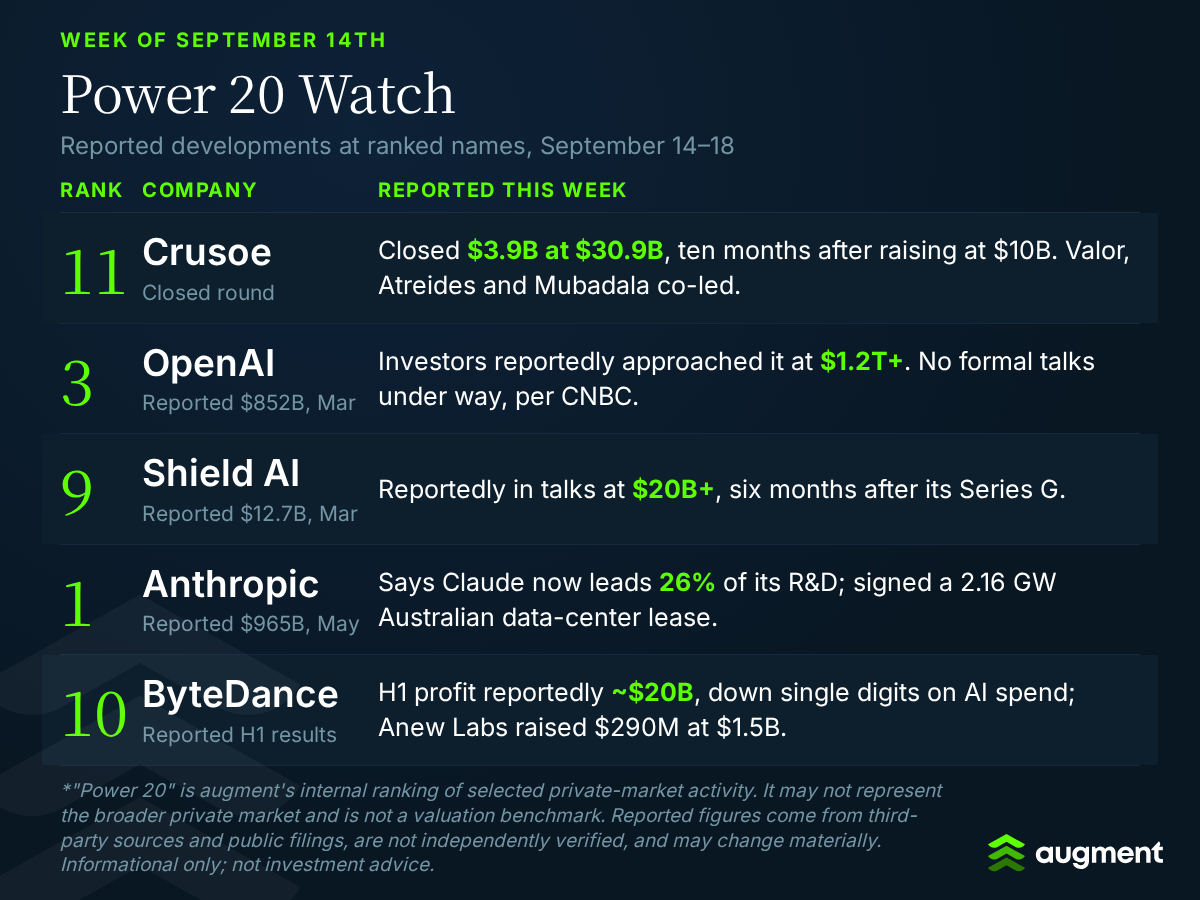
Four Power 20 names had primary-market news this week. The largest reported figure, for OpenAI, remains an investor approach rather than a term sheet.
OpenAI was the subject of reports, beginning with Bloomberg on Tuesday night, about early funding discussions above $1.2 trillion. CNBC's Wednesday account added important limits: investors approached the company with the figure, some described the round partly as a way for employees to sell, the company reportedly believes it is worth at least $1.5 trillion, and no formal talks were under way. OpenAI last raised at $852 billion in March. A round at the reported level would be a 41% increase in six months for the second-largest company in the ranking.
Anthropic said Thursday that Claude now “leads” 26% of its AI research and development work, up from 1% in March, per Bloomberg. The company also published metrics it proposes for tracking the pace of development at frontier labs. Novo Nordisk said Wednesday that it will use Claude to speed drug development, per The Wall Street Journal. Reuters also reported that Anthropic signed its first Australian data-center lease for a planned 2.16-gigawatt inference campus in Queensland. The project is due to begin coming online in 2027, subject to foreign-investment approval. Anthropic's prospectus is expected to become public in late September, per earlier Reuters reporting, though the timing remains subject to market and regulatory conditions. Augment and/or its affiliates hold a position in Anthropic.
Shield AI is reportedly in talks at a valuation of at least $20 billion, per The Information, six months after its $12.7 billion Series G. Shield AI had the most completed trades of any Power 20 company on Augment in the second quarter, according to the Q2 ranking.
Crusoe is covered above. ByteDance, which ranks tenth, reported first-half net profit of about $20 billion, down by a single-digit percentage, as revenue rose about 30% to $120 billion, per The Information. The company also closed $290 million at a $1.5 billion valuation for Anew Labs, the AI drug-discovery unit it spun out in June, retaining a 56% stake, per Reuters.
Neuralink, now among the ranking's top six, is the company that has raised the most funding in a category that PitchBook says has raised more than $1 billion in 2026, compared with $1.56 billion over the previous four years combined, per the Financial Times.
SpaceX left the Power 20 after it listed, and the ranking's aggregate estimated market cap fell for the first time as a result, to $3.77 trillion at the end of the second quarter. Anthropic and OpenAI together account for $2.29 trillion, or about 61%, of that total. Valor's distribution is the first disclosed movement of a large pre-IPO SpaceX position since the company left the ranking.
Reported private-company financials and secondary-market indications may be unaudited, incomplete, non-standard, or based on limited transaction activity. They should not be relied upon as fair value, executable pricing, or a basis for any investment decision.
Quick Takes
The SEC issued a five-year “innovation exemption” for platforms trading tokenized stock — Thursday's order exempts qualifying venues from the definition of an exchange while they trade tokenized versions of listed US stocks. It limits eligible symbols and volume, requires holders to receive the same rights as ordinary shareholders, and allows issuers to object to being listed, per Reuters. Private shares are outside its scope. The order came two days after the Senate failed to advance the Clarity Act, the crypto market-structure bill, on a 50–49 procedural vote that needed 60.
Cohere and Aleph Alpha signed a definitive merger agreement — The combined company, valued at about $20 billion, will operate as Cohere with headquarters in Toronto and Berlin, per Reuters. Aleph Alpha's Ilhan Scheer will become COO. Germany's Schwarz Group is also committing $600 million to a Cohere Series E expected to close later this year. Bloomberg had reported on September 11 that the round could close “as soon as next week.”
May Mobility agreed to go public through a SPAC at a $1.4 billion pro forma enterprise value — The Ann Arbor self-driving company could raise up to $337 million, including a $120 million PIPE, and plans to list on Nasdaq as MAY, per Axios. Its capital-light model does not require it to own fleets, making it a different potential public comparable from the robotaxi operators.
Bay Area tech employers filed layoff notices for more than 14,500 workers in the year to June — Bloomberg's analysis of California employment filings found that the count nearly doubled year over year. Lightcast data also put demand for software engineers in the region down 42% since 2022. The article sets those cuts against reported plans for potential OpenAI and Anthropic listings, which could create a large pool of newly liquid employees in the same metro area.
The Funding Lineup
The following financing rounds are included for market context only and are not recommendations or valuation opinions.
Zipline — reportedly in talks for about $1 billion at roughly $20 billion. Zipline was valued at $7.6 billion in January, and Paradigm is in talks to lead the new round, per Bloomberg. The Information cited three people with knowledge of the discussions. The drone-delivery company's US rollout with Uber provides the commercial backdrop. If completed at the reported valuation, the round would nearly triple Zipline's mark in eight months and show that large step-ups are extending beyond the model labs and defense companies.
Spear Street Technology — reportedly seeking $1 billion at about $10 billion. The maker of Instinct, an invitation-only AI assistant that users text to book reservations or answer messages, raised at $2.25 billion in August, per The Information. Sequoia and Benchmark have discussed leading the new round. The company has raised $350 million to date and has more than 100,000 users. The reported valuation would be more than four times its August mark.
Factory — $200 million at $5 billion. The enterprise coding-agent company raised $150 million at a $1.5 billion valuation in April, per Reuters. Blackstone, Khosla and Sequoia are among its backers, and customers include Nvidia, Adobe and T-Mobile. Factory competes with Cognition and Cursor, which SpaceX agreed to acquire in June.
Exein — $270 million at $1.7 billion. Headline led the round, with Sofina, Goldman Sachs and Balderton also participating, per PitchBook. The Rome company secures robots, drones and other physical machines and is now Europe's most valuable private cybersecurity company by reported valuation, per PitchBook.
Emulate — reportedly near a $700 million seed at $3.7 billion. Index Ventures and Lightspeed are poised to co-lead, per Bloomberg. Three former DeepMind researchers who worked on the Genie world models founded the London company in August. It is the third DeepMind spinout this year to raise a nine- or ten-figure first round, though its technology has not been publicly demonstrated.
Sling Therapeutics — $123 million Series C. Forbion, TPG Life Sciences Innovations and Sectoral Asset Management led the round, per Fierce Biotech. The company is taking linsitinib, an oral therapy for thyroid eye disease licensed from Astellas, into a Phase 3 trial. Here the financing centers on a clinical milestone, a different underwriting question from the compute contracts elsewhere in this issue.
These financings were negotiated over time, and their reported pricing should not be interpreted as having been caused by or directly responsive to Wednesday's Federal Reserve decision.
Data Point of the Day
78.2%
That is the share of all private capital raised in the first half of 2026 that went to funds of $1 billion or more, per PitchBook, up from 59.1% in 2021. Fundraising is on pace to decline for a fifth straight year, with private debt the only strategy up year over year. That concentration may also affect the secondary market: managers unable to raise another fund still have portfolios that may eventually need buyers, while LPs in funds that cannot return capital may sell their stakes to create liquidity.
Reported private-company financials and secondary-market indications may be unaudited, incomplete, non-standard, or based on limited transaction activity. They should not be relied upon as fair value, executable pricing, or a basis for any investment decision.
From the Manual
Form 4
A Form 4 is an SEC filing that officers, directors and holders of more than 10% of a public company's stock generally must submit within two business days of a change in ownership. It shows the transaction type, the number of shares and the price, if any. That is how Valor's SpaceX distribution became public this week: Antonio Gracias sits on SpaceX's board, making Valor's transfers reportable. A distribution to LPs appears as a disposition even though no sale occurred, so the filing may show shares leaving without a sale price. The LPs that receive the shares generally have no Form 4 obligation unless they cross the 10% threshold, so later sales by those holders may not be visible in filings.
What We're Watching
Starship's September 22 orbital attempt. SpaceX set the date on Tuesday for the first flight intended to reach orbit and deploy 26 Starlink V3 satellites, pending regulatory approval. It would be the first major operational event since the IPO and the first since Valor transferred shares to its LPs.
OpenAI's reported round and any tender attached to it. CNBC's account of the $1.2 trillion approaches said some investors described the round partly as a way for employees to sell. If a primary round proceeds at that level, the presence and terms of an employee tender could provide additional context for secondary indications.
Reported rounds for Zipline and Spear Street. Zipline's $20 billion discussions and Spear Street's $10 billion discussions both surfaced Wednesday, the day of the rate decision. Whether either round closes at the reported figure could offer one indication of how much a quarter-point increase affects late-stage private pricing. Cohere's Series E, backed by Schwarz Group's $600 million commitment, is now the round to monitor on that company rather than the earlier Bloomberg report.
The next Fed meeting and dot plot. Sixteen of 18 FOMC participants expect at least one more increase, per CNBC. Third-quarter fund marks will be set as of September 30 and reported in October and November, making them the first quarter-end marks since the tightening cycle began.
Augment Markets Inc. is a technology company offering software and data services. Brokerage services are offered through Augment Capital LLC, an affiliated broker-dealer and member FINRA/SIPC. Investment advisory services are offered through Augment Advisors LLC, an SEC-registered investment adviser.
Important Disclosures: This material has been prepared for informational purposes only. None of the information provided represents a recommendation, an offer or the solicitation of an offer to buy or sell any security. The information provided does not constitute investment, legal, tax, or accounting advice. You should consult with qualified professionals before making any investment decisions. Investing in private securities involves substantial risk, including the potential loss of principal. Private securities are typically illiquid, have limited pricing transparency, and often require longer holding periods. These investments are available exclusively to qualified accredited investors and offer no guarantee of returns. An IPO or other liquidity event is not guaranteed. Additionally, past performance of private securities does not indicate or predict future results. Share price data are estimates only, based on proprietary data from Caplight and Augment Markets Inc. and its affiliates.

Paul leads editorial at Augment, building Pulse into the private markets' go-to intelligence source. He also develops editorial content strategies for startups and venture capital firms. Previously, he spent 15 years as a business and opinion journalist at The New York Times, Fortune, Fast Company, Reuters, and more. He believes transparency creates liquidity—and that someone should actually publish what private shares are trading for. He lives in Marin with his wife and two rescue dogs, and wishes he had more time to surf.
Learn more