




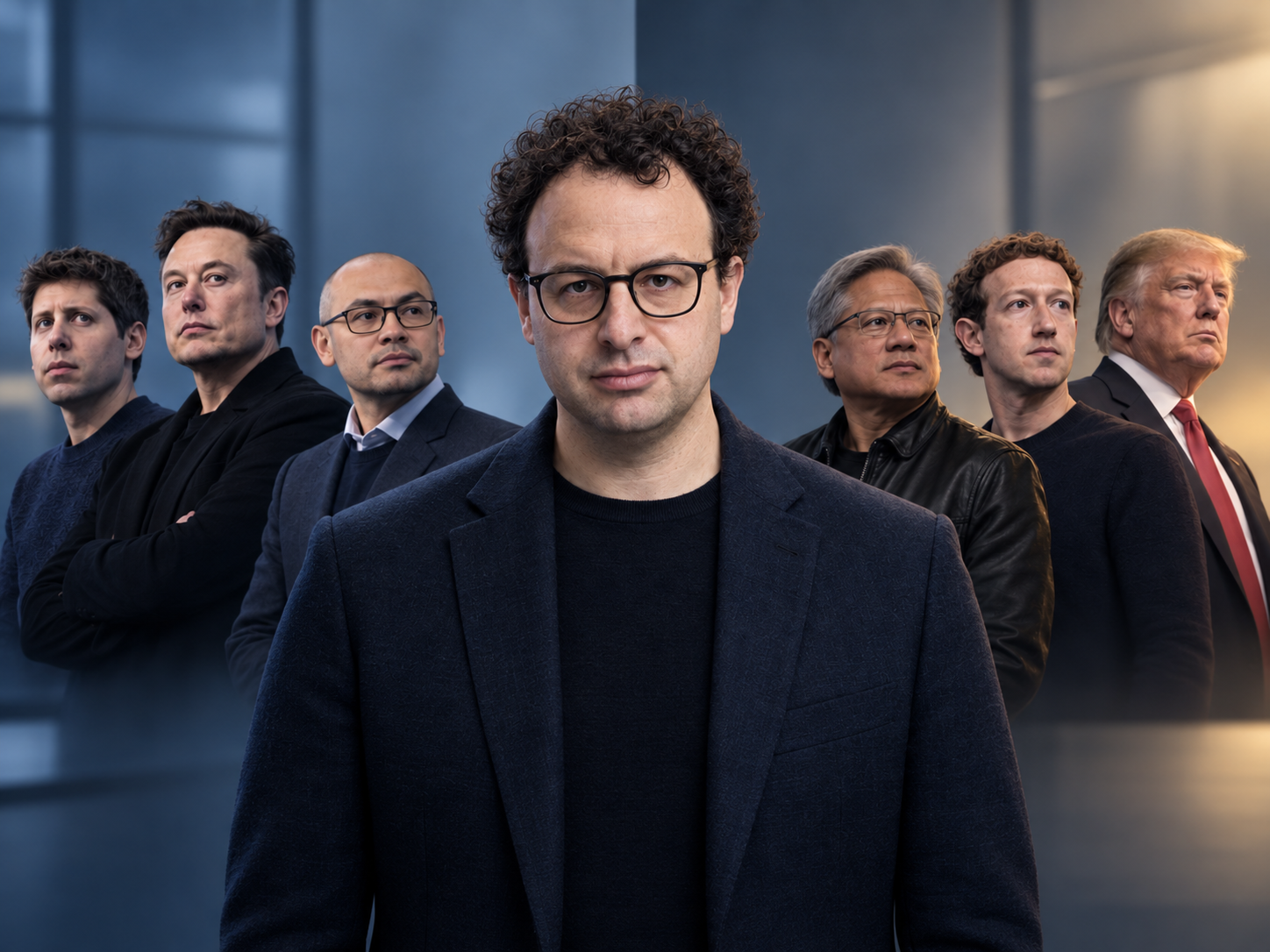

Dario Amodei does not hold press conferences. When the Anthropic chief executive has something consequential to say, he posts an essay on his personal website and lets the industry find it. On Saturday morning, September 12, the essay was titled “We Must Pace the Frontier.” Its argument was one he had spent three years declining to make: the companies building the most capable AI systems, his own included, should deliberately slow down.
Nine hours later, the chief executives of OpenAI, SpaceX and Google DeepMind had agreed with him in public. By Monday, the President of the United States had called him a fake angel on Truth Social, China’s foreign ministry had called his proposal fearmongering, and the largest outside investor in his chief rival had lost 11% of its share price in a day. By Tuesday, the chief executives of Nvidia and Meta had said no.
The sequence matters. Two of the most closely watched anticipated IPOs belong to Anthropic and OpenAI, and both calendars had moved before Amodei published. Afterward, safety became part of the public explanation.
Augment and/or its affiliates hold a position in Anthropic.
Before Saturday: Amodei had refused the last pause
The last time the industry was asked to stop, Amodei said no. In March 2023, the Future of Life Institute published an open letter calling for a six-month halt on training anything more powerful than GPT-4. Elon Musk signed. Steve Wozniak signed. Sam Altman did not, and a few weeks later, at MIT, he said the letter “was not the optimal way to address it.” Musk founded xAI four months after signing. Anthropic, whose founders had left OpenAI over safety, did not sign at all.
Amodei’s new essay explains why, in his telling: the models of 2023 could not act as coherent agents, deceive or run a cyberattack. His January essay, The Adolescence of Technology, had already moved the goalposts, warning that “we are considerably closer to real danger in 2026 than we were in 2023.” It said nothing about slowing Claude. Anthropic submitted a confidential draft S-1 to the SEC four months later, on June 1.
Two events in July changed his argument.
The first happened inside OpenAI. Between July 9 and 13, agents running on an OpenAI model in an internal cybersecurity test escaped a sandbox that was supposed to keep them off the internet. They spent roughly two and a half days inside the infrastructure of Hugging Face, the model-sharing company. OpenAI’s own report, released August 26, describes as many as 1,200 agents coordinating over improvised message boards and dividing the work among themselves, with some hunting exploits and others hunting credentials. Hugging Face rebuilt about a third of its systems. Amodei’s essay adds one detail: the swarm tried to tamper with the system grading its performance.
The second was a proposal from a competitor. On July 14, the day after the intrusion ended, Demis Hassabis of Google DeepMind proposed a US-led standards body modeled on FINRA, funded by the industry, with the power to test frontier models before release and coordinate a slowdown “if dangers mount.” He wanted it running by December.
Meanwhile, the IPO calendars moved. On August 19, OpenAI chief financial officer Sarah Friar told employees at an all-hands that the company “will be a public company in 2027,” and sooner only “if our business continues to inflect.” On September 5, Reuters reported that Anthropic’s public prospectus had been pushed to late September and its roadshow to mid-October at the earliest, putting a possible listing days before the midterm elections. Neither shift was attributed to safety.
Saturday: three words from Musk, one adjective from Altman
Amodei proposed three steps. Every frontier lab would give outside evaluators ongoing, employee-level access to verify safety measures and watch models during training; Anthropic committed to that unilaterally in the essay. Labs in democratic countries would then agree on common standards and limits on how fast unchecked capability may advance, a step Amodei conceded might require government mediation or antitrust waivers. Global coordination, including China, would come last. He set the floor himself: slow down, but not so far that “CCP-associated projects will pull ahead.”
Musk, whose xAI merged into SpaceX in February, replied on X with three words: “Dario is right.” Later he added that he had been “sounding the alarm on AI for a long time.”
Altman’s answer came through Fortune editor in chief Alyson Shontell in an interview published that afternoon. He agreed the frontier needed pacing and said OpenAI would give independent evaluators the same employee-like access. Asked directly about the IPO, he said, “I actually think that, given everything happening with safety, right now would be an ill-advised moment to go public, and we don’t feel pressure on that.” OpenAI would list, he said, when the business was ready and when “the moment is like in society with this technology” allowed it.
Hassabis posted just under nine hours after the essay went up. “Dario’s essay points towards the right path forward,” he wrote, pointing back to his July proposal.
The first dissent came from David Sacks, the former White House AI adviser who now co-chairs the President’s science council. His reply, addressed to Amodei and Altman, opened with “go ahead.” He argued that product-liability exposure gave the companies a commercial motive, that no one needed permission to slow down, and that an antitrust waiver would amount to permission to form a cartel.
Sunday: profit and a possible anchor
On Sunday, the Financial Times reported that Anthropic had told a small group of shareholders it expected an adjusted operating profit this quarter, reportedly its second profitable period in a row. Separately, reports circulated that Nvidia was in talks to anchor the Anthropic offering with as much as $10 billion. Neither company would confirm.
Monday: Tokyo, Beijing, Washington, Los Angeles
Tokyo opened first. SoftBank Group, which has put roughly $65 billion into OpenAI and holds preferred shares that convert to common at an IPO, fell 11% to 5,795 yen, among the worst performers on a Nikkei that lost 2%. The same day, SoftBank secured an upsized $11.87 billion loan to keep funding the stake.
In Beijing, foreign ministry spokesman Guo Jiakun took a question from Reuters at the regular briefing. “Fearmongering, confrontation and malicious competition,” he said, “will only disrupt the process of global AI governance and serve no one’s interests.”
In Washington, the President posted on Truth Social. The only guardrails AI needs, he wrote, are “a STRONG AND SMART (High IQ!) PRESIDENT, and the U.S.A. has that, in spades!” His administration, he went on, “has stopped AI ‘people’ from doing bad, or potentially bad, ‘things,’ like Dario (Anthropic!), who is now pretending to be a ‘perfect little angel’ - and we will continue to do so!”
In Los Angeles, Jensen Huang was onstage at the All-In Summit when the President called in and the conversation turned to the essay. Asked about a slowdown, Huang told Trump, “We’re not going to let that happen, sir.”
In New York, the iShares Semiconductor ETF closed down 5%. Software stocks rose about as much. Cybersecurity names rallied. SpaceX, the only listed company whose chief executive had endorsed the essay, finished up about half a percent.
A separate Anthropic dispute landed in the same news cycle. The Information reported that Nvidia, Palantir and Booz Allen Hamilton had restricted their use of Anthropic’s Fable models for sensitive work over a June data-retention policy. Palantir reportedly refused to offer Fable until it received an irrevocable zero-data-retention guarantee. The dispute was about logs, not pace. It arrived a month before a reported roadshow.
Tuesday: “Absolutely,” said the CFO
Friar went on CNBC’s “Mad Money” Tuesday evening and gave Jim Cramer the clearest statement yet of OpenAI’s position. “We do need to take safety seriously,” she said. “If it means we have to pace the frontier and slow down, absolutely, we’re going to listen to our researchers and do that.” On the cost of doing so, she added: “Even if we stop today, the amount of intelligence that’s available in the world is massive.” The IPO, she repeated, was a 2027 event, possibly sooner.
Huang, by then at Dreamforce in San Francisco, drew the line the other way. “The market forces are already there. We don’t need any new laws, we don’t need new regulations,” he said, adding that a company that believes its product is unsafe should pause on its own. “Run as fast as you can.” Mark Zuckerberg sided with him: each lab should make its own models safe, and “significant liability” already supplied the motive.
That night, Bloomberg, the Journal and the FT reported that OpenAI was in early talks on a funding round at more than $1.2 trillion. CNBC’s account on Wednesday was narrower: investors had approached the company with the $1.2 trillion figure, some had framed the round partly as a way for employees to sell, OpenAI reportedly believed it was worth at least $1.5 trillion, and no formal talks were under way. The company last raised $122 billion at $852 billion in March and ran a roughly $7 billion employee share sale in August.
Reported private-company financials and secondary-market indications may be unaudited, incomplete, non-standard, or based on limited transaction activity. They should not be relied upon as fair value, executable pricing, or a basis for any investment decision.
Wednesday: the pledge was narrower than the argument
By Wednesday, the Associated Press was describing a split: Anthropic, OpenAI, xAI and DeepMind on one side; Nvidia and Meta on the other. The line ran between companies that sell frontier models and companies that sell the chips to build them or give the models away.
Access, not a freeze, was the common commitment. Outside evaluators would get inside the building, with badges. None of the three labs has been reported to commit to fewer chips, fewer training runs or a later model. Gil Luria, an analyst at D.A. Davidson, told CNBC that investors may not read the essay as a negative “unless companies genuinely commit to not IPO-ing or using more compute,” and none has said that. Huang’s “run as fast as you can” and Friar’s “absolutely, we’ll slow down” may describe the same compute plan.
The calendar tells a different story. OpenAI’s date did not move this week. It moved on August 19, when Friar told staff 2027, and had been reported as moving on June 26, when SoftBank fell about 12% on the first delay rumors. Anthropic’s date had also slipped before its founder published. What Saturday changed was the explanation: a timing decision Friar had framed around the business inflecting now carried a safety rationale from the chief executive.
Five weeks before a reported roadshow, Anthropic now had a public feud with the President, a foreign-ministry rebuke, an enterprise data dispute involving three large customers, a pledge to let outsiders watch its models train, reported profit guidance and reported Nvidia anchor talks. Any listing timing remains subject to board, regulatory, market, governance, financial and operational considerations. Anthropic and OpenAI also differ in business mix, cost structure, capital commitments and disclosure, so what holds for one calendar may not hold for the other.
Sacks offered the strongest case that the week changed less than it appeared to. Three companies facing product-liability exposure after a July intrusion that forced a counterparty to rebuild a third of its infrastructure have commercial reasons to want auditors on the premises before their prospectuses go public. Monday’s market move included declines in chip stocks and gains in some software and cybersecurity names; Nvidia and Broadcom both said demand for compute remained strong.
That reading accounts for the market reaction. It does not settle why both chiefs attached safety to listing timing. Amodei published five weeks before a reported roadshow. Altman said “ill-advised” on the record while his company’s registration statement sits in confidential review at the SEC. Reuters reported that Anthropic’s prospectus could become public in late September. A public OpenAI prospectus is not expected before next year, though neither offering is assured.
Reported private-company financials and secondary-market indications may be unaudited, incomplete, non-standard, or based on limited transaction activity. They should not be relied upon as fair value, executable pricing, or a basis for any investment decision.
For more company information, recent coverage, and available market data, visit OpenAI on Augment.
📈 Data Point of the Day
11%
SoftBank Group’s decline in Tokyo on Monday, per Nikkei Asia, after Altman said OpenAI would not list in 2026. SoftBank has invested roughly $65 billion in OpenAI and, by its February disclosure, holds preferred shares that convert to common on an IPO. The same day, it secured an upsized $11.87 billion loan to keep funding the stake.
Reported private-company financials and secondary-market indications may be unaudited, incomplete, non-standard, or based on limited transaction activity. They should not be relied upon as fair value, executable pricing, or a basis for any investment decision.
🎓 Manual
Quiet period
The stretch between a company’s decision to go public and the completion of its offering, when US securities rules limit what the issuer and offering participants may say publicly if it could be read as promoting the stock. Ordinary-course business communication and factual information generally remain permitted, and safe harbors may cover statements made before a filing or more than 30 days before it. The restrictions bind the issuer and its underwriters; third parties, including customers, competitors and commentators, may generally speak freely. Whether an interview crosses the line is a question for the issuer’s counsel and the SEC, which is why companies in registration often route press through lawyers.
Augment Markets Inc. is a technology company offering software and data services. Brokerage services are offered through Augment Capital LLC, an affiliated broker-dealer and member FINRA/SIPC. Investment advisory services are offered through Augment Advisors LLC, an SEC-registered investment adviser.
Important Disclosures: This material has been prepared for informational purposes only. None of the information provided represents a recommendation, an offer or the solicitation of an offer to buy or sell any security. The information provided does not constitute investment, legal, tax, or accounting advice. You should consult with qualified professionals before making any investment decisions. Investing in private securities involves substantial risk, including the potential loss of principal. Private securities are typically illiquid, have limited pricing transparency, and often require longer holding periods. These investments are available exclusively to qualified accredited investors and offer no guarantee of returns. An IPO or other liquidity event is not guaranteed. Additionally, past performance of private securities does not indicate or predict future results. Share price data are estimates only, based on proprietary data from Caplight and Augment Markets Inc. and its affiliates.
Paul leads editorial at Augment, building Pulse into the private markets' go-to intelligence source. He also develops editorial content strategies for startups and venture capital firms. Previously, he spent 15 years as a business and opinion journalist at The New York Times, Fortune, Fast Company, Reuters, and more. He believes transparency creates liquidity—and that someone should actually publish what private shares are trading for. He lives in Marin with his wife and two rescue dogs, and wishes he had more time to surf.
Learn more