






This Week in Private Markets
Happy Friday the 13th. If you're superstitious, or even just a little stitious, the IPO market might confirm your fears.
This was the week that valuation reality caught up with IPO ambition. Clear Street, a cloud-native brokerage platform, postponed its IPO entirely after a bruising 48-hour valuation correction failed to save the deal. The company first slashed its offering by nearly two-thirds — cutting from 23.8 million shares at $40–$44 to 13 million shares at $26–$28 after investors pushed back on the roughly $12 billion target valuation. Even after the revised deal was reportedly oversubscribed at the lower price, the company pulled the offering late Thursday, citing market conditions. The original deal would have raised approximately $1 billion. The final attempt targeted roughly $350 million. Neither happened.
Clear Street isn't alone. Blackstone-backed Liftoff Mobile postponed its listing earlier this month, and Brazilian fintech Agibank also pared back its IPO ambitions. The 2026 IPO pipeline that analysts expected would produce 120 deals raising $160 billion is, at least for the moment, running into headwinds.
The broader backdrop explains why: the S&P 500 software and services index posted its worst three-month performance since May 2002, per Evercore ISI. Software stocks are down roughly 25% from their October peak even as the S&P 500 is up 1%. That divergence is making it difficult for buyers and sellers to agree on price — whether in IPOs, M&A, or private funding rounds.
For private market participants, this dynamic creates both risk and opportunity. Late-stage private companies with public software comps may face valuation pressure. But as Jefferies' Ron Eliasek noted, several public software companies are now trading at approximately one times forward revenue — a level he described as unsustainable. That kind of dislocation tends to attract take-private interest.
The Big Story: The Great Unicorn Recount

PitchBook dropped a report this week that challenges one of venture capital's most sacred metrics: the unicorn count.
Using a new valuation framework that incorporates employee headcount, peer comparisons, and public market signals — essentially a backdoor mark-to-market — PitchBook estimates that more than one-quarter of companies currently classified as unicorns may no longer be worth $1 billion.
The numbers behind the headline:
The aggregate valuation of U.S. unicorns hasn't changed dramatically — roughly $4.4 trillion versus $4.7 trillion at the end of 2025. But that stability masks extreme concentration: the top 10 companies now account for approximately 52% of total unicorn value, up from 18.5% in 2022.
Translation: a small number of AI-era mega-companies (SpaceX, OpenAI, Anthropic, Databricks, Stripe) are propping up the headline number while a long tail of 2021-vintage startups have quietly depreciated.
As Axios' Dan Primack noted, the majority of these "undercorns" haven't raised new funding in years — often a warning sign in its own right. The companies that achieved billion-dollar status during the zero-interest-rate era and haven't returned to market since are, in many cases, simply carrying stale price tags.
What this means for private market investors:
The distinction between stated valuations and actual market-clearing prices is exactly the kind of information gap that secondary markets exist to close. When a company's last fundraise says $2 billion but secondary shares are changing hands at an implied $800 million, the market is providing a data point that the cap table doesn't reflect.
PitchBook also launched daily valuation estimates for VC-backed companies this week — a tool that applies machine learning to estimate current fair values between funding rounds. The move signals growing demand for real-time private market pricing. Companies that haven't raised since 2022 or 2023 are increasingly facing valuation discounts, and more than half of recent IPOs have priced below their most recent private valuations.
Deal of the Week: Nuveen Buys Schroders for $13.5B
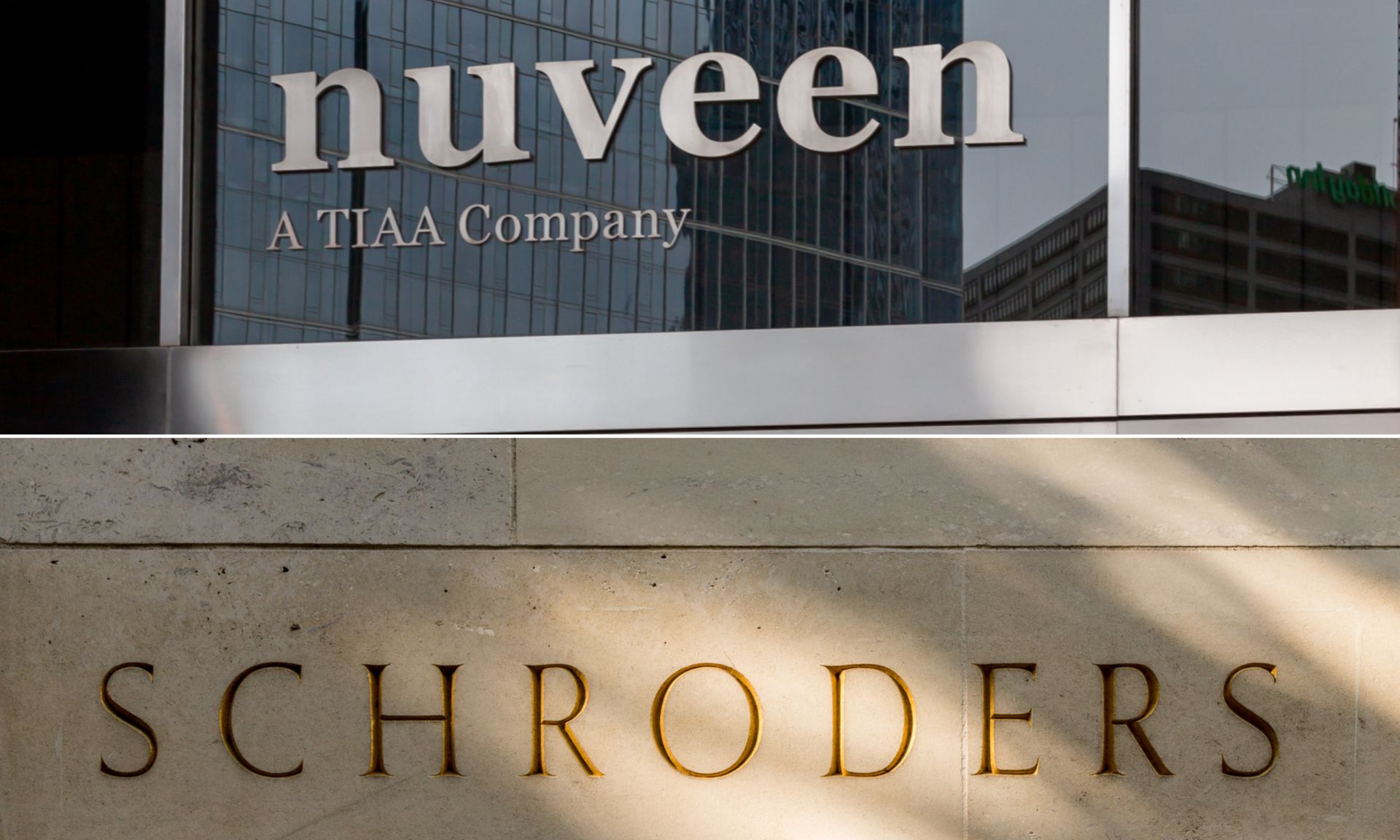
In the "things we didn't see coming" category: Nuveen, the investment management arm of TIAA, announced a $13.5 billion cash acquisition of 220-year-old British asset manager Schroders. The combined firm will manage nearly $2.5 trillion in assets, including $414 billion in private market strategies.
This matters beyond the headline because it's the latest in a rapid consolidation of asset management — and specifically, firms that straddle public and private markets. The deal includes significant private credit, real estate, and infrastructure capabilities on both sides. When firms this large are paying premium prices to bolt on private market capabilities, it signals where the industry expects growth to come from.
Schroders' board unanimously approved the deal at a 34% premium to the prior close. The Schroder family, which held a 44% stake and had controlled the business for over two centuries, backed the transaction.
For context on the consolidation theme: this follows Schwab's pending acquisition of Forge, Morgan Stanley's pending acquisition of EquityZen, and BlackRock's stated push into secondaries. The walls between public and private markets are coming down — and the firms building bridges are paying up for the privilege.
Augment CEO Noel Moldvai in The Wall Street Journal
The WSJ published a look at the surge in startup tender offers this week, and Augment CEO Noel Moldvai was among the industry voices featured. The piece reports that tender offers on Carta rose 60% in 2025, with companies from Stripe to OpenAI to SpaceX giving employees structured paths to liquidity. The trend reflects a broader cultural shift: selling private shares early is no longer seen as a lack of commitment — it's becoming standard practice as companies stay private longer and employees seek access to the wealth tied up in their equity.
Read the full story in the WSJ →
Funding Pulse

This week's notable raises across private markets.
Anthropic: $30B Series G at $380B valuation — The Anthropic fundraising train keeps rolling. We've tracked this one from $61.5B in March, to $183B in September, to the $350B figure in January — and now the company has ballooned that to a $30B Series G raise that pushes the post-money valuation to $380B. GIC and Coatue led, with Microsoft, Nvidia, D.E. Shaw, Founders Fund, and Iconiq Capital participating. The headline number: Anthropic's revenue run rate now reportedly exceeds $14 billion, up from roughly $1 billion in early 2025. That 14x revenue jump in under a year is doing a lot of the valuation work here.
Olix: $220M at $1B valuation — The UK startup developing photonic AI chips designed to avoid high-bandwidth memory constraints reached unicorn status in a round led by Hummingbird Ventures.
Garner Health: $118M at $1.35B valuation — Uses data analytics to help 2.5 million+ workers find high-quality, lower-cost physicians. Kleiner Perkins led the Series D.
Talkiatry: $210M Series D — The NYC-based psychiatric care startup raised from Perceptive Advisors, a16z, Sofina, and others. Mental health infrastructure continues to attract growth-stage capital.
Quick Take
Shopify Q4 revenue up 31% but stock drops 6%+ — Even companies beating estimates are getting punished in this environment. Since the earnings announcement on Wednesday the stock is still down but has yo-yo’d around. A reminder that market sentiment can override fundamentals in the short term, and investors seem confused on how to value SaaS infra right now.
📊 Data Point of the Day
25%+
The estimated share of companies currently classified as unicorns that may no longer be worth $1 billion, according to PitchBook's new valuation framework. The top 10 unicorns now account for roughly 52% of total unicorn value — the highest concentration in a decade. The unicorn label increasingly tells you less about a company than it used to.
🎓 Manual
Take-Private
A transaction in which a publicly traded company is acquired and delisted from stock exchanges, returning to private ownership. Typically executed by private equity firms, these deals often occur when public market valuations are depressed relative to a company's perceived intrinsic value. With software stocks trading at historically low revenue multiples, bankers expect take-private activity to increase — potentially creating future secondary market opportunities when those companies eventually return to public markets.
What We're Watching
- IPO market reset — Clear Street's suspension marks the second postponed listing in a week. If this pattern continues, companies targeting Q1 2026 listings may push timelines. That could mean more secondary market activity as employees and early investors seek alternative liquidity.
- Software valuation floor — Vista Equity's Robert Smith wrote to investors this week that the selloff is "driven primarily by sentiment, not fundamental performance." Whether the market agrees will shape private SaaS valuations for the rest of the year.
- Undercorn fallout — PitchBook's report could accelerate conversations between LPs and GPs about marking down aging unicorn positions. That kind of repricing tends to increase secondary market activity.
Augment Markets Inc. is a technology company offering software and data services. Brokerage services are offered through Augment Capital LLC, an affiliated broker-dealer and member FINRA/SIPC. Investment advisory services are offered through Augment Advisors LLC, an SEC-registered investment adviser.
Important Disclosures: This material has been prepared for informational purposes only. None of the information provided represents a recommendation, an offer or the solicitation of an offer to buy or sell any security. The information provided does not constitute investment, legal, tax, or accounting advice. You should consult with qualified professionals before making any investment decisions. Investing in private securities involves substantial risk, including the potential loss of principal. Private securities are typically illiquid, have limited pricing transparency, and often require longer holding periods. These investments are available exclusively to qualified accredited investors and offer no guarantee of returns. An IPO or other liquidity event is not guaranteed. Additionally, past performance of private securities does not indicate or predict future results. Share price data are estimates only, based on proprietary data from Caplight and Augment Markets Inc. and its affiliates.

Paul leads editorial at Augment, building Pulse into the private markets' go-to intelligence source. He also develops editorial content strategies for startups and venture capital firms. Previously, he spent 15 years as a business and opinion journalist at The New York Times, Fortune, Fast Company, Reuters, and more. He believes transparency creates liquidity—and that someone should actually publish what private shares are trading for. He lives in Marin with his wife and two rescue dogs, and wishes he had more time to surf.
Learn more