Accessing private investments requires meeting specific investor qualifications defined by the U.S. Securities and Exchange Commission (SEC). These standards exist to make sure investors understand and can bear the risks that come with private offerings.
At Augment, participation on the platform is limited to accredited investors, but some private funds or alternative products may require investors to qualify as a Qualified Client(QC) or Qualified Purchaser (QP). Each tier expands access to a broader range of private investment opportunities.
Private investments don’t offer the same disclosures, liquidity, or protections found in public markets. To prevent less experienced investors from taking on risks they may not fully understand, the SEC restricts access to those who meet certain income, net worth, or asset thresholds.
The table below summarizes the financial thresholds and qualifications for each investor category, helping you understand which private market opportunities may be available to you.
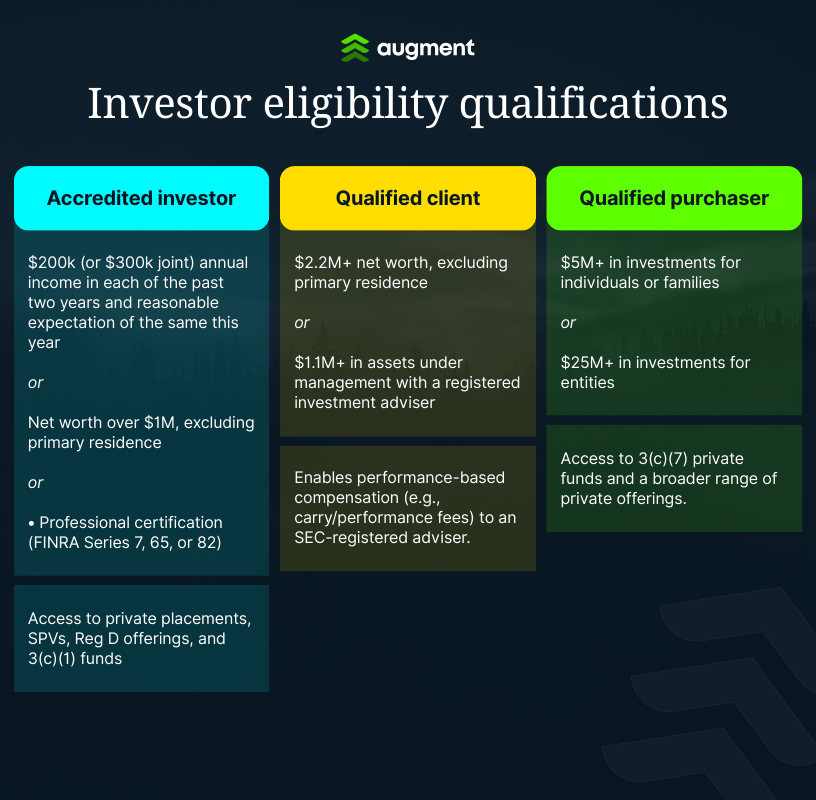
• Accredited Investor — the entry point for most individuals investing in private companies or SPVs. It opens access to offerings under Regulation D and many secondary market opportunities.
• Qualified Client — mainly relevant when working with investment advisers who charge performance-based fees. It’s not about access to new deals, but about compliance in fee structures.
• Qualified Purchaser — applies to high-net-worth individuals and entities with large investment portfolios. This tier unlocks access to 3(c)(7) private funds and institutional-level offerings.
• Qualified institutional buyer (QIB) — reserved for institutional investors such as banks, insurance companies, and asset managers that hold at least $100 million in securities. QIBs can participate in large-scale private placements and Rule 144A offerings, which are typically not available to individual investors.
The higher your designation, the greater your range of available investment opportunities, but also the more documentation required to verify your status.
Your eligibility doesn’t guarantee a specific deal, but it can determine your access to certain investment opportunities and which offerings you’re allowed to review.
If you meet one of the following pathways used to confirm accredited investor status (for example, income, net worth, or approved credentials), you’ll often see access to:
For net worth-based accreditation, it’s common to calculate eligibility excluding the value of your home—meaning your primary residence typically isn’t counted. Many verification flows will explicitly ask you to exclude amounts tied to the value of your primary residence, which is why primary residence questions come up so frequently.
Qualified Client status is most relevant when working with an investment advisor charging performance-based fees. In other words, it’s less about unlocking new deals and more about meeting regulatory requirements for certain fee arrangements.
Qualified purchaser criteria are generally tied to holdings—often described as having a million or more in investments (for individuals). Certain entities may be subject to higher thresholds, commonly referenced around 25 million. In practice, this is why many people compare accredited investors and qualified purchasers: QP status can expand access to a wider set of fund structures, particularly 3(c)(7) funds.
The higher your designation, the greater your range of available investment opportunities, but also the more documentation required to verify your status.
In practice, the conversation around qualified purchasers vs accredited investors often comes down to how private funds are structured under the Investment Company Act. Many private funds are designed to be exempt from registration, commonly relying on 3(c)(1) or 3(c)(7).
Many 3(c)(1) funds are offered to investors who are considered accredited investors. These funds generally operate with more restrictive investor count limits, which can affect how broadly a manager can raise capital and how many investors can participate over time.
3(c)(7) funds are typically limited to qualified purchasers. That’s why qualified purchasers have access to many private fund opportunities that may not be available to an accredited investor or qualified purchaser depending on the vehicle’s structure. Put simply: 3(c)(7) is often used for more institutional-style funds that can accommodate a larger investor base.
Augment’s marketplace connects accredited investors to pre-IPO opportunities in leading private companies. To invest, users must verify their accredited status through documentation or third-party verification.
In real-world private markets, verification typically happens at the platform or issuer level to align with securities laws and offering rules. That means you may be asked to confirm accredited investor status (or, for some offerings, qualified client or qualified purchaser status) before you can participate.
Common verification methods may include:
Because private offerings can have different disclosure requirements, verification expectations may vary by product. Some vehicles also require additional checks if the offering involves an affiliate relationship or other potential conflicts that investors should be able to evaluate.
While most offerings on Augment are open to accredited investors, certain collective investment vehicles or fund structures may require Qualified Client or Qualified Purchaser status. Understanding where you fall on the spectrum helps ensure smooth onboarding and regulatory compliance.
Investor definitions are periodically revisited by the SEC and other market stakeholders, especially as more investors seek diversification and access to private markets. While the core framework remains stable, future updates could affect how regulators construe eligibility pathways, what documentation is expected, and how platforms apply verification to different products.
As always, this article is for general informational purposes and not investment advice. If you’re unsure which standard applies to you—or how a specific offering defines an accredited investor or qualified purchaser—it may help to consult a qualified professional. And remember: investing involves risk, including loss of principal and illiquidity.
Securities transactions are executed on Augment Capital, LLC’s ATS and offered through Augment Capital, LLC (member FINRA/SIPC).
Important Disclosures: Investing in private securities involves substantial risk, including the potential loss of principal. Private securities are typically illiquid, have limited pricing transparency, and often require longer holding periods. These investments are available exclusively to qualified accredited investors and offer no guarantee of returns. Past performance of private securities does not indicate or predict future results.
Qualified purchaser status generally has the highest bar, typically requiring $5 million or more in investments, compared with lower income and net-worth thresholds for accredited investor status.
Funds relying on certain Investment Company Act exemptions are required to limit investors to qualified purchasers, which lets them avoid certain registration and disclosure requirements that apply to funds accepting merely accredited investors.
It's uncommon in practice since qualified client thresholds are generally set at levels that would also satisfy accredited investor tests, but the two classifications are evaluated under different regulations.
Sometimes. Certain entity-level tests look through to underlying owners, so an entity composed entirely of accredited individuals may itself qualify even if it wouldn't independently meet the asset threshold.
Platforms typically request supporting documentation, such as tax returns, brokerage statements, or professional letters, specific to whichever classification is required for a given offering.
Get started today — explore pricing, offerings, and submit your first order.
FOR QUALIFIED INSTITUTIONAL AND ACCREDITED INVESTORS ONLY: Under federal securities laws, private market investments on this platform are available exclusively to Institutional and Accredited Investors. Verification of status required before investing. Private investments involve significant risks including illiquidity, potential loss of principal, and limited disclosure requirements. "Augment" refers to Augment Markets, Inc. and its affiliates. Augment Markets, Inc. is a technology company offering software and data services, not a bank or financial institution. Cash Accounts are provided by Modern Treasury Corp. financial institution partners and through Augment's technology. Augment does not act as a money services business, provide money transmission, or serve as a custodian of funds. Funds held in your Cash Account are not FDIC insured unless expressly disclosed. Full terms available in the Augment Cash Account Agreement.Brokerage services are offered through Augment Capital, LLC, an affiliated broker-dealer and member FINRA/SIPC. “Investment accounts” are not brokerage accounts and do not hold customer funds or securities. Investment advisory services are offered through Augment Advisors, LLC, an SEC-registered investment adviser. Registration with the SEC does not imply a certain level of skill or training. Augment and its affiliates do not provide legal or tax advice; consult your attorney or tax professional regarding your specific situation. For additional information, please refer to Augment Advisors, LLC’s Form ADV Part 2A (Firm Brochure) and FINRA BrokerCheck.