For decades, private markets operated on a simple (if inconvenient) bargain: lock up your capital for a decade, wait through years of negative returns, and hope the payoff justifies the patience. Institutional investors accepted these terms because they had few alternatives. Individual investors, for the most part, were never invited to the table at all.
Evergreen funds are changing that equation. These open-ended, continuously operating vehicles have grown from a niche experiment into one of the fastest-expanding segments of asset management—approaching $500 billion in U.S. net assets as of Q3 2025, with projections to surpass $1 trillion by 2029, according to Morningstar and PitchBook. More than 200 evergreen funds have launched since 2019, and 2025 set a record for new fund creation.
The growth isn't accidental. It reflects a structural shift in how capital flows into private markets—and who gets to participate.
To understand why evergreen funds are gaining traction, it helps to understand what they're replacing—and where traditional private fund structures create friction for investors.
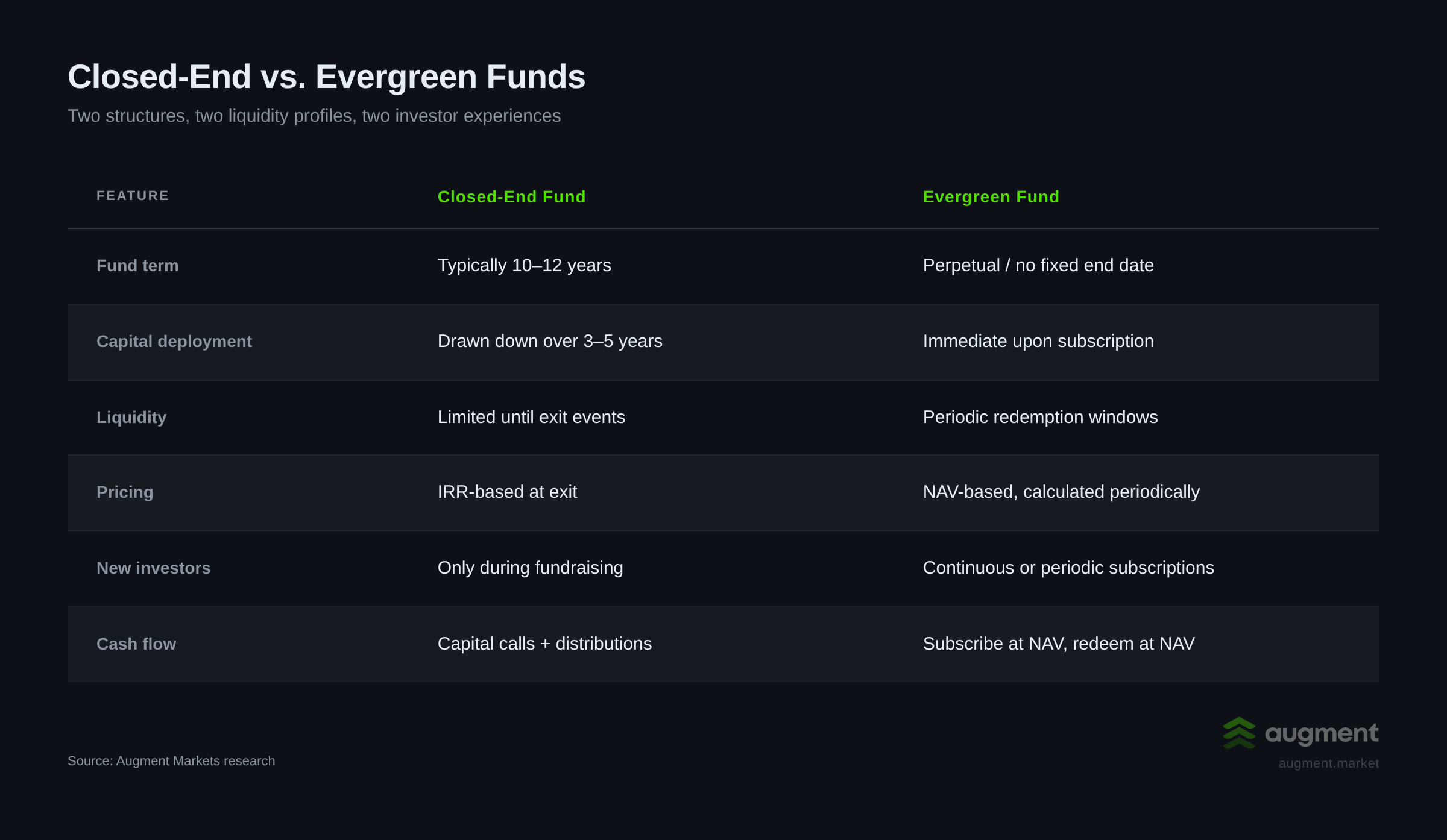
Fixed lifecycles and long lockups. Conventional closed-end private equity funds operate on fixed terms, typically 10 to 12 years. Investors commit capital upfront, the general partner draws it down over several years, deploys it into portfolio companies, and eventually returns proceeds as investments are exited. There's little flexibility to adjust course once committed. If an investor's circumstances change—or if a better opportunity appears elsewhere—the capital remains locked.
Capital calls and unpredictable cash flows. Traditional fund structures require investors to respond to capital calls on the GP's timeline, creating cash flow uncertainty. An investor might need to hold significant liquid reserves just to meet future commitments, which introduces drag on overall portfolio returns. For high-net-worth individuals and family offices managing across multiple asset classes, this unpredictability can be a meaningful operational burden.
These structural features were designed for institutional allocators with dedicated private markets teams and multi-decade time horizons. They were never built for the broader investor population now seeking private market exposure.
Demand for flexibility and smoother exposure. As private markets have matured, investors have increasingly sought structures that deliver private asset exposure without the operational complexity of traditional drawdown vehicles. Evergreen funds address this directly: investors subscribe at net asset value, gain immediate portfolio exposure, and can request redemptions at periodic intervals rather than waiting for the fund to wind down.
Growing participation from HNWIs and advisors. Wealth-focused evergreen vehicles held roughly $427 billion in AUM at the end of 2024 and are projected to grow at approximately 20% annually, potentially surpassing $1.1 trillion by the end of 2029, according to PitchBook's base-case forecast. Wealth advisors are driving much of this growth as they seek to allocate client portfolios into private assets that were previously accessible only through multimillion-dollar commitments.
The math is straightforward: the number of publicly listed U.S. companies has declined to roughly 4,500, while privately held companies continue to grow. Advisors who want to offer diversified exposure increasingly need private market tools that work within their existing workflow.
Ongoing subscriptions and redemptions. Unlike closed-end funds with a defined fundraising period, evergreen vehicles accept new capital on a continuous or periodic basis—monthly, quarterly, or semiannually depending on the fund. Investors purchase shares at the current NAV and can typically request partial or full redemptions at specified intervals, subject to the fund's liquidity terms.
Portfolio recycling instead of forced exits. In a traditional closed-end fund, the GP must exit all investments before the fund's term expires, which can lead to suboptimal timing on sales. Evergreen structures eliminate this pressure. When a portfolio company is sold, the proceeds can be recycled into new investments rather than distributed to investors. This allows GPs to compound returns over a longer horizon and avoid selling assets simply because a fund term is expiring.
Liquidity windows versus fixed fund terms. The most visible difference is liquidity. Closed-end funds typically provide no liquidity until investments are exited and proceeds distributed, which may take years. Evergreen funds offer periodic redemption windows—quarterly is common—giving investors some ability to access capital without waiting for the full fund lifecycle. However, these redemption windows are not the same as daily liquidity in a mutual fund. They come with notice periods, potential gating provisions, and capacity limits.
NAV-based pricing and valuation mechanics. Evergreen fund shares are priced based on the fund's net asset value, calculated at regular intervals. This creates a transparent pricing mechanism but also introduces valuation complexity. Private assets are inherently harder to price than publicly traded securities, and NAV calculations depend on periodic appraisals rather than real-time market pricing. The gap between appraisal-based valuations and what the market would actually pay—sometimes called "NAV lag"—is an important consideration for investors evaluating these vehicles.
The growth in evergreen fund adoption reflects more than structural convenience. These vehicles can address specific portfolio construction challenges that traditional private funds create.
Periodic redemption options. Evergreen funds provide a middle ground between the total illiquidity of a closed-end fund and the daily liquidity (and corresponding volatility) of publicly traded assets. Quarterly or semiannual redemption windows allow investors to adjust allocations over time without being subject to the daily price swings that characterize public equities and fixed income. For investors who value stability in reported returns and can tolerate modest liquidity constraints, this tradeoff may be attractive.
Reduced J-curve effects. The "J-curve" is one of the most frequently cited drawbacks of traditional private equity investing. Because closed-end funds charge fees from day one but take years to deploy capital and generate returns, investors often experience negative performance in the early years of a fund's life. Evergreen structures can mitigate this effect because investors subscribe into a portfolio that's already invested, gaining immediate exposure to mature assets alongside newer positions.
Consistent exposure to private assets. One of the practical challenges of building a private markets allocation through traditional funds is the "commitment pacing" problem: investors must continuously commit to new fund vintages to maintain a target allocation, because each fund eventually winds down. Evergreen structures simplify this by maintaining a perpetual portfolio, allowing investors to hold a steady allocation without the need to manage multiple fund commitments across vintage years.
Simplified allocation and rebalancing. For wealth advisors constructing diversified portfolios across clients, evergreen vehicles can significantly reduce the operational complexity of maintaining private market exposure. A single allocation to an evergreen fund can replace the need to manage multiple drawdown commitments, track capital calls, and reinvest distributions. This ease of use is a meaningful factor in the growth of advisor adoption.
Evergreen funds are not one-size-fits-all. Different investor segments are adopting these vehicles for different reasons, and the structures themselves vary accordingly.
Lower minimums and simplified onboarding. Many evergreen vehicles have been designed specifically for the wealth channel, with investment minimums that are meaningfully lower than traditional closed-end funds. While a conventional PE fund might require a $5 million to $25 million commitment, some evergreen funds accept subscriptions starting at $50,000 to $250,000. This lower barrier has expanded the addressable market considerably.
Wealth management integration. For individual investors working with wealth advisors, evergreen funds integrate more naturally into a broader portfolio management framework. Positions appear on consolidated statements, NAV updates are reported at regular intervals, and the subscription/redemption process more closely resembles familiar investment experiences. These may seem like operational details, but they've been significant barriers to broader private market participation historically.
Evergreen sleeves within larger private programs. Institutional investors aren't abandoning traditional drawdown funds, but many are adding evergreen allocations as a complementary exposure. Some use evergreen vehicles to maintain baseline private market exposure while closed-end commitments are being deployed, effectively reducing the cash drag that comes from uninvested capital waiting to be called.
Use in long-term strategic allocations. For investors with truly long-term horizons—endowments, pension funds, sovereign wealth funds—the perpetual nature of evergreen structures can align well with perpetual investment mandates. Rather than continuously re-upping into new fund vintages, these allocators can maintain exposure through a single vehicle that compounds returns over time.
The growth of evergreen funds has generated warranted enthusiasm, but these vehicles carry risks and structural complexities that deserve careful consideration. Flexibility comes with trade-offs.
Mismatch between assets and investor flows. The fundamental tension in any evergreen fund is the mismatch between the illiquidity of underlying private assets and the periodic liquidity offered to investors. If many investors request redemptions simultaneously—during a market downturn, for example—the fund may not be able to sell assets quickly enough to meet all requests. This is the scenario that leads to redemption gating, where the fund limits the amount investors can withdraw in a given period.
Importance of fund design discipline. Not all evergreen funds manage this risk equally. The size and composition of a fund's liquidity sleeve (the portion held in cash and liquid instruments to meet redemptions) directly affects both its ability to honor redemption requests and its investment performance. A larger liquidity sleeve provides a bigger buffer against redemption pressure but creates more cash drag on returns. Investors should understand a fund's liquidity management framework before committing capital.
NAV lag and appraisal risk. Because private assets are valued through periodic appraisals rather than real-time market pricing, the reported NAV of an evergreen fund may not reflect current market conditions. During periods of rapid market movement—either up or down—the gap between appraised values and realizable values can be significant. This means investors who subscribe during a downturn may be buying at stale (and potentially above-market) valuations, while those who redeem during a rally may leave value on the table.
Manager discretion and oversight. Evergreen funds give managers broad discretion over portfolio construction, recycling decisions, and liquidity management. Without the natural discipline of a fixed fund term (which forces eventual liquidation and return of capital), investors rely more heavily on manager governance and oversight. Fee structures also warrant scrutiny: management fees based on NAV, combined with incentive fees on both realized and unrealized gains, can compound over the fund's perpetual life in ways that may differ from traditional closed-end fee arrangements. As of Q3 2025, semiliquid funds averaged annual net expense ratios exceeding 3%, compared with under 1% for most public market vehicles.
Beyond their investment mechanics, evergreen funds represent a broader structural shift in who can participate in private markets—and how efficiently capital moves within them.
Broader participation beyond institutions. The combination of lower minimums, simplified operations, and periodic liquidity has meaningfully expanded the private markets investor base. Historically, private equity participation was concentrated among institutional allocators and ultra-high-net-worth individuals with the resources to manage complex fund structures. Evergreen vehicles are pulling this boundary outward, enabling accredited investors and their advisors to build private market allocations with operational simplicity closer to what they're accustomed to in public markets.
Digital platforms enabling scale. Technology infrastructure is a meaningful enabler of evergreen fund growth. Digital platforms now handle subscription processing, NAV reporting, and redemption management at scale—operational capabilities that would have been prohibitively expensive for most GPs even a decade ago. This infrastructure is reducing the cost of serving a larger number of smaller investors, which further supports the democratization trend.
Portfolio-level flexibility. The growth of the secondary market has been a key enabler of evergreen fund structures. Secondary transactions—where investors buy and sell existing positions in private funds—provide an additional liquidity mechanism beyond the fund's own redemption windows. For evergreen fund managers, the ability to sell portfolio positions on the secondary market adds a tool for managing liquidity and portfolio composition.
Secondary deal volume reached a record $226 billion in 2025, according to Evercore, reflecting the increasing maturity and depth of this market. That growth benefits evergreen fund investors both directly (through manager flexibility) and indirectly (through the broader price discovery and liquidity that a healthy secondary market provides).
Price discovery and exit optionality. A robust secondary market also contributes to better pricing transparency for private assets. When fund interests and direct positions trade regularly on the secondary market, it creates data points that complement appraisal-based valuations. This can help reduce the NAV lag problem discussed earlier and give investors more confidence in the reported value of their holdings.
For investors who want additional flexibility beyond an evergreen fund's built-in redemption windows, the secondary market offers a potential avenue to adjust positions—or to acquire exposure to funds that may no longer be accepting new subscriptions through their primary channel.
The rise of evergreen funds and the growth of secondary markets are two sides of the same trend: private markets are becoming more accessible, more transparent, and more liquid than at any point in their history.
Evergreen structures require smart liquidity management. As more capital flows into perpetual vehicles, the importance of thoughtful liquidity design increases. Investors benefit from understanding how their funds manage the tension between staying fully invested and honoring redemption requests—and from having options when fund-level liquidity doesn't align with their own needs.
Secondary access helps investors stay flexible. For investors holding positions in private companies—whether through evergreen funds, traditional fund structures, or direct holdings—the private stock marketplace provides a mechanism for managing liquidity on their own timeline. Secondary markets complement evergreen structures by adding another layer of exit optionality that doesn't depend on the fund manager's redemption schedule.
Augment supports transparency and efficient private market participation. The same information asymmetry that limited private market access historically also made secondary trading unnecessarily opaque. Pre-IPO investment platforms like Augment are working to change that by providing price transparency, streamlined execution, and access to shares in top pre-IPO companies that were previously available only through insider networks.
Programmatic liquidity complements long-term evergreen strategies. As the private markets ecosystem matures, the distinction between "primary" and "secondary" is becoming less relevant. What matters is whether investors have access to the tools and information they need to manage their private market exposure intelligently. Evergreen funds represent one important evolution. Transparent, efficient secondary markets represent another. Together, they're making private markets work better for a broader range of participants.
Augment Markets, Inc. is a technology company offering software and data services with securities-related services offered through its wholly-owned but separately managed subsidiary Augment Capital, LLC, Member of FINRA/ SIPC.
Important Disclosures: This material has been prepared for informational purposes only. None of the information provided represents an offer or the solicitation of an offer to buy or sell any security. The information provided does not constitute investment, legal, tax, or accounting advice. You should consult with qualified professionals before making any investment decisions. Investing in private securities involves substantial risk, including the potential loss of principal. Private securities are typically illiquid, have limited pricing transparency, and often require longer holding periods. These investments are available exclusively to qualified accredited investors and offer no guarantee of returns. Additionally, past performance of private securities does not indicate or predict future results.
Evergreen funds typically offer periodic redemption windows, often quarterly, giving investors some path to liquidity, whereas closed-end funds usually lock capital until the fund's full term ends.
No. Evergreen funds are structured to continue indefinitely, recycling capital and reinvesting proceeds rather than winding down after a fixed 10-year-style term.
Yes. Most evergreen structures include gates that cap the percentage of assets redeemable in a given period, protecting remaining investors if redemption requests spike.
Evergreen fund NAV is typically calculated periodically by the manager based on underlying valuations, while direct secondary pricing reflects real-time negotiated transactions, so the two can diverge, especially in volatile periods.
Growing retail and individual investor demand for private market access, combined with fewer traditional exits like IPOs, has pushed managers toward structures offering more flexibility than the classic closed-end model.
Get started today — explore pricing, offerings, and submit your first order.
FOR QUALIFIED INSTITUTIONAL AND ACCREDITED INVESTORS ONLY: Under federal securities laws, private market investments on this platform are available exclusively to Institutional and Accredited Investors. Verification of status required before investing. Private investments involve significant risks including illiquidity, potential loss of principal, and limited disclosure requirements. "Augment" refers to Augment Markets, Inc. and its affiliates. Augment Markets, Inc. is a technology company offering software and data services, not a bank or financial institution. Cash Accounts are provided by Modern Treasury Corp. financial institution partners and through Augment's technology. Augment does not act as a money services business, provide money transmission, or serve as a custodian of funds. Funds held in your Cash Account are not FDIC insured unless expressly disclosed. Full terms available in the Augment Cash Account Agreement.Brokerage services are offered through Augment Capital, LLC, an affiliated broker-dealer and member FINRA/SIPC. “Investment accounts” are not brokerage accounts and do not hold customer funds or securities. Investment advisory services are offered through Augment Advisors, LLC, an SEC-registered investment adviser. Registration with the SEC does not imply a certain level of skill or training. Augment and its affiliates do not provide legal or tax advice; consult your attorney or tax professional regarding your specific situation. For additional information, please refer to Augment Advisors, LLC’s Form ADV Part 2A (Firm Brochure) and FINRA BrokerCheck.