The $1 trillion question hanging over private markets





This Week in Private Markets
The growing push to "retailize" private markets got a reality check this week—and a new product launch—within 48 hours of each other.
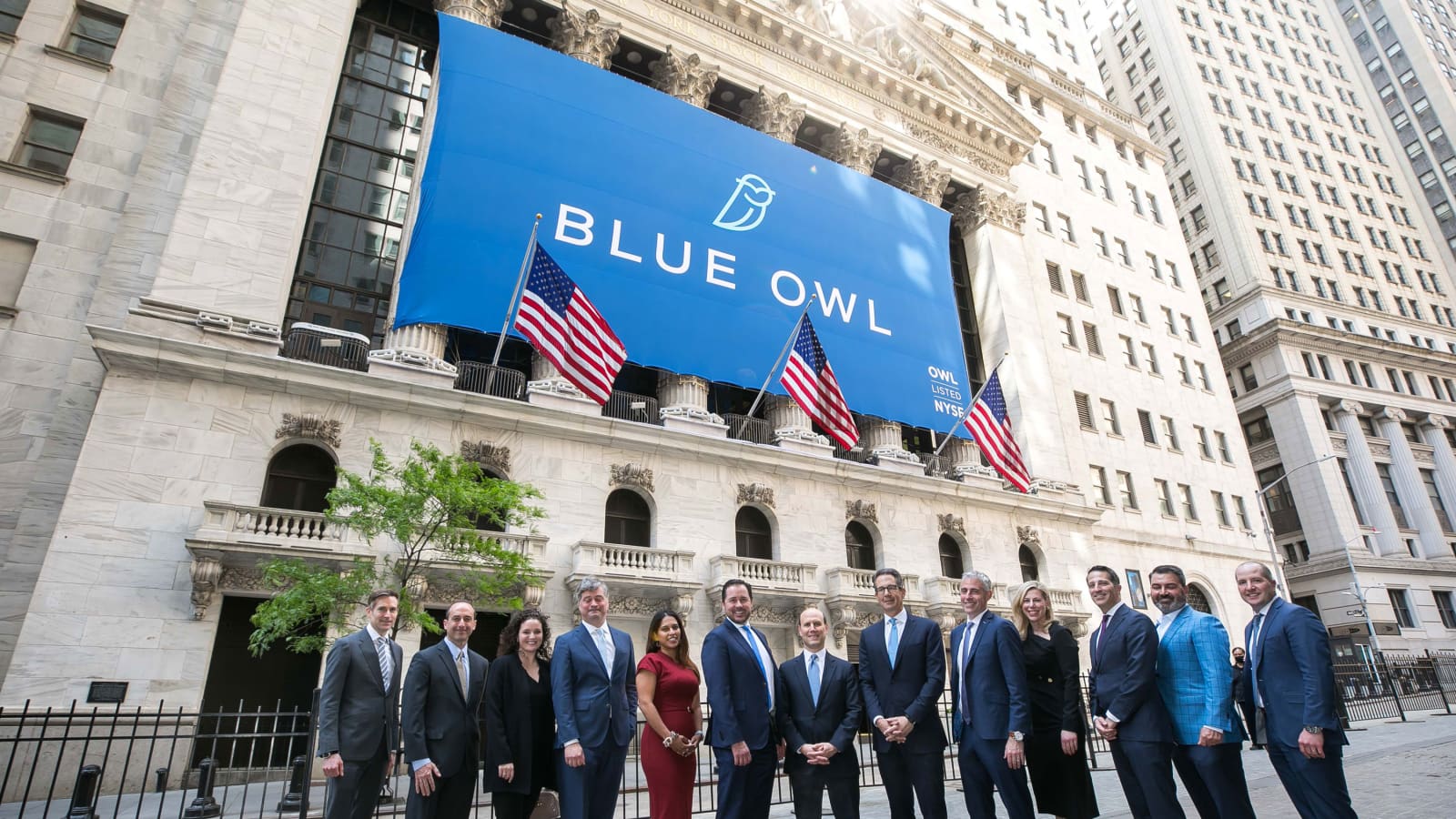
On Wednesday, Blue Owl Capital permanently halted investor redemptions from one of its retail-focused private credit funds, reversing earlier plans to resume quarterly buybacks. The firm sold $1.4 billion in loans across three funds to generate capital for payouts, but the shift from optional redemptions to scheduled distributions underscored a fundamental tension: private assets don't become liquid just because retail investors want them to be.
Blue Owl shares fell roughly 10% on Thursday, dragging Apollo, Blackstone, KKR, and TPG down with them. Former PIMCO CEO Mohamed El-Erian publicly asked whether this was a "canary in the coalmine" for the economy. (After its stock plunged, the firm issued a damage control statement on Thursday, arguing its new redemption scheme is actually returning capital faster than before.)
Meanwhile, Robinhood announced its Ventures Fund I (RVI), a closed-end fund expected to IPO at $25/share on the NYSE on February 26. The fund holds stakes in Databricks, Revolut, Oura, and Ramp, with an agreement to add Stripe post-listing. No accreditation required. No investment minimums. Goldman Sachs is leading the offering.
These two stories sit on a spectrum of approaches to the same structural question: how do you give individual investors access to private markets without the liquidity mismatches that have plagued institutional vehicles?
Semi-liquid funds like Blue Owl's promise periodic redemptions but can restrict them when conditions tighten—as investors just learned. (To be clear, mega-sized alternative asset managers operate in a very different market than marketplaces that facilitate investments in tech startups.)
Meanwhile, closed-end funds that contain private stock, like Robinhood's RVI trade on public exchanges, giving investors daily liquidity through the market price, though that price can diverge significantly from the value of underlying assets.
Secondary market platforms offer a third path: direct buying and selling of individual private company shares, where price discovery happens in real time between willing buyers and sellers.
Each model involves tradeoffs around liquidity, pricing transparency, and access. But the Blue Owl episode is a reminder that the structure matters as much as the assets inside it. The investors who fared worst weren't the ones holding illiquid assets—they were the ones holding illiquid assets inside a vehicle that implied they could leave whenever they wanted.
The Big Story: Nvidia Finalizes $30B OpenAI Investment
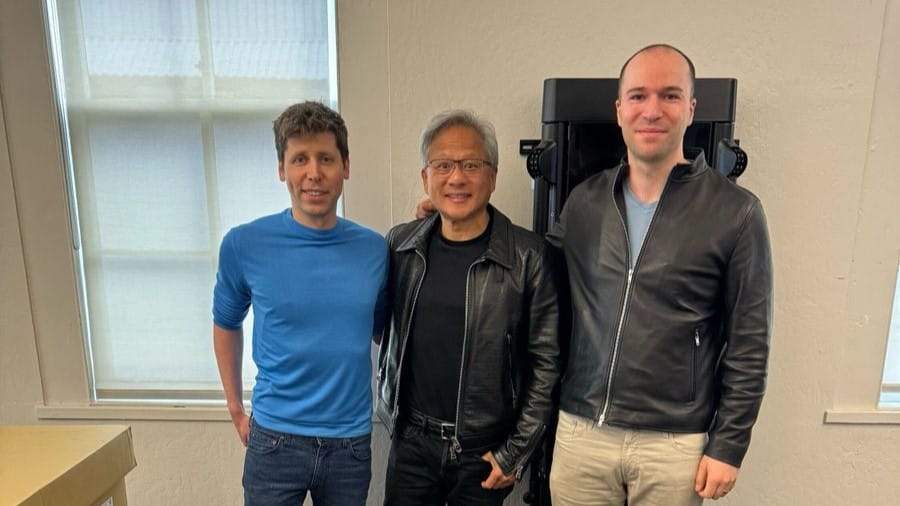
Nvidia is reportedly close to finalizing a $30 billion equity investment in OpenAI as part of a funding round that could value the AI company at approximately $830 billion. The deal could close as soon as this weekend.
This is a significant restructuring of the relationship between the two companies. Last September, Nvidia announced plans to invest up to $100 billion in OpenAI tied to deploying 10 gigawatts of computing infrastructure. That deal stalled after Nvidia CEO Jensen Huang raised concerns about OpenAI's cash burn and business model, while critics flagged "circular financing"—OpenAI raising capital from Nvidia, then spending it on Nvidia hardware.
The new structure converts the relationship from an infrastructure commitment to a direct equity stake, which reduces Nvidia's balance sheet risk while preserving its position as a core OpenAI stakeholder. OpenAI reportedly plans to reinvest much of the capital into Nvidia hardware regardless.
For private market investors tracking the AI capital cycle, this matters because it signals a shift from open-ended infrastructure commitments to more conventional venture-style equity investments. The circular financing concern hasn't gone away, but a $30B equity check is more legible to the market than a $100B infrastructure pledge with unclear terms.
The SaaS-pocalypse Has a Comms Problem

Roughly $1 trillion in software market capitalization has been wiped out since mid-January. But as comms veteran Jim Prosser pointed out in his Person Familiar newsletter this week, earnings have actually been solid. Companies are hitting their numbers. This isn't a business crisis—it's a narrative crisis.
Prosser identified a pattern among SaaS CEOs that's worth understanding for anyone tracking private software valuations. Most are running the 2023 playbook: launch an AI product, cite adoption metrics, declare themselves a platform, announce a buyback. The market isn't buying it. ServiceNow delivered a beat-and-raise quarter and still dropped 10%. Morgan Stanley's assessment was blunt: stable growth "likely falls short of shifting the narrative."
Figma's Dylan Field stood out as the exception. After an 80%-plus decline from its post-IPO high, Field reported 40% revenue growth and guided above expectations—but more importantly, he engaged with the existential AI threat directly rather than deflecting it, arguing that as AI output improves, teams will do more design, not less, and Figma benefits from that dynamic. He also announced usage-based credit pricing to address seat compression fears. In response, the stock surged 15-18% after hours and held onto roughly half those gains in the next trading day.
Private market investors should pay attention. If public SaaS companies are being repriced on narrative rather than fundamentals, that repricing is coming for private software portfolios too. Apollo reportedly cut its direct lending funds' software exposure by nearly half in 2025. Blue Owl's loan sales this week were 13% software and services. The companies that can articulate a clear thesis for why AI makes them more valuable—not less—will be the ones that hold their valuations.
Funding Pulse

World Labs: $1B for spatial intelligence. AI pioneer Fei-Fei Li's startup raised $1 billion from Nvidia, AMD, Autodesk, Fidelity, and Emerson Collective. World Labs is building "large world models" that enable AI to perceive and reason about 3D environments—a fundamentally different approach from the text-and-image models dominating the current AI cycle. The company's first product, Marble, generates interactive 3D worlds from text or image prompts. Bloomberg previously reported funding discussions at a valuation of approximately $5 billion. Li, whose work on ImageNet helped catalyze the modern deep learning era, is positioning spatial intelligence as the foundation for robotics, scientific discovery, and augmented reality. Read the full article on Bloomberg
Battery Ventures: $3.25B Fund XV. The 43-year-old Boston VC firm closed its fifteenth fund, with approximately 80% of capital from existing LPs. Battery invests across software, AI, infrastructure, industrial tech, and life sciences.
Vestwell: $385M at $2B valuation. The digital savings platform raised from Blue Owl Capital and Sixth Street Growth to scale retirement, education, and emergency savings programs. Total funding now stands at $660 million.
Heron Power: $140M Series B. Andreessen Horowitz and Breakthrough Energy Ventures co-led a round for the solid-state transformer maker serving data centers, solar installations, and grid-scale batteries.
Quick Takes

SpaceX/xAI combined entity valued at $1.25T after merger closes — The largest M&A deal in history. Musk cited orbital data centers as the strategic rationale. The combined company is preparing for what could be the largest IPO ever, with reports targeting a June listing.
Axios: Can public markets absorb three trillion-dollar IPOs? — OpenAI, Anthropic, and SpaceX/xAI have all been reported as preparing to go public as early as this year. Investors are already cycling out of sectors over AI disruption fears, and the capital reallocation could ripple through AI proxy companies.
Klarna reports Q4 revenue up 38% to $1.08B, net loss of $26M — The BNPL company's stock is down roughly 24% from its September IPO price. CEO Sebastian Siemiatkowski said the company expects to shrink from 3,000 to under 2,000 employees by 2030, attributing much of the reduction to AI.
eBay acquiring Depop from Etsy for $1.2B — Etsy paid $1.62 billion for the secondhand fashion marketplace in 2021. Depop brings 7 million active buyers and roughly $1 billion in 2025 gross merchandise sales to eBay. In a rare win-win, both stocks rallied on the news.
📊 Data Point of the Day
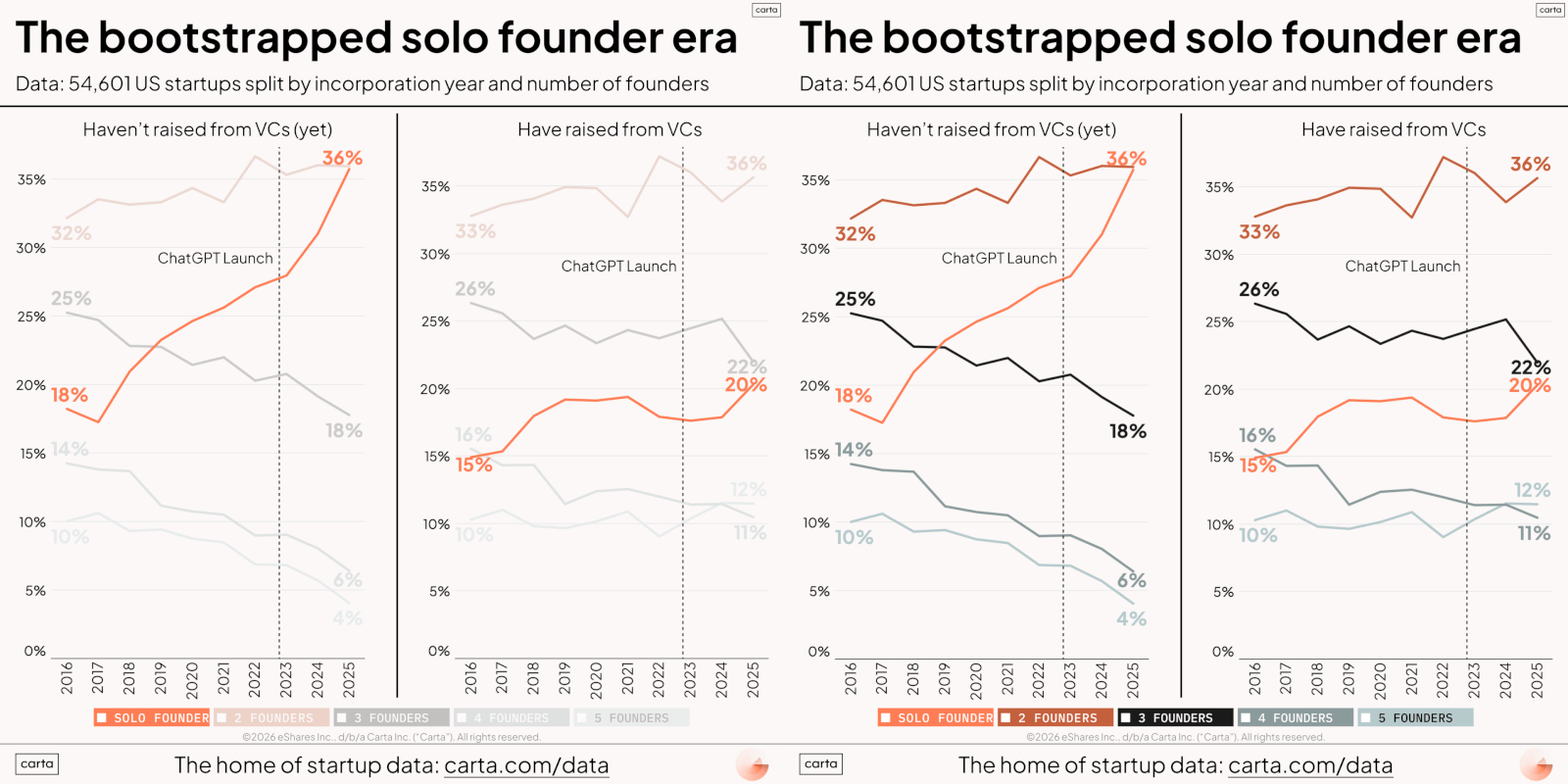
36%
The share of new companies on Carta run by solo founders in 2025—double the 18% rate in 2016, per Carta's Head of Insights, Peter Walker. The acceleration has been sharp since ChatGPT's launch, as AI tools lower the barriers to company formation. The caveat: VCs remain more skeptical of solo founders. Only about 20% of VC-backed companies on Carta are solo-founded, even as the broader trend surges. The gap between company creation and venture funding suggests a growing population of bootstrapped, AI-enabled startups that may eventually seek secondary market liquidity rather than traditional VC paths.
🎓 Manual
Closed-End Fund (CEF)
A publicly traded investment fund that raises capital through an IPO and then trades on an exchange like a stock. Unlike mutual funds or ETFs, CEFs do not continuously issue or redeem shares, meaning the market price can trade at a premium or discount to the underlying net asset value. Robinhood's new Ventures Fund I is structured as a CEF—giving retail investors daily liquidity through exchange trading, even though the underlying private company shares are illiquid.
What We're Watching
- Blue Owl fallout — Whether the redemption halt triggers similar moves at other semi-liquid private credit vehicles marketed to retail investors. Redemption requests at Blue Owl's tech-focused fund hit 15% of NAV last quarter.
- OpenAI mega-round — The reported $100B+ round with Nvidia, SoftBank, Amazon, and Microsoft participation would be the largest private funding in history. How the circular financing dynamics are structured will matter.
- The SaaS repricing in private markets — Public software stocks have lost roughly $2 trillion since October. Private software valuations have lagged that adjustment. The Blue Owl loan sales and Apollo's portfolio repositioning suggest the correction is beginning.
Augment Markets Inc. is a technology company offering software and data services. Brokerage services are offered through Augment Capital LLC, an affiliated broker-dealer and member FINRA/SIPC. Investment advisory services are offered through Augment Advisors LLC, an SEC-registered investment adviser.
Important Disclosures: This material has been prepared for informational purposes only. None of the information provided represents a recommendation, an offer or the solicitation of an offer to buy or sell any security. The information provided does not constitute investment, legal, tax, or accounting advice. You should consult with qualified professionals before making any investment decisions. Investing in private securities involves substantial risk, including the potential loss of principal. Private securities are typically illiquid, have limited pricing transparency, and often require longer holding periods. These investments are available exclusively to qualified accredited investors and offer no guarantee of returns. An IPO or other liquidity event is not guaranteed. Additionally, past performance of private securities does not indicate or predict future results. Share price data are estimates only, based on proprietary data from Caplight and Augment Markets Inc. and its affiliates.

Paul leads editorial at Augment, building Pulse into the private markets' go-to intelligence source. He also develops editorial content strategies for startups and venture capital firms. Previously, he spent 15 years as a business and opinion journalist at The New York Times, Fortune, Fast Company, Reuters, and more. He believes transparency creates liquidity—and that someone should actually publish what private shares are trading for. He lives in Marin with his wife and two rescue dogs, and wishes he had more time to surf.
Learn more