




This Week in Private Markets

Something shifted this week. Not in the data—in the narrative.
Block cut roughly half its workforce and the stock had its best day in years. Nvidia reported a 73% revenue surge and the stock fell 5.5%. CoreWeave posted earnings that put the entire AI infrastructure financing model under scrutiny. And the week's biggest venture rounds went to autonomous trucks, AI accounting agents, and robotics data infrastructure—not chatbots.
The market is telling us something: the "build AI" phase is giving way to the "deploy AI" phase. Companies that can show AI translating into operating leverage are being rewarded. Companies still promising future returns—even spectacular ones—are being questioned.
For private market investors, this distinction matters. The next wave of IPOs will be priced not on what AI might do, but on what it's already doing to margins, headcount, and revenue per employee.
The Big Story: Block's 4,000-Person Layoff Is a Preview of What's Coming

Block laid off more than 4,000 employees on Wednesday—roughly 40% of its workforce—in what CEO Jack Dorsey described as a transformation into an "intelligence-native" company. The stock surged 24% in after-hours trading.
This wasn't a distress signal. Block reported Q4 gross profit up 24% year-over-year and raised its 2026 guidance to $12.2 billion. The company is producing more with dramatically fewer people. Dorsey was blunt about the implications: "The majority of companies will reach the same conclusion within the next year."
Why this is the private markets story of the week:
The Block move reframes how investors should think about AI-driven operating leverage. It's one thing when an early-stage startup builds lean. It's another when a public company with 10,000+ employees demonstrates that AI can replace roughly half of them while simultaneously raising revenue guidance.
For late-stage private companies approaching IPO, the calculus just changed. Public market investors will increasingly benchmark companies not just on revenue growth, but on revenue-per-employee—a metric that Block just redefined. Pre-IPO companies that can demonstrate similar AI-driven efficiency gains have a new proof point to reference. Those that can't will face harder questions about headcount and margins.
The software sector, already down 23% year-to-date on fears of AI disruption, now has a concrete case study. Block isn't theorizing about AI replacing knowledge work. It's executing on it—and the market is applauding.
The second-order effect: If Dorsey is right that most companies will reach the same conclusion within a year, the implications for talent markets, commercial real estate, and enterprise software spending are enormous. Every SaaS company selling per-seat licenses to companies that are about to halve their seat count should be paying very close attention.
OpenAI's New Math: $280B Revenue, $600B Spend, $110B Raise

Two disclosures from OpenAI this week reshape how investors should evaluate the company.
First, Bloomberg reported that OpenAI is now projecting revenue exceeding $280 billion by 2030. CFO Sarah Friar confirmed the company's annualized revenue topped $20 billion in 2025, up from roughly $6 billion the prior year. CNBC reported OpenAI generated $13.1 billion in actual 2025 revenue (beating its $10 billion target) while burning $8 billion (below target).
Second, OpenAI told investors it now plans to spend roughly $600 billion on compute by 2030—a significant walk-back from the $1.4 trillion in infrastructure commitments CEO Sam Altman had previously announced. The recalibration signals that OpenAI is taking investor concerns about capital efficiency seriously, even as it pursues the largest private funding round in history.
That round is now complete. Reports are that Nvidia made a roughly $30 billion investment, SoftBank approximately $30 billion, Amazon $20 billion+, and Microsoft around $10 billion at a pre-money valuation of approximately $730 billion.
ChatGPT now supports more than 900 million weekly active users. Codex, OpenAI's coding tool, has surpassed 1.5 million weekly active users—putting it in direct competition with Anthropic's Claude Code, which recently disclosed $2.5 billion in annualized revenue.
OpenAI has also begun testing ads in ChatGPT's free tier, with minimum advertiser commitments of $200,000. Premium subscriptions remain ad-free. The advertising layer, if it scales, would represent an entirely new revenue stream beyond subscriptions and API usage.
The Nvidia Paradox: Why the Best Quarter Ever Wasn't Enoughng Pulse

Nvidia reported Q4 revenue of $66 billion—up 73% year-over-year—with data center revenue accounting for over half. The company guided strong for Q1. By any historical standard, a spectacular quarter.
The stock fell 5.5%, its biggest single-day decline since April, and continued to fall today.
JPMorgan analysts identified a contradiction in current market sentiment that's worth understanding: investors simultaneously fear that AI will destroy the entire software industry, and that hyperscaler AI spending won't pay off. Both can't be true. If AI is potent enough to displace software companies (which it appears to be, per Block), then the infrastructure spending fueling it is rational.
Jensen Huang addressed the software selloff directly, arguing markets "got it wrong" on the AI threat to SaaS companies.
The private markets read-through:
Hyperscaler capex is now projected to approach $650-700 billion in 2026—up roughly 60% from 2025. That spending is the oxygen supply for OpenAI, Anthropic, CoreWeave, and the entire AI infrastructure stack.
But the Nvidia reaction sends a clear signal to private companies planning IPOs: "beat and raise" is no longer sufficient. The market wants visibility into how revenue converts to durable profit. That standard—not just growth at any cost—is what Databricks, Anthropic, and every other AI company heading toward public markets will be measured against.
Funding Pulse: Where Capital Flowed This Week
The week's most notable venture rounds share a pattern: capital is moving from "AI that talks" to "AI that does."
Wayve: $1.2B Series D for autonomous driving — The London-based self-driving startup raised $1.2 billion (up to $1.5B including milestone payments from Uber) from Mercedes-Benz, Stellantis, Nissan, Nvidia, Microsoft, and Uber, valuing the company at $8.6 billion. Wayve plans to deploy Uber robotaxis beginning in London this year. Founder Alex Kendall told TechCrunch the company took a "contrarian" approach—end-to-end deep learning that doesn't require HD maps, just data. Three automakers investing alongside two tech giants in a single round suggests autonomous driving is entering a commercialization phase, not just a research one.
MatX: $500M Series B for AI training chips — Led by Jane Street and Situational Awareness, with Marvell and the Stripe co-founders (Patrick and John Collison) among investors. MatX claims roughly 10× GPU performance for LLM training—a bold claim backed by serious money from a trading firm that would know. The Nvidia alternatives category is attracting capital at a pace that would have been unthinkable 18 months ago.
Anthropic: $5-6B employee secondary at $350B valuation — Bloomberg reported that Anthropic is organizing a $5 billion to $6 billion secondary sale for employees, valuing the company at $350 billion. This is one of the largest private company secondary transactions ever attempted—and it's happening on a platform-like scale. For context, Anthropic's annualized revenue recently climbed to $14 billion, with Claude Code alone generating $2.5 billion in annualized revenue. Employee secondaries at this scale signal that Anthropic is choosing structured liquidity over an IPO, at least for now.
Basis: $100M Series B at $1.15B valuation — The AI accounting platform raised $100 million led by Accel and GV, reaching unicorn status. Roughly 30% of the top 25 accounting firms already use its AI agents, reporting 20-50% efficiency gains. Former Goldman Sachs CEO Lloyd Blankfein also invested. The Block parallel is hard to miss: AI agents replacing professional services headcount, not just augmenting it.
Profound: $96M Series C at $1B valuation — Led by Lightspeed, with Sequoia, Kleiner Perkins, and Saga VC participating. Profound helps brands measure and influence how they appear in AI search and recommendation systems—a category that barely existed a year ago. As more consumers discover products through ChatGPT and Perplexity rather than Google, this is becoming critical marketing infrastructure. The 18-month-old company has now raised more than $155 million total.
Gambit Security: $61M seed for cyber resilience — Backed by Spark Capital, Kleiner Perkins, and Cyberstarts. The Tel Aviv-based startup builds AI-powered systems that help businesses stay operational during cyberattacks—not just detect threats, but maintain continuity through them. At $61 million, this is one of the largest seed rounds of the year, reflecting investor conviction that cybersecurity is shifting from prevention to resilience.
Rowspace: $50M Series A for financial AI — Co-led by Sequoia and Emergence Capital, with Stripe (the company, not the founders) also investing. Rowspace builds an AI analytics layer on top of proprietary data for private equity firms, hedge funds, and financial institutions—turning messy internal data into investment insights. The investor list reads like a who's who of enterprise infrastructure backers.
The pattern: The biggest capital movement of the week was Anthropic's employee secondary—up to $6 billion in structured liquidity without an IPO. The primary rounds split between custom AI chips (MatX), autonomous systems (Wayve), and a new category worth watching: AI agents that replace or augment specific professional functions—accounting (Basis), brand management (Profound), financial analysis (Rowspace), and cyber operations (Gambit). Capital is following deployment, not development.
Quick Takes
AI selloff stalls 2026 IPO pipeline — The Wall Street Journal reports that an AI-driven tech selloff has forced private equity-backed software firms to pull or delay offerings. Roughly 75% of 2025's tech IPOs now trade below their issue price, and the class is down 18% overall. For private market investors, this is the backdrop against which every IPO-bound company is making its timing decision.
SpaceX mega-IPO expected to crowd out smaller listings — Bloomberg reports SpaceX's planned IPO, which could raise up to $50 billion, is expected to absorb so much investor attention that PE-backed firms are racing to avoid competing with it. The gravitational pull of a single listing reshaping the entire IPO calendar is unprecedented.
CoreWeave Q4: wider loss, stock drops 8-13% after hours — Revenue of $1.57B roughly in line, but the 89-cent loss (vs. 72-cent estimate) and surging capex spooked investors already nervous about AI infrastructure debt loads. The company carries roughly $19 billion in debt against a $56 billion backlog.
Anthropic acquires Vercept, a desktop AI agent startup — The two-year-old Seattle startup built an AI desktop agent called Vy that observes screens and automates repetitive tasks. The acquisition signals Anthropic's push beyond chat interfaces toward agentic AI that can operate computer workflows autonomously.
TechCrunch: 17 U.S. AI startups have raised $100M+ in 2026 so far — And it's only February. U.S. AI startups raised more than $76 billion through mega-rounds in 2025. The 2026 pace suggests another record year.
📊 Data Point of the Day
$650-700 billion
Projected combined capex from the four major hyperscalers (Alphabet, Amazon, Meta, Microsoft) in 2026—up roughly 60% from 2025. That figure is the single most important demand signal for the AI private company ecosystem. It funds OpenAI's inference costs, Anthropic's compute expansion, CoreWeave's data center buildout, and the chip startups raising hundreds of millions this week. Nvidia's best quarter ever was built on it. The question is no longer whether the money is being spent—it's whether the returns will justify the investment.
🎓 Manual
Revenue Per Employee (RPE)
A metric measuring a company's total revenue divided by its headcount, increasingly used by investors to evaluate AI-driven operating leverage. Block's layoffs this week brought its workforce from roughly 10,200 to approximately 6,000 while simultaneously raising revenue guidance—dramatically improving its RPE. For pre-IPO companies, RPE is becoming a critical benchmark. Anthropic generates roughly $14 billion in annualized revenue with approximately 1,500 employees (~$9.3M RPE). Databricks produces $4.8 billion with roughly 7,000 employees (~$686K RPE). As public market investors reward AI-driven efficiency, expect RPE to feature prominently in every major tech IPO prospectus this year.
What We're Watching
- The Block ripple effect. Dorsey predicted most companies will reach the same conclusion about AI-driven headcount reduction within a year. If even a fraction of tech companies follow, the implications for enterprise software (per-seat pricing), commercial real estate (office demand), and labor markets are significant.
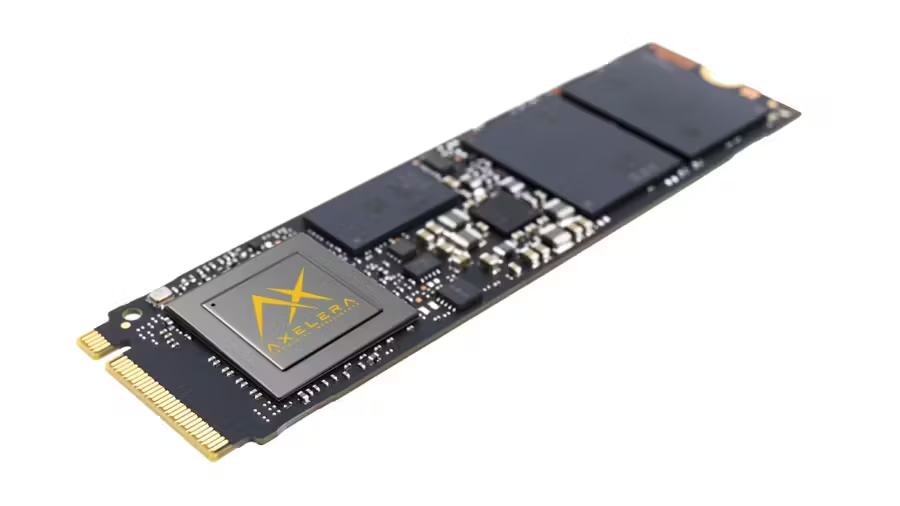
- Custom AI chip proliferation. MatX ($500M), SambaNova ($350M), and Axelera ($250M) all raised this week—totaling over $1 billion for Nvidia alternatives in a single week. As inference becomes the dominant AI workload, the chip landscape is fragmenting fast.
- OpenAI's $110B round. It’s the largest private funding round in history by a wide margin. The investor syndicate (Nvidia, SoftBank, Amazon, Microsoft) reads more like a strategic alliance than a venture round.
Augment Markets Inc. is a technology company offering software and data services. Brokerage services are offered through Augment Capital LLC, an affiliated broker-dealer and member FINRA/SIPC. Investment advisory services are offered through Augment Advisors LLC, an SEC-registered investment adviser.
Important Disclosures: This material has been prepared for informational purposes only. None of the information provided represents a recommendation, an offer or the solicitation of an offer to buy or sell any security. The information provided does not constitute investment, legal, tax, or accounting advice. You should consult with qualified professionals before making any investment decisions. Investing in private securities involves substantial risk, including the potential loss of principal. Private securities are typically illiquid, have limited pricing transparency, and often require longer holding periods. These investments are available exclusively to qualified accredited investors and offer no guarantee of returns. An IPO or other liquidity event is not guaranteed. Additionally, past performance of private securities does not indicate or predict future results. Share price data are estimates only, based on proprietary data from Caplight and Augment Markets Inc. and its affiliates.

Paul leads editorial at Augment, building Pulse into the private markets' go-to intelligence source. He also develops editorial content strategies for startups and venture capital firms. Previously, he spent 15 years as a business and opinion journalist at The New York Times, Fortune, Fast Company, Reuters, and more. He believes transparency creates liquidity—and that someone should actually publish what private shares are trading for. He lives in Marin with his wife and two rescue dogs, and wishes he had more time to surf.
Learn more