






Six private mega-caps trade at 2–3x public comps. The evergreen funds marking NAV off those prints are running a feedback loop, not price discovery. Four IPO catalysts in 120 days will break the loop or prove it right.
The Big Story
In the past 60 days, private markets ran an organic experiment that you can read four ways.
Stripe tendered at $159 billion in February — up from $91.5 billion in its 2025 tender, and higher than the $140 billion the tender was originally shopped at. Anthropic closed a $30 billion Series G at $380 billion the same month, led by GIC and Coatue, with the round expanded by $10 billion during fundraising to meet demand. Blackstone's BXPE — the retail-access vehicle holding OpenAI, Anthropic, and SpaceX — posted a 20% annual gain, with roughly 30% of that reportedly attributable to AI bets. Fundrise's Innovation Fund (VCX)listed on the NYSE on March 19 at ~$31 and spiked more than 1,700% intraday within days before pulling back to ~$114 by mid-April. Destiny Tech100 (DXYZ)now trades as a de facto SpaceX proxy.
Retail demand is voracious. The supply is a handful of names. And the plumbing connecting them is marking NAV (net asset value — the price at which fund shares are bought and redeemed) to prices that exist only inside a closed loop.
The Liquidity Discrepancy Trap
The consensus view on evergreen funds is that they democratize private markets. Retail gets access. Secondary marketplaces like Forge, Hiive, Carta, and EquityZen — aggregated by data providers like CapLight (one of the sources that Augment uses for its pricing data) across $300+ billion of transactional volume — generate observable price signals. Fund valuation committees use those signals, plus third-party models, to set quarterly NAV under Rule 2a-5 of the Investment Company Act. The system is working as designed. Retail gets access, companies stay private longer, secondary marks provide price discovery.
That story is the product of a three-year bull run in a cohort of roughly seven names — what we’re calling the Private Mag 6. It has never been tested against a simultaneous public-market repricing event.
And this is not 2022. In 2022, public markets corrected and private marks lagged — mostly because venture-backed companies could refuse to raise at a markdown and ride out the cycle. The structural situation in 2026 is different: public markets haven't corrected, but a cohort of private companies large enough to move indices is about to exit privacy itself. A single IPO print marks the entire category.
The Evidence
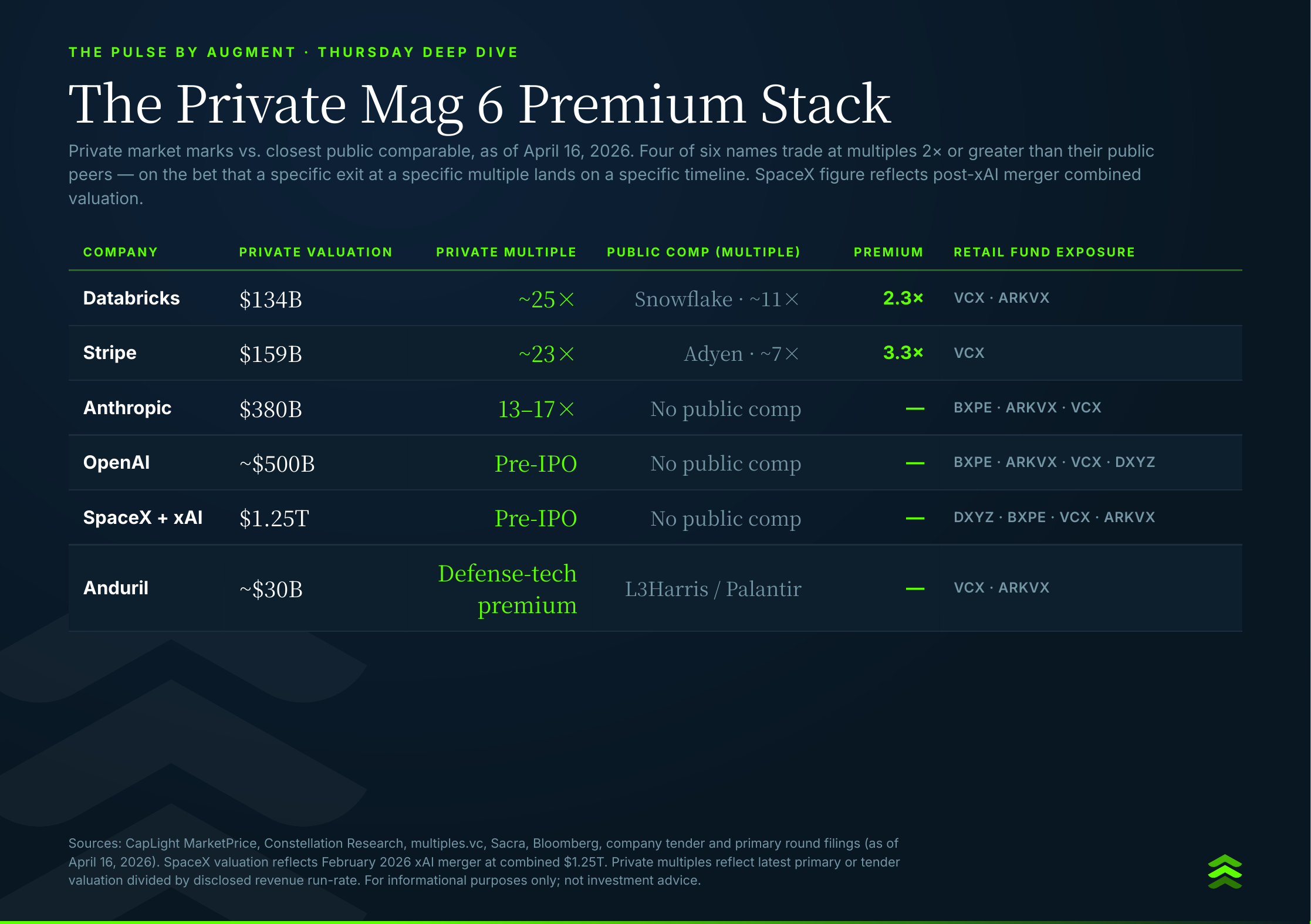
Anduril, Anthropic, Databricks, OpenAI, SpaceX/xAI, and Stripe. (xAI merged into SpaceX in February 2026 at a combined $1.25 trillion valuation — collapsing the old "Private Magnificent 7" into six.) Together these six names represent roughly 43% of total U.S. unicorn valuations. Four of them are now traded at revenue multiples more than double their closest public comparable.
Consider the two cleanest examples.
Databricks announced a ~$5 billion Series L at a $134 billion valuation in December 2025, and by February 2026 reported a $5.4 billion annualized revenue run rate — roughly 25x revenue. Growth is real: 65% year-over-year, with AI product revenue run-rate now $1.4 billion or ~26% of the total. Snowflake, the closest public comp, trades at ~11x revenue on $4.68 billion in annual revenue, growing 29%. Same scale of business, one growing more than twice as fast — but a multiple gap north of 2x between the public and private marks. Growth differential explains some of the gap. Not all of it. A DCF assuming Databricks sustains 65% growth for three more years and terminal-values at Snowflake's multiple still lands closer to $90–100 billion than $134 billion.
CapLight's MarketPrice data has Databricks secondary transactions clustered near the Series L primary valuation — holding the mark while Snowflake's multiple continues to compress. Nasdaq Private Market data is directionally consistent. Those are the prints feeding into the NAV of every evergreen fund holding Databricks.
Stripe ran the same play in February. The tender priced at $159 billion, backed primarily by Thrive Capital, Coatue, and Andreessen Horowitz. Stripe's 2024 net revenue was $5.12 billion; Sacra estimates 2025 at ~$6.9 billion, up 36%. At $159 billion, the implied multiple sits around ~23x on 2025 revenue and closer to 17x on a 2026 run-rate extrapolation. Adyen, the closest public comparable, currently trades at a single-digit revenue multiple with EBITDA margins north of 50% that Stripe has only just approached. Similar volume, similar growth profiles — the public multiple has been compressing while the private mark has been expanding.
Anthropic's $380 billion is harder to bench. In a leaked internal memo, OpenAI's Chief Revenue Officer argued Anthropic is overstating its run-rate by $8 billion — the dispute turns on whether Anthropic's AWS/Azure/Google Cloud distribution revenue should be booked gross (Anthropic's treatment) or net (OpenAI's approach). Whichever side an S-1 auditor accepts, the gap defines the multiple: $380B / $30B = 12.7x; $380B / $22B = 17x. There is no revenue-per-dollar public comp for a frontier lab, and CapLight's secondary trade data has Anthropic clustered near the primary mark into April.
SpaceX traded in its December 2025 tender at $421 per share / $800 billion valuation, then absorbed xAI in February 2026 at a combined $1.25 trillion — the largest merger in history. The combined entity is now reportedly targeting a June 2026 roadshow with a $75 billion raise, 30% reserved for retail. OpenAI is reportedly targeting a Q4 2026 IPO near $1 trillion, with secondary transactions pricing in line with that target per CapLight data. CFO Sarah Friar has internally flagged the timeline as aggressive; the disagreement is now public.
The pattern across the cohort: private-market multiples 2–3x what public-market comparables command, on the bet that a specific exit at a specific multiple on a specific timeline gets delivered. All three have to line up.
The Distinction That Matters
Here is where the consensus misses it. The Private Mag 6 secondary marks are not a price discovery mechanism. They are a feedback loop.
The chain has four steps.
Step one. Secondary marketplaces match buyers and sellers, publishing observed prints. Aggregators like CapLight triangulate trade, order, and funding round data across venues into MarketPrice estimates. Average daily volume for even the most active pre-IPO companies is under $10 million. Prints are thin, directional, and often anchored to tender-offer pricing the company itself controls.
Step two. Evergreen fund valuation committees — operating under Rule 2a-5 — use those prints and third-party estimates, plus private DCF models and periodic independent valuations, to set quarterly NAV.
Step three. Retail investors buy and sell at NAV. BXPE takes redemptions quarterly, capped at 3% of net asset value per quarter (with a 5% early-redemption haircut on shares held less than two years). VCX is now listed, so it trades at market — but the market prices against published NAV. DXYZ is a closed-end fund that has, at various points, traded at a multi-hundred-percent premium to NAV because retail cannot get SpaceX exposure any other way. ARKVX is interval, with quarterly tenders.
Step four — the loop closes. Rising secondary marks lift NAV. Rising NAV attracts retail inflows. Those inflows get deployed into the same secondary market, bidding up the next print. The prints reinforce themselves. Nothing in the chain is illegal. Nothing in it is a price-discovery mechanism either. It is an echo chamber with fee compression in the middle.
CapLight's own aggregated data is the tell. Across the broader unicorn universe, most secondary prices trade below the last primary round — for more than four in five unicorns. The Mag 6 names are the exception. That exception is the argument. When most of the market is already marked down on secondary and a handful of mega-cap AI and infrastructure names are holding near primary, the dispersion itself is the signal: these seven are the reason the evergreen cohort still looks healthy. When one of them reprices publicly, the support structure goes with it.
This is what the SEC's March 4 Private Markets Roundtable was actually about. The Division of Investment Management convened it explicitly to examine governance under Rule 2a-5 and "valuation considerations for retail access products." Chair Paul Atkins delivered the opening remarks. Cliff Asness of AQR, John Finley of Blackstone, Katie King of PwC, and Marc Pinto of Moody's debated valuation transparency, liquidity management, and investor protection on the same panel. Brian Daly, Director of the SEC's Division of Investment Management, said it plainly: "With retail exposure to alternative investments becoming more common, we want to help everyday investors understand the different valuation approaches used in these products."
Seminars don't get Chair-level opening remarks. This was scaffolding for rulemaking.
The contrarian reframe of "liquidity" for an evergreen fund: it is not measured by whether a holder can redeem on a normal day. It is measured by what happens when a meaningful fraction of holders redeem at the same time — a scenario this cohort has never faced because it launched in a bull market and has grown every single quarter. Morningstar is adding 30+ evergreen strategies to rating coverage this year for that exact reason: the category got too big to ignore, and it is untested in a drawdown.
The Private Markets Angle
Four dated catalysts inside the next 120 days will mark this cohort to public-market reality.
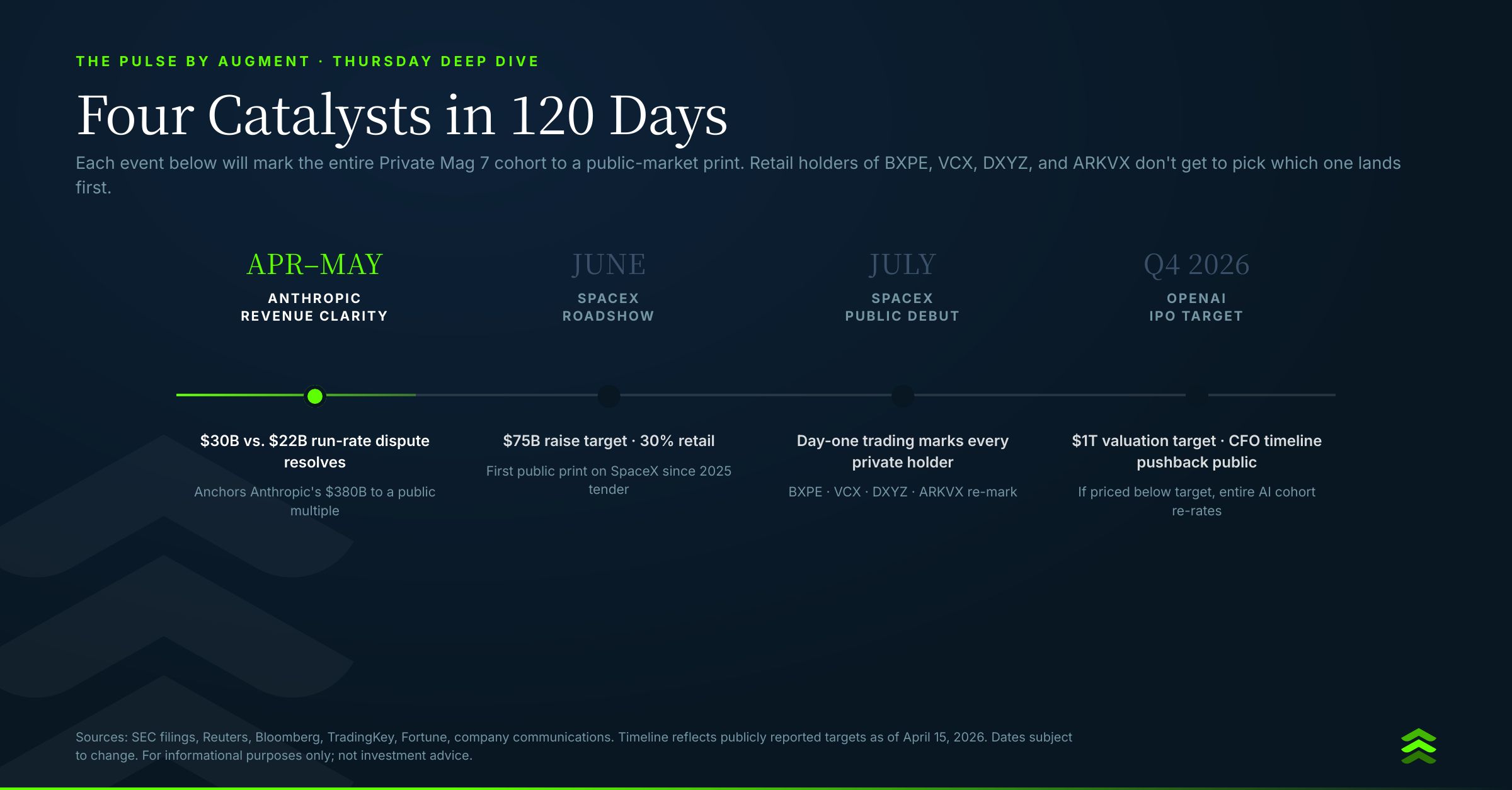
April–May 2026 — Anthropic revenue clarity. The public OpenAI/Anthropic dispute over Anthropic's $30 billion run-rate claim forces a number into the open. Whichever figure survives anchors the $380 billion valuation to a multiple — which then becomes the benchmark for every frontier-lab private valuation.
June 2026 — SpaceX roadshow. Musk has reportedly filed confidentially and is targeting a $75 billion raise. First time SpaceX has to justify its valuation to a public book. The roadshow pricing marks every fund holding SpaceX — BXPE, VCX, DXYZ, ARKVX — to a real print.
July 2026 — SpaceX/xAI public debut. First trading day reprices every private holder. Every subsequent earnings call re-marks the position.
Q4 2026 — OpenAI IPO target. $1 trillion target with internal CFO/CEO timing tension already public. If OpenAI prices below $1 trillion, the entire frontier-AI cohort re-rates downward. If OpenAI prices above, the premium is vindicated — but at that point the retail trade converges with the public trade because public investors can buy the name directly.
The asymmetry is the operative observation. A single data point from any of these four events marks the entire cohort. Retail holders of BXPE, VCX, DXYZ, and ARKVX do not get to pick which name prints first. Whichever one does sets the comp for the others. And funds that hold multiple names see it twice.
Three structural questions follow from this for the three audiences most exposed.
For direct secondary holders of SpaceX, Stripe, or Anthropic, the compressed window is observable: the first public-comp benchmark is inside 90 days, and secondary bid-ask spreads historically widen when prints move — meaning transaction costs into a repricing event tend to be higher than out of one. Another observable: venture funds with 2018–2020 vintages are running on DPI clocks that may pressure secondary marks before public prints do. A tranche of SpaceX shares clearing at a 10% discount to the last tender is one such pattern worth tracking as signal rather than noise.
For accredited buyers and family offices, the analytical frame that follows from the multiple gap is a stress test of each secondary mark against the most conservative public comp. For Databricks at $134 billion, applying Snowflake's 11x revenue multiple implies the buyer is paying for ~$12 billion in revenue today; actual run-rate is $5.4 billion. The premium embeds more than a 2x additional growth trajectory plus a multiple that does not contract. The structural question is whether the prospectus redemption gate of the fund being allocated to is understood at the specific language level — not the marketing summary. A 3% quarterly NAV cap caps annualized redemption at 12% of the fund; whether the cash and public-equity sleeve of the fund can absorb a simultaneous 10% or 20% redemption event across the category, when inflows slow at the same time, is a separate question from the prospectus headline.
For RIAs allocating client capital, the March 4 SEC roundtable transcript maps directly onto a 2a-5 governance review. The regulatory frontier is valuation committee independence, input transparency, frequency, and override authority. A cohort liquidity stress test — modeling simultaneous redemption scenarios across BXPE, VCX, DXYZ, and ARKVX — is a different question than a single-fund stress test, because all four funds own a substantially overlapping set of names. The portfolio-level answer is not the same as the fund-level answer.
None of these observations are recommendations. They are the structural questions the plumbing invites once you stop reading NAV as a price and start reading it as a model output.
The Counterargument
The steel-man version is that this time is different because the supply-demand imbalance is structural. Companies are staying private longer because capital is abundant; retail was structurally locked out for a decade and the evergreen wrapper finally closes that gap. The Private Mag 6 deserves a premium because the frontier-AI cohort is genuinely category-defining and the standard comp set doesn't apply — comparing Anthropic to any public company is category error, and comparing Databricks to Snowflake under-counts AI's operating leverage on data infrastructure. If OpenAI prices at $1 trillion in Q4, the premium is vindicated. Even if it prices lower, the structural demand for private access persists — and NAV smoothing is a feature of the wrapper, not a bug, because daily marks on genuinely illiquid holdings would themselves be arbitrary.
That case is coherent. It has been the operating assumption of every evergreen marketing deck since 2022. The problem is that it has never been tested against a simultaneous public-market repricing of the names that collectively anchor four major retail funds — and the SpaceX/xAI merger just increased the concentration. June is the test.
📈Data Point of the Day
More than four in five unicorns
CapLight's aggregated secondary market data — drawn from over $300 billion of transactional volume across Forge, Hiive, Carta, and EquityZen — shows that most secondary trades across the broader unicorn universe clear below the last primary round. The Private Mag 6 names are the exception, not the rule. The dispersion between those two cohorts is the signal worth watching.
🎓 Manual
NAV Smoothing
The practice, common in evergreen and interval funds holding illiquid assets, of using quarterly valuation cycles, third-party appraisals, and model inputs to produce a net-asset-value series that is less volatile than the underlying asset prices would support. Smoothing is not illegal and is sometimes structurally required — daily marks on genuinely illiquid holdings would be arbitrary — but it creates a gap between reported NAV and what a true liquidation event would recover. Rule 2a-5 under the Investment Company Act governs how 40-Act funds must perform fair valuation on these holdings.
Augment Markets Inc. is a technology company offering software and data services. Brokerage services are offered through Augment Capital LLC, an affiliated broker-dealer and member FINRA/SIPC. Investment advisory services are offered through Augment Advisors LLC, an SEC-registered investment adviser.
Important Disclosures: This material has been prepared for informational purposes only. None of the information provided represents a recommendation, an offer or the solicitation of an offer to buy or sell any security. The information provided does not constitute investment, legal, tax, or accounting advice. You should consult with qualified professionals before making any investment decisions. Investing in private securities involves substantial risk, including the potential loss of principal. Private securities are typically illiquid, have limited pricing transparency, and often require longer holding periods. These investments are available exclusively to qualified accredited investors and offer no guarantee of returns. An IPO or other liquidity event is not guaranteed. Additionally, past performance of private securities does not indicate or predict future results. Share price data are estimates only, based on proprietary data from Caplight and Augment Markets Inc. and its affiliates.

Paul leads editorial at Augment, building Pulse into the private markets' go-to intelligence source. He also develops editorial content strategies for startups and venture capital firms. Previously, he spent 15 years as a business and opinion journalist at The New York Times, Fortune, Fast Company, Reuters, and more. He believes transparency creates liquidity—and that someone should actually publish what private shares are trading for. He lives in Marin with his wife and two rescue dogs, and wishes he had more time to surf.
Learn more