





Anthropic is turning away investors offering $800 billion-plus valuations — a signal that the company may believe its leverage only increases from here, especially with an IPO reportedly on the table for October. Meanwhile, a routine Alaska filing revealed Google's hidden 6% stake in SpaceX, worth an estimated $100 billion at IPO. And Amazon-backed nuclear startup X-Energy hit the road this week for an $800 million IPO on Nasdaq, bringing AI's power problem one step closer to an investable thesis.
Anthropic Turns Down $800B. That's the Point.
The most telling thing in private markets this week isn't a deal that closed — it's one that didn't happen. Multiple venture capital firms offered Anthropic funding at a valuation of $800 billion or more, according to Bloomberg and TechCrunch reporting. Anthropic said no — at least for now.
That figure would more than double the $350 billion pre-money valuation the company commanded just two months ago, when it closed a $30 billion Series G at a $380 billion post-money. But with annualized revenue reportedly hitting $30 billion by the end of March — up from $9 billion at the end of 2025 — investor appetite has outpaced even the most aggressive capital plan.
Why turn it down? The most plausible read: Anthropic doesn't need the money, and accepting more capital at $800 billion could complicate an IPO rumored for as early as October 2026. Taking a preemptive round at one price and then listing within months at a potentially higher one creates messy optics for both existing and new investors. It also adds another set of governance expectations at exactly the moment when the company needs maximum flexibility.
For the secondary market, this is a significant data point. When a company declines capital at a price that would make it the most valuable private company in history (by valuation, not revenue multiples), it suggests management sees the current trajectory as self-financing — or believes the public market will assign an even higher number. Either way, the pricing signal may reverberate across other AI-adjacent names in the private markets.
Google's $100 Billion SpaceX Secret Was Hiding in Alaska

A regulatory filing SpaceX submitted in Alaska this week revealed what had been one of tech's worst-kept but never-confirmed secrets: Alphabet's Google holds a 6.11% stake in SpaceX, dating back to a 2015 investment alongside Fidelity at roughly a $12 billion valuation.
That stake, likely diluted to approximately 5% following SpaceX's merger with xAI in February, could be worth $100 billion at the company's anticipated IPO valuation of $1.75 trillion or higher. For context, that single position would exceed the market capitalizations of most S&P 500 companies.
The disclosure happened because Alaska requires companies to report holders with stakes above 5%. SpaceX confidentially filed its S-1 with the SECon April 1, with the public filing expected in late April or May and a June listing targeted. When it does list, it would reportedly be more than three times the size of the largest U.S. IPO in history.
For investors tracking private-to-public transitions, this is a reminder that the SpaceX IPO isn't just a SpaceX story — it's an Alphabet story, an xAI story, and a capital-markets event that may reshape liquidity dynamics for every other name in the IPO queue.
Augment has tracked AI's share of Power 20 activity for seven consecutive quarters. The data tells a story that headlines miss:
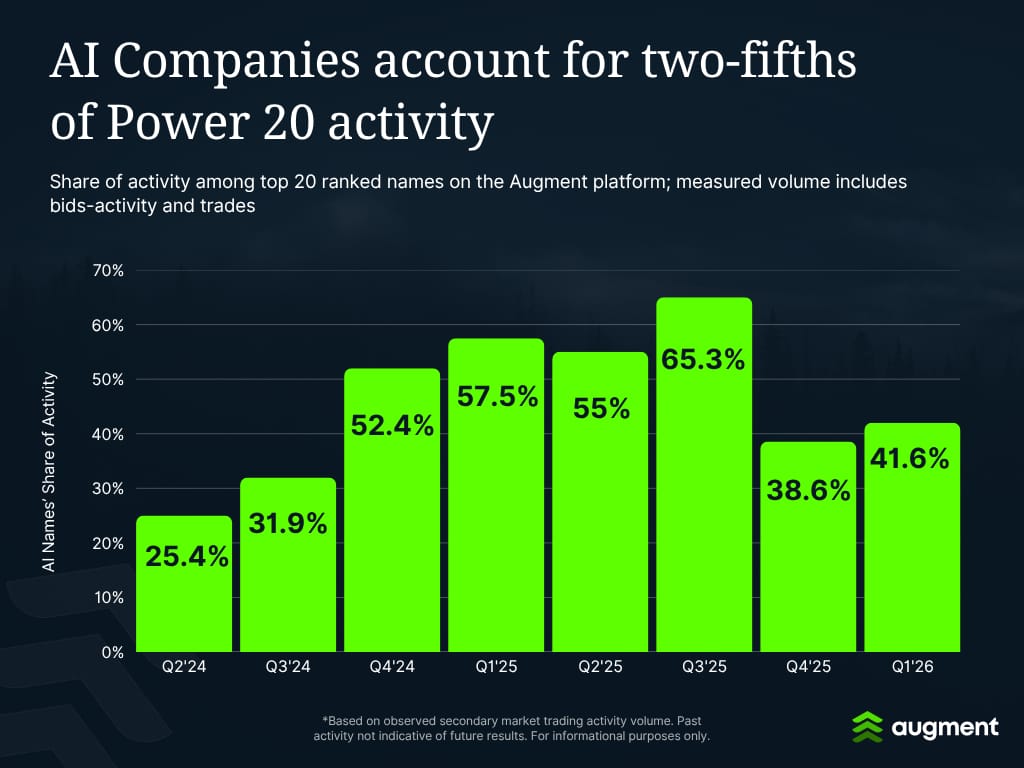
- Q2'24: 25.4%
- Q3'25: 65.3% (the peak)
- Q1'26: 41.6%
Three forces drove the pullback:
- AI consolidation (xAI, Groq, Scale AI all exiting through acquisition)
- Category broadening (defense-tech now at 35.5% of activity)
- The rise of non-AI platforms like Stripe and Polymarket drawing serious secondary demand.
None of this means AI is less important. It means the pre-IPO market is growing up. When activity diversifies beyond a single sector, price discovery improves for everyone.
The Q1'26 Power 20 tracks all of it. Get the full report here.
X-Energy Starts Its IPO Roadshow — Nuclear Meets the AI Power Thesis
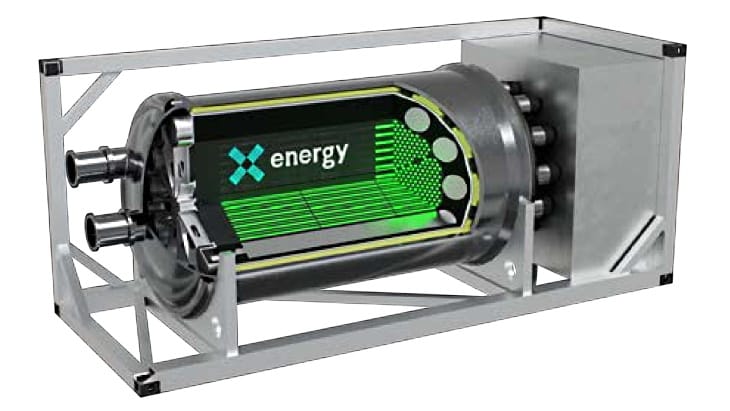
Amazon-backed nuclear startup X-Energy launched its investor roadshow on Tuesday, offering 42.9 million Class A shares at $16 to $19 each. With a greenshoe option, the offering could raise up to $814 million and value the company between $6.3 billion and $7.5 billion. It plans to list on Nasdaq under the ticker "XE."
X-Energy builds small modular reactors (SMRs) and proprietary TRISO-X fuel, positioning itself directly at the intersection of nuclear energy and AI-driven power demand — a theme that has animated investor interest since hyperscalers began signaling their willingness to sign long-term power purchase agreements. J.P. Morgan, Morgan Stanley, Jefferies, and Moelis are leading the offering.
This isn't a private markets transaction, but it matters for the private pipeline: X-Energy's pricing and reception could set the tone for other deep-tech, infrastructure-heavy companies weighing the public markets in 2026.
Power 20 Watch
The AI Valuation Inversion — and What It Means for the Queue
This week sharpened a dynamic that has been building since February: Anthropic's implied valuation is converging with — and may soon surpass — OpenAI's. The $800 billion-plus offers Anthropic declined sit within striking distance of OpenAI's $852 billion post-money from its $122 billion raise last month. At least one investor with stakes in both companies told the Financial Times that justifying OpenAI's round required assuming an IPO valuation of $1.2 trillion or more — making Anthropic's $380 billion look like a relative bargain.
Meanwhile, Anthropic's annualized revenue reportedly surpassed OpenAI'swhile spending roughly 4x less on training. Eight of the Fortune 10 are now Claude customers. Claude Code alone is reportedly generating $2.5 billion in annualized revenue.
Sitting behind these two in the IPO queue: SpaceX (targeting June at $1.75T), Databricks ($134B last round), Stripe ($159B secondary tender), and a growing roster of AI infrastructure companies. The question for capital allocators isn't whether any single company goes public — it's whether the market can absorb multiple $50B+ offerings in a compressed window without repricing the entire cohort.
Quick Takes

SiFive Raises $400M in Final Round Before IPO — The RISC-V chip designer closed a Series G at a $3.65 billion valuation, led by Atreides Management with participation from Nvidia, Apollo, and T. Rowe Price. CEO Patrick Little called it the company's last private round, positioning SiFive as one of the rare semiconductor IPO candidates in a market dominated by AI software names.
SpaceX Fires Up Starship V3 Ahead of May Flight — SpaceX completed a full-duration static fire of its next-generation Starship V3, clearing the final ground test before Flight 12 — described as the most powerful rocket debut in history. Separately, the company hit its 1,000th Starlink satellite launch of 2026 this week, an operational cadence that strengthens the revenue narrative ahead of the IPO.
Shield AI Closes $1.5B Series G at $12.7B Valuation — Led by Advent International and JPMorgan with $500M in additional Blackstone preferred equity, this is the largest defense AI round since Anduril's $2.5B in June 2025. Defense tech continues to command premium valuations and attract strategic capital at levels that diverge from most enterprise software names.
Hermeus Raises $350M for Hypersonic Aircraft — The Atlanta-based company pulled in $200M in equity plus $150M in debt, led by Khosla Ventures, to build hypersonic aircraft for both commercial and defense applications. Aerospace is quietly assembling one of the deepest private funding pipelines outside of AI.
Secondary Market Discounts Shrink to 8% in Q1 — EquityZen reports the average secondary trade executed at just an 8% discount to the last primary round in Q1 2026, down from 29% at the end of 2025. Meanwhile, 34% of trades now clear at a premium — up from 19%. The secondary market is repricing in real time as the IPO pipeline expands.
📈 Data Point of the Day
$1 billion to $30 billion in 14 months
That's Anthropic's revenue trajectory from early 2025 to March 2026 — the fastest organic revenue ramp in American corporate history, per Axios. For comparison, Salesforce took approximately 20 years to reach $30 billion in annual revenue. Anthropic's enterprise customer base spending $1M+ annually has doubled from roughly 500 to over 1,000 in the past two months alone.
🎓 Manual
Preemptive Round
A funding round initiated by investors rather than the company. In a preemptive round, VCs approach a startup with term sheets before the company has signaled any intention to raise, typically because the company's growth trajectory suggests its valuation will only increase. Anthropic declining multiple preemptive offers at $800B+ this week is a textbook case: when a company's leverage exceeds the capital markets' ability to set pricing, the traditional fundraising dynamic inverts entirely.
👀 What We’re Watching
- Anthropic's IPO sequencing. With an October timeline reportedly in play, the question becomes whether Anthropic files before or after SpaceX lists — and how the $800 billion data point is ultimately reflected in its public offering price. If revenue growth continues at this pace, it could raise the implied valuation at which the company approaches public markets.
- The secondary market spread compression. Average discounts falling from 29% to 8% in a single quarter is historically unusual. If the IPO window stays open, secondaries could begin trading at consistent premiums — a shift from historical discount patterns.
- X-Energy's pricing reception. If the nuclear SMR company prices at the top of its range, it would suggest the market views the AI-power-demand thesis as actionable rather than theoretical. Watch for oversubscription signals this month.
Augment Markets Inc. is a technology company offering software and data services. Brokerage services are offered through Augment Capital LLC, an affiliated broker-dealer and member FINRA/SIPC. Investment advisory services are offered through Augment Advisors LLC, an SEC-registered investment adviser.
Important Disclosures: This material has been prepared for informational purposes only. None of the information provided represents a recommendation, an offer or the solicitation of an offer to buy or sell any security. The information provided does not constitute investment, legal, tax, or accounting advice. You should consult with qualified professionals before making any investment decisions. Investing in private securities involves substantial risk, including the potential loss of principal. Private securities are typically illiquid, have limited pricing transparency, and often require longer holding periods. These investments are available exclusively to qualified accredited investors and offer no guarantee of returns. An IPO or other liquidity event is not guaranteed. Additionally, past performance of private securities does not indicate or predict future results. Share price data are estimates only, based on proprietary data from Caplight and Augment Markets Inc. and its affiliates.

Paul leads editorial at Augment, building Pulse into the private markets' go-to intelligence source. He also develops editorial content strategies for startups and venture capital firms. Previously, he spent 15 years as a business and opinion journalist at The New York Times, Fortune, Fast Company, Reuters, and more. He believes transparency creates liquidity—and that someone should actually publish what private shares are trading for. He lives in Marin with his wife and two rescue dogs, and wishes he had more time to surf.
Learn more