







Anthropic closed a reported $65 billion Series H this week at a $965 billion post-money valuation, nudging past the $852 billion mark OpenAI set in its March round and reordering the top of the AI-lab table. Apollo and Blackstone are reportedly shopping a roughly $36 billion private-credit deal to buy Google chips that Anthropic would lease. The quieter story is defense AI absorbing nearly half of all venture dollars in a single recent week.
The Big Story: Anthropic tops OpenAI
Anthropic raised a reported $65 billion in a Series H round this week at a $965 billion post-money valuation, according to the company and multiple outlets. The round was reportedly co-led by Altimeter, Dragoneer, Greenoaks, and Sequoia, with Coatue, Capital Group, Fidelity, Blackstone, and others participating. Anthropic says its run-rate revenue crossed roughly $47 billion earlier this month, up sharply since its February Series G.
The number that travels is the comparison. OpenAI's last primary round, reported in March, priced at an $852 billion post-money. On the primary tape, Anthropic now sits above it. For two years the assumption baked into nearly every AI secondary mark was that OpenAI was the category's most valuable private company and everything else priced at a discount to it. That ordering just changed on the primary side.
One private-market interpretation worth tracking: how the open-market secondary indications in each name move relative to these primary marks over the next several weeks. A primary round may influence the reference points that market participants consider in later secondary indications, although those indications may not be executable or representative of fair value.
Whether secondary indications in Anthropic firm toward the $965 billion reference, and whether OpenAI indications hold near its March mark or nearer the lower level implied by its recent employee tender is something to monitor.
The cleanest caveat is that the Anthropic-versus-OpenAI comparison may not hold cleanly. The two differ in business mix, cost structure, capital commitments, and disclosure quality, and a single post-money number compresses all of that into one figure.
Reported private-company financials and secondary-market indications may be unaudited, incomplete, non-standard, or based on limited transaction activity. They should not be relied upon as fair value, executable pricing, or a basis for any investment decision.
Sources: Anthropic — Series H, CNBC (May 28), TechCrunch (May 28), Washington Post (May 28)
Defense AI’s $6.2 billion funding

Here is the structural story the valuation headlines buried this week. In the week of May 11–17, defense AI absorbed about $6.2 billion — roughly 44% of all disclosed venture capital across 74 rounds — on the back of two deals: Anduril's $5 billion round at a reported $61 billion valuation, and Helsing's reported $1.2 billion at $18 billion. Strip those two out, and the rest of the venture market shrank by roughly half week-over-week.
That concentration is the part worth sitting with. The dominant narrative is "AI is eating venture." The more accurate read this quarter is narrower: a handful of defense and dual-use names are absorbing the capital, and growth-stage companies outside that lane are competing for a materially smaller pool than the aggregate numbers suggest.
For secondary-market observers, concentration like this has a mechanical consequence. When primary capital crowds into one category, the names outside it tend to see thinner primary support, which can widen the gap between where sellers mark inventory and where buyers will actually clear. If a 2024–25-vintage secondary position in a non-defense growth name hasn't repriced to reflect that, the spread is one thing to watch over the next quarter.
Reported private-company financials and secondary-market indications may be unaudited, incomplete, non-standard, or based on limited transaction activity. They should not be relied upon as fair value, executable pricing, or a basis for any investment decision.
Sources: StartupHub.ai (May 2026), TechCrunch — Anduril (May 13), SiliconANGLE — Helsing (May 11)
AI chip leasing

Back to Anthropic, but from the other ledger. Apollo and Blackstone are reportedly working to syndicate a roughly $36 billion debt financing that would buy Google's custom TPU chips, with the chips then leased to Anthropic for data centers reportedly sited in New York, Texas, Louisiana, and Indiana. Broadcom, which helps Google build the chips, is reportedly backstopping the senior tranches — about $31 billion — through a residual-value support agreement: if Anthropic's lease payments fall short and the used chips don't cover the debt, Broadcom reportedly absorbs the gap. Orders are reportedly due this week, with a close targeted for next week. If it prices as described, it would rank among the largest private-credit transactions on record and the biggest chip-financing debt deal to date.
The structural observation isn't the size — it's the location. The AI buildout's financing is reportedly migrating off the equity cap table and into asset-backed private credit, with a public chip supplier underwriting the tail risk. That changes who is exposed when a compute bet doesn't pencil out, and it pulls private-credit managers into the same capex cycle that until recently lived almost entirely in venture equity. For anyone modeling the durability of AI infrastructure demand, the appetite for this paper, and the price it clears at, may provide an additional market signal, separate from headline equity valuations.
Reported private-company financials and secondary-market indications may be unaudited, incomplete, non-standard, or based on limited transaction activity. They should not be relied upon as fair value, executable pricing, or a basis for any investment decision.
Sources: Bloomberg (May 28), Reuters (May 28)
Power 20 Watch
"Power 20" refers to Augment's internal ranking of selected private-market activity, based on secondary-market interest, valuation scale, and proximity to a potential liquidity event. It may not represent the broader private market and should not be treated as a valuation benchmark.
The week reordered the top of the list. With Anthropic stock now above OpenAI on the primary tape, and SpaceX's public S-1 already on EDGAR, the Power 20's largest names are reportedly moving toward potential public listings inside a tight window. That sets up the structural question for the back half of 2026: if several of the largest private names pursue listings in the same stretch, is there enough institutional demand to absorb all of them without one offering pulling capital from the next?
There's no answer yet — only the observation that the pipeline at the very top is unusually crowded, and that crowding is itself a variable. Large listings may compete for overlapping pools of institutional demand, although actual demand will depend on issuer fundamentals, market conditions, index eligibility, valuation, timing, and investor appetite.
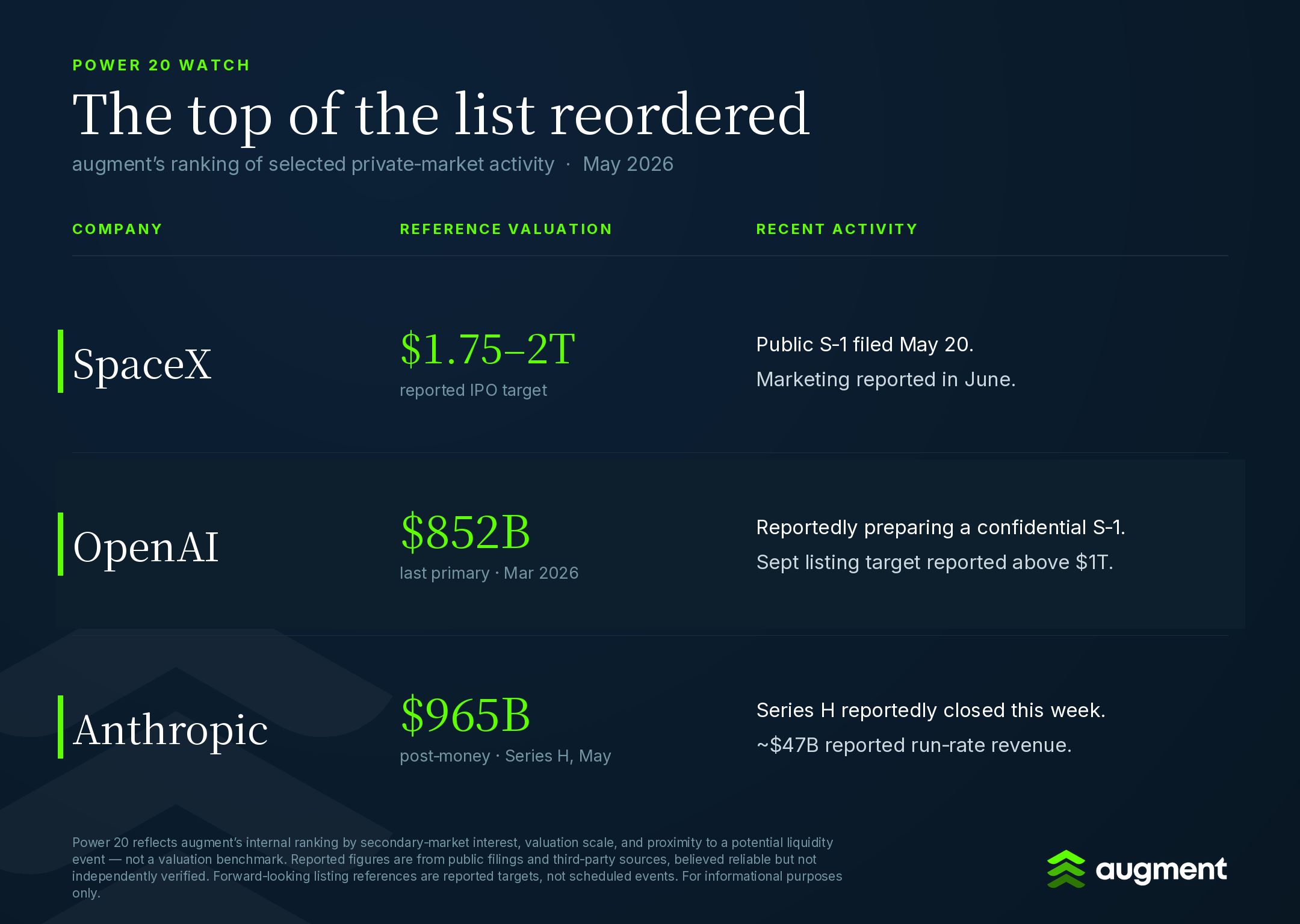
All figures reportedly sourced to the filings and reporting linked above and below. Forward-looking listing references are reported targets, not scheduled events.
Sources: SpaceX S-1 (SEC EDGAR), Fortune — SpaceX prospectus (May 21), Axios — OpenAI confidential filing (May 20), CNBC — Anthropic (May 28)
💨 Quick Takes
- Autodesk to buy MaintainX for ~$3.6 billion in cash — A strategic-acquirer exit for the maintenance-software company rather than an IPO path. Another data point in the year's pattern of late-stage privates clearing through M&A as the listing window stays selective. (SiliconANGLE)
- IBM commits $10B+ to quantum computing over five years — A public-company capital commitment, but a marker for the private quantum cohort: it sets a reference for the scale of capital the category may need to be taken seriously.
- The INVEST Act remains stuck in Senate Banking — The House passed accredited-investor expansion in December; the Senate has reportedly taken no further action in five months. Any platform whose growth thesis assumes a regulatory unlock of the retail market may need to discount that line item.
- ClickHouse triples annualized revenue to ~$250M, charts an IPO path — The open-source analytics company is the kind of infrastructure name sitting underneath the trillion-dollar headlines that could define the 2027 pipeline if this year's mega-listings clear.
💰The Funding Lineup
The following financing rounds are included for market context only and are not recommendations or valuation opinions.
- Cognition — $1B round at ~$26B post-money (May 27) — Lux, General Catalyst, and 8VC reportedly co-led. The maker of the Devin coding agent reportedly more than doubled its September mark, with run-rate revenue reportedly up from ~$37M a year ago to ~$492M. Reported financings suggest continued investor interest in AI developer tools, although valuations may vary materially by company and market conditions.
- Airwallex — new funding at ~$12B valuation (May 28) — Lee Fixel's Addition reportedly led, lifting the payments company from ~$8B late last year, with reported ARR around $1.5B. Cross-border fintech infrastructure remains one of the few non-AI categories still drawing step-up rounds.
- Corgi — $106M Series B1 at $2.6B (May 28) — The AI insurance startup reportedly doubled its valuation roughly three weeks after a prior round. Insurtech rebuilt on AI underwriting is drawing the kind of rapid re-rates that were rare in the category two years ago.
- Triomics — $22M Series B (May 27) — Oncology-specific AI for cancer centers, following a 2024 Series A. A reminder that vertical healthcare AI keeps raising at a smaller scale while the frontier labs absorb the headline checks.
- Thea Energy — $100M Series B (May 27) — Thomas Tull's US Innovative Technology Fund reportedly led the Princeton fusion spinout's round. The framing on the raise is explicit: fusion as a power source for AI compute, putting climate and the buildout in the same sentence.
📈 Data Point of the Day
$70 billion
That's the upper end of the capital expenditure ByteDance is reportedly weighing for 2026, according to Bloomberg — more than double last year and reportedly funded largely out of the ~$50 billion in profit the company earned in 2025. ByteDance is reportedly already discussing a figure closer to $100 billion for next year. For the AI-infra cluster, reported capex at this scale may influence demand for chips, power, and data-center capacity, although the actual market impact will depend on timing, supplier contracts, and execution.
Source: Bloomberg (May 27)
🎓 Manual
Residual Value Support Agreement
A residual value support agreement is a guarantee in which a third party agrees to cover a shortfall if the collateral behind a loan — here, used AI chips — sells for less than the outstanding debt when the borrower can't pay. In the reported Anthropic chip financing, Broadcom is said to be providing this support on the senior tranches, which is what lets lenders treat highly specialized hardware as financeable collateral. The mechanism may allow debt to flow into assets that would otherwise be too illiquid or too fast-depreciating to lend against on their own.
👀 What We're Watching
- Whether secondary indications in Anthropic and OpenAI track their new primary marks. Anthropic's reported $965B and OpenAI's $852B March round reset the reference points; additional open-market trades, if they occur, may provide context on whether the secondary tape aligns with the primary one. (CNBC, May 28)
- How the ~$36B Anthropic chip-financing deal prices and whether it closes next week. The order book and clearing terms are one observation worth tracking on how much appetite private credit has for AI-infrastructure paper at this scale. (Bloomberg, May 28)
- The trillion-dollar IPO test as SpaceX's prospectus circulates and OpenAI's confidential filing advances. Two of the largest privates appear to be moving toward listings in overlapping windows; how the first prices is one input into the next. (Fortune, May 21)
- Any movement on the INVEST Act in Senate Banking. Accredited-investor reform has reportedly stalled; further action, if it occurs, would matter for the retail-distribution assumptions underpinning several wealth-platform growth theses. (Carlton Fields)
Augment Markets Inc. is a technology company offering software and data services. Brokerage services are offered through Augment Capital LLC, an affiliated broker-dealer and member FINRA/SIPC. Investment advisory services are offered through Augment Advisors LLC, an SEC-registered investment adviser.
Important Disclosures: This material has been prepared for informational purposes only. None of the information provided represents a recommendation, an offer or the solicitation of an offer to buy or sell any security. The information provided does not constitute investment, legal, tax, or accounting advice. You should consult with qualified professionals before making any investment decisions. Investing in private securities involves substantial risk, including the potential loss of principal. Private securities are typically illiquid, have limited pricing transparency, and often require longer holding periods. These investments are available exclusively to qualified accredited investors and offer no guarantee of returns. An IPO or other liquidity event is not guaranteed. Additionally, past performance of private securities does not indicate or predict future results. Share price data are estimates only, based on proprietary data from Caplight and Augment Markets Inc. and its affiliates.

Paul leads editorial at Augment, building Pulse into the private markets' go-to intelligence source. He also develops editorial content strategies for startups and venture capital firms. Previously, he spent 15 years as a business and opinion journalist at The New York Times, Fortune, Fast Company, Reuters, and more. He believes transparency creates liquidity—and that someone should actually publish what private shares are trading for. He lives in Marin with his wife and two rescue dogs, and wishes he had more time to surf.
Learn more