



Kalshi built a forward curve for GPU rentals this week. The most-traded private AI names contracted their way off it years ago.
Deep Dive: The Compute Curve Prices the Wrong Companies
This week Kalshi put a price on the one input the AI economy had been guessing at. On July 14 it launched CFTC-regulated forward curves for the cost of renting an Nvidia B200, H200, or A100 by the hour. The contracts run weekly and monthly, stitched out to a year, and resolve against Ornn's index of live GPU-rental prices, the same index that reached the Bloomberg Terminal in April. Tarek Mansour, Kalshi's CEO, called compute "the new oil" and said compute futures would eventually dwarf oil futures. For the first time there is a public, forward-looking price for the largest cost line in AI. Until now, a GPU-hour cost whatever your supplier said it cost.
Here is the reading almost everyone will reach for, and on its face it's a good one. Private AI has always been hard to underwrite because its largest cost was unknowable; put a price on the compute and you can finally put a price on the company. It's how the rest of the market already works: you value an airline against the jet-fuel curve, an oil major against forward crude. "Compute is the new oil" is an invitation to build the same machinery here. Take a company's burn, run it against the curve out to next year, and back into the cost base, the margin, the valuation. You can almost feel the analyst note writing itself: the private mark as a spread over a number anyone can pull up on a terminal.
But, it's backwards.
The curve prices the spot market: what a GPU costs to rent by the hour, today. The companies that dominate secondary trading don't rent by the hour. They locked in years of compute at fixed prices, specifically to get off the market the curve tracks.
OpenAI has a seven-year, $38 billion commitment with AWS, more than $300 billion over five years with Oracle, and a reported $250 billion arrangement with Microsoft's Azure. Those are take-or-pay commitments: capacity bought years forward at a negotiated price, specifically to convert a volatile hourly cost into a fixed one. A company with substantial multi-year compute commitments may be less directly exposed to short-term spot rental prices than companies relying on hourly or short-duration GPU rental markets. It is the least exposed participant in the market to the price Kalshi just made tradable, because getting off that price was the entire point. (Anthropic has contracted across multiple clouds on similar logic. Augment and/or its affiliates hold a position in Anthropic.)
And secondary volume pools in exactly those names. The most-traded pre-IPO AI companies are the hedged ones: real buyers, real size, a mark you could act on. So the curve prices the cost base of companies that barely change hands, and misses the ones that do. It is most useful exactly where you can least use it.
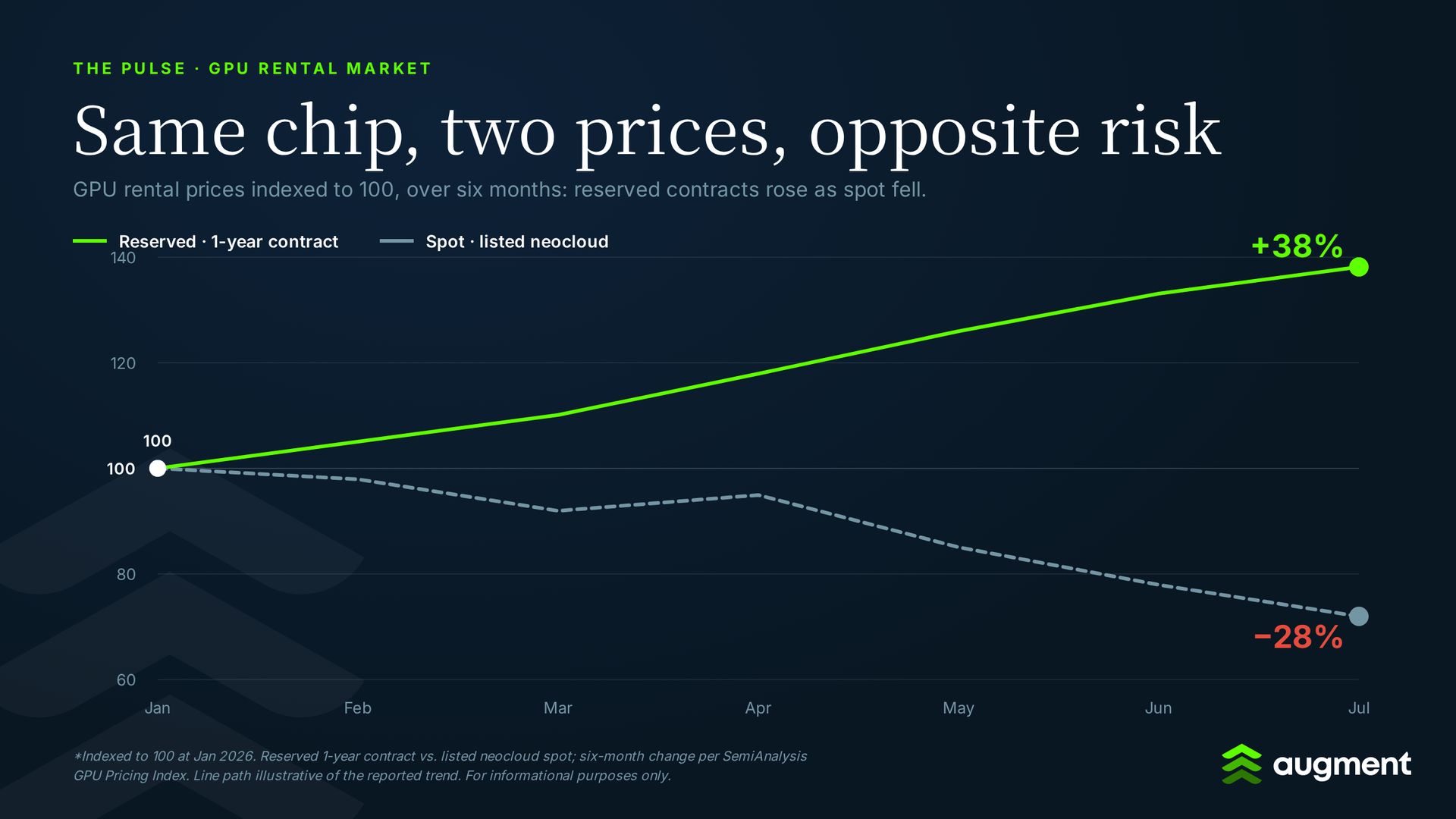
The split is already visible in the rental data. Over the last six months, reserved one-year contract prices rose roughly 38% while listed spot fell about 28%. Hyperscaler reserved H100 capacity has held in the mid-$7-per-hour range; neocloud spot has compressed toward the low $2s. B200 spot, meanwhile, ran up sharply this spring before pulling back. Contracted capacity is a flat line. Spot is a seismograph. Whoever sits on the flat line is insulated from the curve. Whoever sits on the seismograph carries the risk it just made legible.
Reported private-company financials and secondary-market indications may be unaudited, incomplete, non-standard, or based on limited transaction activity. They should not be relied upon as fair value, executable pricing, or a basis for any investment decision.
Look at who sits on the seismograph. Reflection AI, founded in 2024 by two former DeepMind researchers, has yet to ship a model and just signed more than $1 billion of Nebius compute through 2029 on Nvidia GB300s. That's its second nine-figure-plus commitment, after an earlier SpaceX deal for the same chips. The company is currently valued at $8 billion and has raised close to $2.6 billion from backers including Nvidia, Sequoia, and Lightspeed.
So a company with no product has committed to more than $1 billion of compute against the roughly $2.6 billion it has raised in its entire life. Its cost structure is the curve, more or less in full. Its valuation appears to depend heavily on team pedigree, compute access, investor support, and future execution, given the company’s early stage and limited public operating history, with no liquid secondary mark to check it against. The counterparty is under visible strain: Nebius broke below $200 this week on cash-burn concerns, after reportedly guiding to $20–25 billion of 2026 capex it expects contracted cash flows to cover only about 60% of. The one place the curve is a live valuation input is the one place there is nothing liquid to trade. (Reflection and OpenAI differ in stage, business model, capital commitments, and disclosure quality; the contrast here is structural, not a like-for-like comparison.)
Reported private-company financials and secondary-market indications may be unaudited, incomplete, non-standard, or based on limited transaction activity. They should not be relied upon as fair value, executable pricing, or a basis for any investment decision.
Now the harder turn, the one that cuts against the frontier's own story. Those take-or-pay contracts may function as a hedge against short-term supply scarcity, but they can also create a different exposure: fixed obligations that may sit above market if demand softens or newer, cheaper compute becomes available. A $300 billion commitment is a fixed liability priced to today's expectations. If AI demand softens, or a cheaper chip generation lands, which happens on roughly an 18 month cycle, the megacaps are locked in above market while the spot tail re-rates down and gets cheaper. Read that way, the curve isn't just blind to the frontier's cost base. It's a running mark-to-market on a bet the frontier can no longer unwind: that it will need this much compute, at these prices, for years. The names that look insulated are carrying the least visible risk in the complex. The tail's risk is loud, priced by the hour, and small. The head's is quiet, embedded in multi-year contracts, and enormous.
That reframes what Kalshi actually built. Not a valuation tool but a risk-transfer map. It shows compute-price risk pooling at the two ends: the startups renting by the hour and the neoclouds financing the hardware, both fully exposed to spot, neither trading cleanly in size. The frontier sits in the middle, insulated from the hourly price and exposed instead to its own demand forecast, the one number no curve prints. One private-market interpretation worth tracking: pricing pre-IPO AI off "compute cost" reads the tail's risk clearly and mismarks the head's, because the head's real compute exposure never shows up as a rental rate. It shows up as a liability that only moves if the demand thesis breaks.
There is a case on the other side, and it's worth stating plainly. Locking supply years forward may simply be the moat. If compute is the new oil, the majors securing their barrels is the winning move, and the tail's spot exposure is proof it lost the supply race before it started. And the curve could deepen into a real underwriting input: if over-the-counter compute swaps begin referencing Ornn and liquidity thickens, "a spread over the curve" stops being a figure of speech. This thesis has a shelf life, and the day a secondary desk prices a mark off Ornn is the day it changes.
But that day isn't here. What arrived this week is a public price for compute that the market will be tempted to read as an X-ray of the private AI complex. It's an X-ray of the bottom of it. The curve didn't make the frontier legible. It showed that the frontier already paid to make the question moot. The check it wrote is a bet no one can see the mark on.
📈 Data Point of the Day
Δ = 10%
Over the past six months, reserved one-year GPU contract prices rose roughly 38% while listed spot prices fell about 28%, per SemiAnalysis's rental index. The two prices are moving in opposite directions. That's the whole thesis in miniature. Whoever locked in a year ago is watching the market they left get cheaper; whoever rents by the hour is watching contract holders get more expensive. Same chip, two prices, opposite risk.
Sources: SemiAnalysis GPU Pricing Index.
🎓 Manual
Take-or-Pay Contract
An agreement in which a buyer commits to pay for a set quantity of something (power, pipeline capacity, GPU-hours) whether or not it actually uses it. In compute, a multi-year cloud commitment may function this way: it locks in supply and price, which can insulate the buyer from spot-market swings, but in some cases it also converts a variable cost into a fixed liability that can sit above market if prices or demand move the wrong way. The protection and the exposure are the same contract.
Augment Markets Inc. is a technology company offering software and data services. Brokerage services are offered through Augment Capital LLC, an affiliated broker-dealer and member FINRA/SIPC. Investment advisory services are offered through Augment Advisors LLC, an SEC-registered investment adviser.
Important Disclosures: This material has been prepared for informational purposes only. None of the information provided represents a recommendation, an offer or the solicitation of an offer to buy or sell any security. The information provided does not constitute investment, legal, tax, or accounting advice. You should consult with qualified professionals before making any investment decisions. Investing in private securities involves substantial risk, including the potential loss of principal. Private securities are typically illiquid, have limited pricing transparency, and often require longer holding periods. These investments are available exclusively to qualified accredited investors and offer no guarantee of returns. An IPO or other liquidity event is not guaranteed. Additionally, past performance of private securities does not indicate or predict future results. Share price data are estimates only, based on proprietary data from Caplight and Augment Markets Inc. and its affiliates.

Paul leads editorial at Augment, building Pulse into the private markets' go-to intelligence source. He also develops editorial content strategies for startups and venture capital firms. Previously, he spent 15 years as a business and opinion journalist at The New York Times, Fortune, Fast Company, Reuters, and more. He believes transparency creates liquidity—and that someone should actually publish what private shares are trading for. He lives in Marin with his wife and two rescue dogs, and wishes he had more time to surf.
Learn more