



.jpeg)

The week's biggest private-markets story was a payments company reaching into the AI stack. Stripe is reportedly in talks to buy OpenRouter for around $10 billion, roughly eight times where the startup was marked in May. Meanwhile a public 10-Q did what secondary desks usually do in the dark: Alphabet's filing put a fair-value number on its Anthropic stake, and the number was roughly $124 billion. And the public market spent two days deciding it's nervous about the cost.
Stripe reaches into the model layer
Stripe is reportedly in talks to acquire OpenRouter, the marketplace that lets developers route a single request across dozens of AI models, in a deal that could value the company at around $10 billion although a proposed acquisition value may incorporate control premiums and strategic considerations that are not reflected in a financing valuation. OpenRouter raised in May at a reported $1.3 billion, per PitchBook figures cited in the coverage. If the talks convert at anything near $10 billion, that's roughly an eight-fold step-up in about two months, not on new revenue disclosed to the public but on what a strategic buyer will reportedly pay to own the routing layer between developers and the labs.The reported acquisition value is substantially higher than the company’s May financing valuation
The structural read is more interesting than the headline number. Stripe already sits underneath OpenRouter as its payments processor, so this is a company buying the thing it already powers. It also lands while Stripe is reportedly weighing a far larger target in PayPal. A payments company last valued at a reported ~$159 billion is pushing past moving dollars toward owning how AI itself gets bought and sold.
For private-market observers, the signal to monitor is the exit path itself. OpenRouter is a two-year-old company that, if this closes, would clear through a strategic acquirer rather than an IPO or a secondary tender. That's yet another venture-backed AI name in a month to have its liquidity question answered by M&A instead of a listing. The comparison matters for anyone marking model-adjacent infrastructure names, though it should be read with care — routing marketplaces, payment rails, and the labs themselves differ in revenue durability and customer concentration.
Reported private-company financials and secondary-market indications may be unaudited, incomplete, non-standard, or based on limited transaction activity. They should not be relied upon as fair value, executable pricing, or a basis for any investment decision.
A private valuation, printed in a public filing

Photo by Karollyne Videira Hubert on Unsplash
Most of the time, the value of a large private stake is a matter of estimate and inference. This week Alphabet disclosed one directly. Its second-quarter filing put the value of its investments in unidentified private companies at roughly $124.3 billion as of June 30, a figure the reporting attributes primarily to its stake in Anthropic. Alphabet holds a reported ~14% position, although the precise percentage may depend on the measurement date, subsequent financings and the treatment of additional investment commitments. That filing turned a quiet holding into a line item: per Fortune, the markups helped drive close to $99 billion of "other income" for the quarter, of which Bank of America estimated roughly $80 billion came from unrealized gains on the private book — the biggest paper profit quarter in the company's history.
For secondary observers, a quarterly fair-value mark from a large public holder is a rare, dated reference point in a market that usually has none. It's a mark, not an executable price or a tender. But when the marks on AI-side private names have mostly lived in estimates and one-off transactions, it is an aggregate carrying amount reported in a public company’s SEC filing, subject to the company’s accounting policies, internal controls and applicable reporting requirements.
Reported private-company financials and secondary-market indications may be unaudited, incomplete, non-standard, or based on limited transaction activity. They should not be relied upon as fair value, executable pricing, or a basis for any investment decision.
The public market started counting the bill

Photo by Prometheus 🔥 on Unsplash
For two years the AI buildout has been a story about ambition. This week it briefly became a story about cost. After Tesla and Alphabet both signaled heavier AI spending, Tesla closed down 14.52% asnd Alphabet down 6.89%yesterday, July 23. Not on weak results, but on what investors read as the mounting price of staying in the race. Alphabet's quarter included record cloud growth and a record paper profit, and the stock fell anyway.
That's a public-market repricing, and we won’t forecast where it goes. But the private-market question sits one layer down. The late-stage names that supply the buildout — inference silicon, data-center capacity, model infrastructure — are marked against the same demand thesis that public investors just questioned. If the public market is starting to weigh capex against return, late-stage marks in the same cluster may eventually face the same test.
📊 Power 20 Watch: A valuation isn't a mark
The Power 20 usually trades on inference: a tender here, a Forge print there, an estimate stitched together from fragments. This week the reference points came from an unusual place: a public company's balance sheet.
Alphabet's filing marked its private book, and two Power 20 names sat inside it. The Anthropic stake drove the ~$124.3 billion disclosure. Its SpaceX position, per Fortune, was the other major contributor to the quarter's markups — a reminder that when a public holder marks a private stake, the number cuts both ways as the underlying moves. Stripe, meanwhile, spent the week as an acquirer rather than a target.
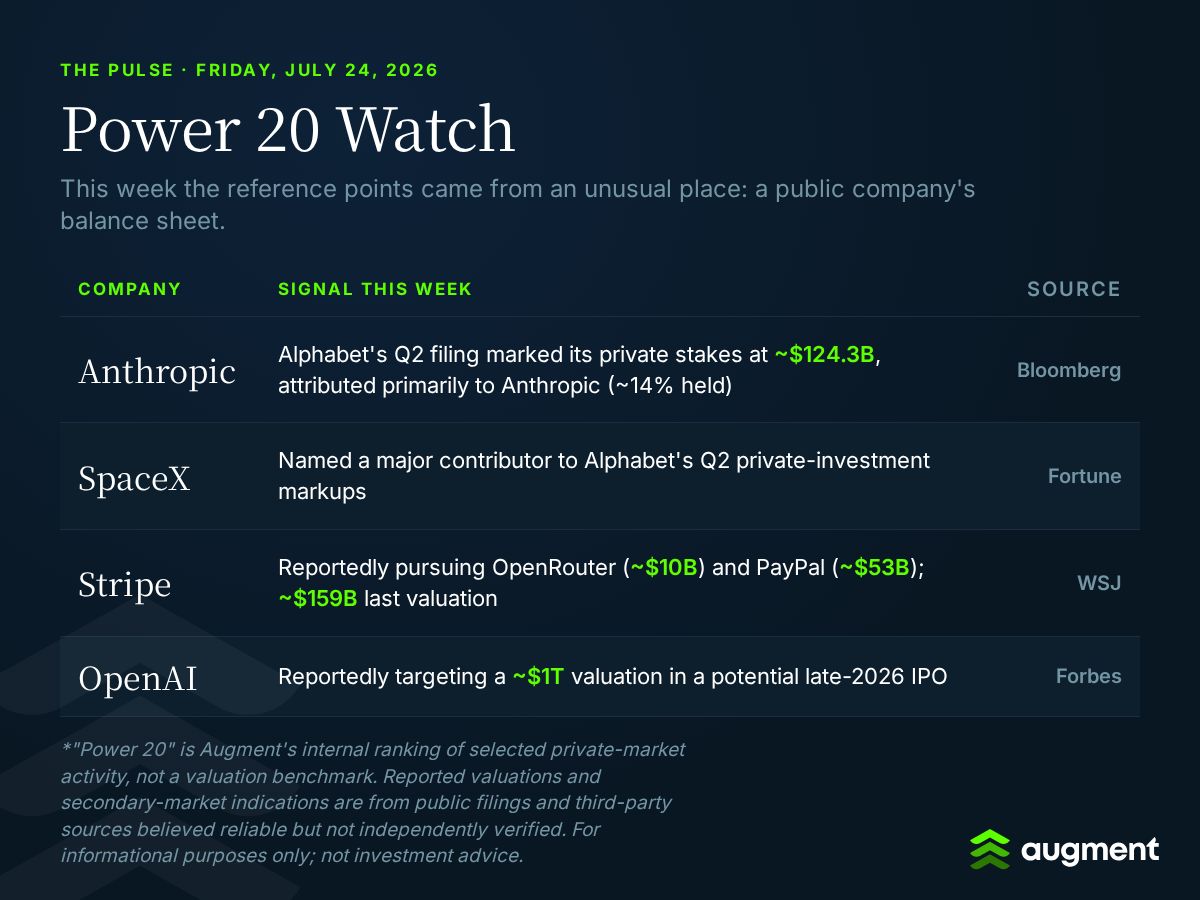
As more public companies hold large private AI stakes, quarterly fair-value marks may become a recurring, if imperfect, window into private valuations, one that arrives on the SEC's calendar rather than the secondary market's.
"Power 20" refers to Augment's internal ranking of selected private-market activity based on Augment's proprietary methodology combining reported financing activity, secondary indications, and public disclosures. It may not represent the broader private market and should not be treated as a valuation benchmark. Inclusion does not constitute a recommendation, endorsement, valuation opinion or indication that a company is more likely to generate investment returns or complete a liquidity event. The methodology involves judgment and may change without notice.
💨 Quick Takes
- Sierra acquires Takeoff — Bret Taylor's Sierra bought the year-old, three-person agent startup Takeoff, which reportedly reached a near-eight-figure revenue run rate, for an undisclosed sum. Another sub-scale agent company answering its future through acquisition rather than a raise — Sierra's second such deal in a few months.
- IBM buys HRL Laboratories — IBM agreed to acquire the storied research lab from Boeing and General Motors for an undisclosed sum, folding HRL's electron-spin quantum work into its own roadmap. Deep-tech consolidation from a corporate acquirer, not a venture one.
- Oracle lands up to $7B from the Pentagon — The Defense Department signed a deal worth an initial $3.31 billion, rising to as much as $6.99 billion over up to 10 years, to consolidate its on-premises software licenses under Oracle. A reminder of how much government spend is in play as the software layer reorganizes.
- Yelp partners with OpenAI — Yelp will feed real-time local recommendations into ChatGPT, one more legacy internet company renting its data to a frontier lab rather than competing with one.
💰The Funding Lineup
The following financing rounds are included for market context only and are not recommendations or valuation opinions.
- Etched — $300M Series C at $10.3B (July 23) — Sequoia led, with a16z, Jane Street, and SK Hynix in — roughly double Etched's ~$5B mark from late 2025. The Harvard-dropout chip startup builds a transformer-specific inference ASIC and reportedly emerged from stealth with over $1 billion in signed customer contracts. A strategic memory maker on the cap table is the real tell.
- Genesis AI — reportedly ~$500M at a ~$3B pre-money (July 23) — The robotics-foundation-model company is reportedly in talks to raise about $500 million, a steep step-up from the record $105M seed it launched with a year ago. Physical AI is where a chunk of this year's largest early rounds are landing.
- Crystalys Therapeutics — $130M Series B — Frazier Life Sciences led an oversubscribed round to push the gout drug dotinurad into global Phase 3, less than a year after a $205M Series A. Late-stage biotech capital is still flowing to clinical assets with a clear regulatory path.
- Cathedral — $160M at a $1.4B valuation (July 22) — a16z and Sequoia led a round for the military-cyber startup founded by former DOGE staffers, both firms taking board seats. Defense software keeps drawing top-tier venture at unicorn marks out of the gate.
- AegisAI — $36M Series A — Battery Ventures led the round for the ex-Google security team building agents to catch AI-generated spear-phishing. The security market is increasingly a fight between AI attackers and AI defenders, and capital is following the defenders.
📈 Data Point of the Day
$811 billion
That's Alphabet's reported contracted future spending commitments as of June (chips, data centers, power, and more it's already on the hook for), up nearly $500 billion in a single quarter. For the AI-infrastructure cluster, it's a concrete floor under the demand thesis: one hyperscaler alone has committed to buying nearly a trillion dollars of capacity it hasn't yet taken delivery on.
🎓 Manual
Mark-to-market
Marking to market means restating an asset at its current fair value rather than the price originally paid. For public securities it's constant; for private stakes held by a public company, accounting rules can require a fresh fair-value estimate each quarter, with the change flowing through earnings. It's why Alphabet's Anthropic position showed up as a large paper gain this quarter — and why a private valuation that usually lives in estimates briefly became a reported number. A mark is an estimate, not an executable price, and it may move sharply as conditions change.
Certain private-company investments are adjusted when observable transactions or impairment events occur. Other holdings may be accounted for under different methods depending on their characteristics
👀 What We're Watching
- Whether a bidding contest forms around OpenRouter. Stripe is reportedly pursuing it while also weighing PayPal, and other technology firms have reportedly looked. If a second bidder surfaces, the routing layer between developers and the labs gets repriced in public view. Additional developments, if they occur, may provide context.
- The path to close on EA's $55B take-private. The European Commission cleared the PIF–Silver Lake–Affinity buyoutunder EU merger rules this week. The deal — announced last September and described in coverage as the largest leveraged buyout on record — has cleared its shareholder vote and U.S. antitrust review; the CFIUS national-security review is the last major gate before an expected early-2027 close. Worth tracking as a benchmark for how large sponsor equity can go.
- Consolidation inside the AI labs. Amazon cut staff across its AGI unitthis week, trimming model-customization and post-training roles as it pivots toward enterprise deployment over frontier research. When a hyperscaler with substantial financial resources narrows its research bets, it's one signal on where the frontier's economics are landing.
- The packaging bottleneck. Nvidia struck a $1.5B agreement with Amkor, a prepayment to expand advanced packaging capacity in Arizona. Advanced packaging has been widely identified as one of the real constraints on the buildout, and prepayments into it are worth monitoring as a read on supply.
Augment Markets Inc. is a technology company offering software and data services. Brokerage services are offered through Augment Capital LLC, an affiliated broker-dealer and member FINRA/SIPC. Investment advisory services are offered through Augment Advisors LLC, an SEC-registered investment adviser.
Important Disclosures: This material has been prepared for informational purposes only. None of the information provided represents a recommendation, an offer or the solicitation of an offer to buy or sell any security. The information provided does not constitute investment, legal, tax, or accounting advice. You should consult with qualified professionals before making any investment decisions. Investing in private securities involves substantial risk, including the potential loss of principal. Private securities are typically illiquid, have limited pricing transparency, and often require longer holding periods. These investments are available exclusively to qualified accredited investors and offer no guarantee of returns. An IPO or other liquidity event is not guaranteed. Additionally, past performance of private securities does not indicate or predict future results. Share price data are estimates only, based on proprietary data from Caplight and Augment Markets Inc. and its affiliates.
Paul leads editorial at Augment, building Pulse into the private markets' go-to intelligence source. He also develops editorial content strategies for startups and venture capital firms. Previously, he spent 15 years as a business and opinion journalist at The New York Times, Fortune, Fast Company, Reuters, and more. He believes transparency creates liquidity—and that someone should actually publish what private shares are trading for. He lives in Marin with his wife and two rescue dogs, and wishes he had more time to surf.
Learn more




FOR QUALIFIED INSTITUTIONAL AND ACCREDITED INVESTORS ONLY: Under federal securities laws, private market investments on this platform are available exclusively to Institutional and Accredited Investors. Verification of status required before investing. Private investments involve significant risks including illiquidity, potential loss of principal, and limited disclosure requirements. "Augment" refers to Augment Markets, Inc. and its affiliates. Augment Markets, Inc. is a technology company offering software and data services, not a bank or financial institution. Cash Accounts are provided by Modern Treasury Corp. financial institution partners and through Augment's technology. Augment does not act as a money services business, provide money transmission, or serve as a custodian of funds. Funds held in your Cash Account are not FDIC insured unless expressly disclosed. Full terms available in the Augment Cash Account Agreement.Brokerage services are offered through Augment Capital, LLC, an affiliated broker-dealer and member FINRA/SIPC. “Investment accounts” are not brokerage accounts and do not hold customer funds or securities. Investment advisory services are offered through Augment Advisors, LLC, an SEC-registered investment adviser. Registration with the SEC does not imply a certain level of skill or training. Augment and its affiliates do not provide legal or tax advice; consult your attorney or tax professional regarding your specific situation. For additional information, please refer to Augment Advisors, LLC’s Form ADV Part 2A (Firm Brochure) and FINRA BrokerCheck.