





Anthropic and OpenAI each launched a separately capitalized deployment vehicle in the same news cycle Monday — Anthropic's $1.5B JV with Blackstone, Goldman Sachs, and Hellman & Friedman to push Claude into mid-market enterprises, and OpenAI's $4B+ raise at a $10B pre-money for a new venture called The Deployment Company. Cerebras filed updated IPO terms with a $115–$125 range and a $26.6B fully-diluted mark, and Anthropic's separate $50B primary round at a $900B valuation could close within two weeks.
The Big Story — The Labs Just Spun Off Deployment
Anthropic and OpenAI launched parallel deployment vehicles on Monday. Anthropic announced a $1.5B joint venture with Blackstone, Hellman & Friedman, and Goldman Sachs — Blackstone and H&F each reportedly committing ~$300M, Goldman ~$150M, with General Atlantic, Leonard Green, Apollo, GIC, and Sequoia following on — to embed Claude inside mid-size businesses, with healthcare, manufacturing, financial services, and real estate as initial sectors. Same news cycle, Bloomberg reported that OpenAI has finalized a $10B post-money JV called The Deployment Company, anchored by TPG and Brookfield (with Advent, Bain, and Goanna among 19 investors), pulling in $4B+ of fresh PE capital. OpenAI commits up to $1.5B itself, reportedly retains super-voting control, and reportedly offers PE backers a guaranteed 17.5% minimum return and payment seniority, per The Next Web's read of the structure. TechCrunch covers both side-by-side.
The structural read is the lead. The bottleneck on AI enterprise revenue is no longer the lab's ability to ship a model — it's the slow industrial work of getting an agent embedded next to a knowledge worker. Both vehicles say so explicitly: anchored by PE firms that historically wanted nothing to do with frontier-lab equity, with structural protections (Anthropic's targeted-deal cohort; OpenAI's guaranteed-return floor) that look more like infrastructure underwriting than venture pricing.
Three things follow for private markets readers. The buyer pool has shifted: Blackstone, H&F, TPG, and Brookfield underwrite contracted services revenue and infrastructure-style cash flow, and the JV structure is what makes the AI value chain digestible for them. This is a new pre-IPO security category — the OpenAI Deployment Company is a $14B post-money instrument distinct from OpenAI parent's $852B March mark, and may begin to trade on Forge or Hiive in its own right over the coming quarters. And it's a structural admission. By agreeing on day one to share both the customer relationship and the upside with a third-party vehicle, the labs have positioned the model itself as closer to a supplier than a brand.
Cerebras Just Put a Price on AI Infrastructure
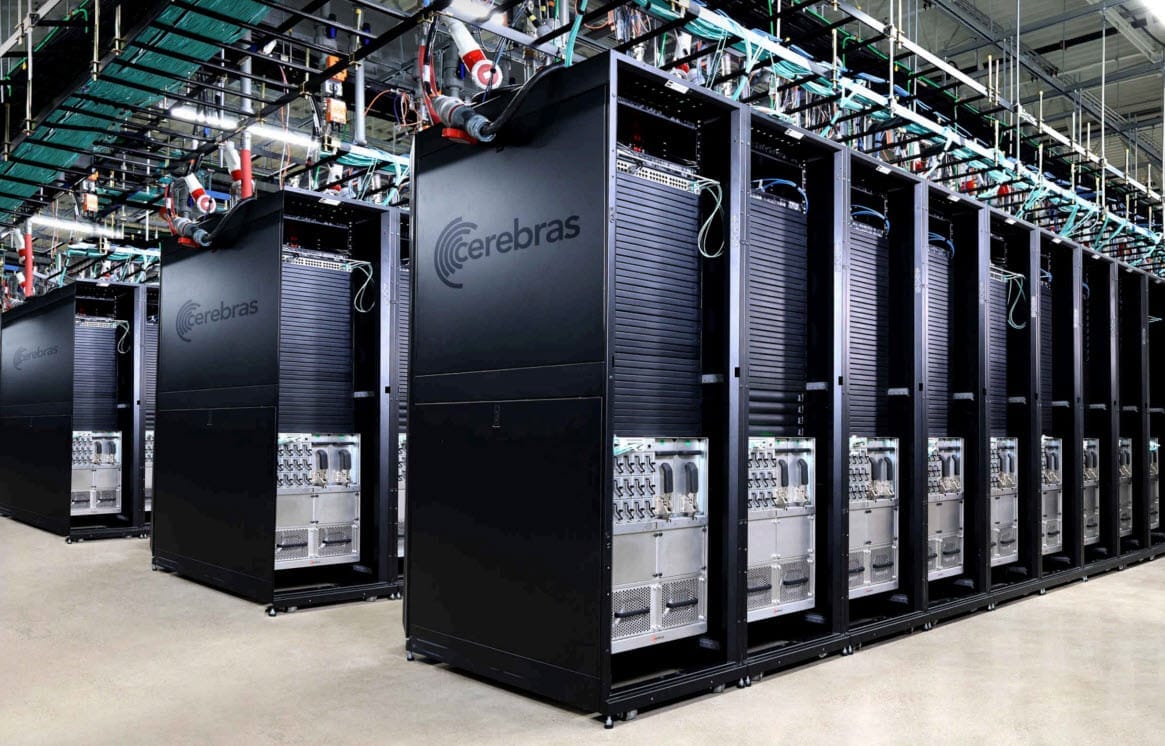
Cerebras filed an amended S-1 Monday with a $115–$125 price range across 28 million shares — a $3.5B raise at a $26.6B fully-diluted valuation, with pricing teed up for the night of May 13 and first trades May 14 on the Nasdaq under CBRS (SiliconANGLE). Morgan Stanley, Citi, Barclays, and UBS lead the book.
The number worth flagging isn't $26.6B in isolation. It's where it sits relative to the secondary tape. Forge and Hiive desks were quoting Cerebras at $26–28B through April, against the original April 17 S-1 target of $22–25B. Monday's filing didn't move toward the secondary mark — it landed inside it. That's a setup we haven't seen often this cycle. For most of the last decade, IPOs priced through the secondary market and private holders took a haircut on the way out. Cerebras reverses the polarity: the secondary tape was the leading indicator, and the IPO is being marked to it. Two reads. This is a confirmed-bid event, not a price-discovery event — exactly what the IPO market needs after eight quarters of cancellations. And whatever clears May 13 becomes the comp the rest of the AI infra cohort has been waiting for: Groq, SambaNova, Tenstorrent, Etched.
The thing the IPO investor is really being asked to underwrite isn't Cerebras' chip economics. It's the $20B+ Master Relationship Agreement with OpenAI— a 750 MW compute commit through 2030 with an option to scale to 2 GW, plus warrants that could give OpenAI up to ~10% of Cerebras at full vesting. Strip the MRA out and the trailing-twelve-month picture is $510M in FY25 revenue chasing a $26.6B mark.
💨 Quick Takes

- Anthropic's $50B round at $900B could close in two weeks — Separate from the Blackstone JV, Anthropic is in talks for a primary equity raise that would more than double its February $380B Series Gand leapfrog OpenAI's $852B March primary mark. Board decision reportedly expected in May. The Forge secondary mark has already been pricing close to $1T for several weeks, so a close at $900B would compress the gap between primary and secondary to roughly nothing.
- Haun Ventures raises $1B across two funds — Katie Haun split the raise evenly between an early-stage and a later-stage vehicle, with a global mandate at the intersection of financial services, AI agents, and alternative assets. Receipts make it worth tracking: Bridge sold to Stripe for $1.1B (Haun was in at a $100M mark), BVNK to Mastercard for $1.8B, and the firm holds an early position in Erebor, the $4.35B Palmer Luckey/Founders Fund–backed, FDIC-insured digital bank. The thesis — that AI agents will need regulated financial plumbing, and the stablecoin-infrastructure cohort is positioned to build it — points at exactly the cohort that ends up on the secondary tape two-to-three years out.
- Sierra raised $950M at $15.8B post-money — Bret Taylor's AI customer service agent company, up from $10B in fall 2025. Tiger Global and GV led, with Benchmark, Sequoia, and Greenoaks following on. The round is notable both for the size and for being in a category (AI agents for customer service) that's commoditizing fast. The market is pricing the founder-and-distribution premium more than the technology premium.
- SpaceX public S-1 window opens May 15 — The confidential filing has been with the SEC since April 1; the 15-day pre-roadshow rule means a June listing requires the public version this month, with May 22 as the back end of the window. Roadshow is targeting the week of June 8.
- Blackstone files for $1.75B Digital Infrastructure Trust IPO — A REIT (ticker BXDC, NYSE-listed) priced at $20 per share, externally managed by Blackstone, with priority over other Blackstone funds for data-center deals sourced by the firm. Targets newly built data centers in the $250M–$1.5B range, leased to investment-grade hyperscalers. Reads alongside KKR's $10B Helix raise from last week as the institutional infra trade getting industrialized through public-market vehicles, not just funds.
- SEC pushes back the prediction-market ETF cohort — Reuters reported Monday that the SEC delayed roughly two dozen ETFs from Roundhill, Bitwise, and GraniteShares that were set to launch this week, requesting more information on product mechanics, pricing-algorithm translation to share prices, and disclosure structure. Reads against last Friday's Senate prediction-market trading ban as a unified federal posture forming faster than the secondary marks for Kalshi and Polymarket would suggest.
📈 Data Point of the Day
$14 billion
The post-money valuation of OpenAI's new "Deployment Company" JV — $4B+ in fresh capital at a $10B pre-money mark, per Bloomberg's reportingMonday. Anthropic's parallel JV with Blackstone, H&F, and Goldman is $1.5B in committed capital. Together that's $5.5B+ of fresh institutional money committed in a single news cycle to a structure that didn't exist a quarter ago — a frontier-lab deployment vehicle, separately capitalized, with PE-style backers underwriting services revenue rather than model risk. If the OpenAI Deployment Company begins to trade on the secondary platforms over the coming quarters, the marks will be the first read on whether the market thinks the deployment business deserves a multiple of its own — distinct from the lab parent.
🎓 Manual
Greenshoe option
A provision in an IPO that gives the underwriters the right to sell additional shares — typically up to 15% — at the offering price, usually within 30 days, if demand exceeds the base allocation. Named after Green Shoe Manufacturing, where the structure first appeared in 1963. In Cerebras' filing Monday, the syndicate holds an option on an additional 4.2 million shares on top of the 28 million-share base, which at the top of the range would push the total raise from ~$3.5B to closer to $3.9B. The greenshoe is the cleanest single signal of how oversubscribed an IPO actually was — if it gets exercised in full within the first month, demand was real, not staged.
👀 What We're Watching
- Cerebras pricing on May 13. The cleanest near-term read on whether the $26–28B secondary mark holds when paper hits the public float. Watch the greenshoe exercise window through June for the cleanest signal of follow-through demand.
- The deployment-JV cap stack. Both Anthropic's and OpenAI's deployment vehicles are now separate equity instruments, with their own investors and their own valuation marks. Whether they trade on the secondary platforms — and at what marks — is the first read on whether the deployment business deserves a multiple distinct from the lab parent. Forge and Hiive listings would be the signal.
- SpaceX's public S-1 timing. Every business day past May 15 tightens the calendar for a June listing. A late-May filing would likely push the roadshow into mid-to-late June, stacking against Cerebras' first earnings print and the Anthropic round close.
- The Trump administration's AI EO.Per the NYT, with Bloomberg follow-on, the administration is discussing an executive order that would create an AI working group of tech executives and government officials and add pre-release model review — a sharp reversal of the prior hands-off posture, with Anthropic's Mythos cited as the catalyst. If it lands soon and is broad in scope, it materially changes the disclosure calculus for any lab considering a 2026 IPO — including OpenAI, whose CFO has reportedly told insiders the company isn't on track for Q4 (Morningstar).
Augment Markets Inc. is a technology company offering software and data services. Brokerage services are offered through Augment Capital LLC, an affiliated broker-dealer and member FINRA/SIPC. Investment advisory services are offered through Augment Advisors LLC, an SEC-registered investment adviser.
Important Disclosures: This material has been prepared for informational purposes only. None of the information provided represents a recommendation, an offer or the solicitation of an offer to buy or sell any security. The information provided does not constitute investment, legal, tax, or accounting advice. You should consult with qualified professionals before making any investment decisions. Investing in private securities involves substantial risk, including the potential loss of principal. Private securities are typically illiquid, have limited pricing transparency, and often require longer holding periods. These investments are available exclusively to qualified accredited investors and offer no guarantee of returns. An IPO or other liquidity event is not guaranteed. Additionally, past performance of private securities does not indicate or predict future results. Share price data are estimates only, based on proprietary data from Caplight and Augment Markets Inc. and its affiliates.

Paul leads editorial at Augment, building Pulse into the private markets' go-to intelligence source. He also develops editorial content strategies for startups and venture capital firms. Previously, he spent 15 years as a business and opinion journalist at The New York Times, Fortune, Fast Company, Reuters, and more. He believes transparency creates liquidity—and that someone should actually publish what private shares are trading for. He lives in Marin with his wife and two rescue dogs, and wishes he had more time to surf.
Learn more