

The Big Story: Meta Just Signed a $21 Billion Receipt for AI Compute
Meta and CoreWeave announced Wednesday that they have expanded their AI infrastructure agreement by $21 billion, a deal that will run from 2027 through 2032 and supply Meta with cloud capacity powered in part by Nvidia's next-generation Rubin chip systems. It is the largest single AI cloud commitment disclosed this year. Combined with the $14.2 billion contract announced six months earlier, CoreWeave now holds $35 billion in total commitments from Meta alone.
The scale of the deal is worth pausing on. CoreWeave went public earlier this year carrying a revenue concentration problem — Microsoft represented 62% of the company's 2024 revenue, which made any IPO conversation a discussion about single-customer risk. With the expanded Meta commitment in place, CoreWeave says no single customer will represent more than 35% of total contracted revenue. In one deal, the structural overhang that defined CoreWeave's public-market narrative shifted from a liability to a resolved question.
For private-markets readers, the signal cuts two ways. On the demand side, Meta's willingness to lock in $35 billion in external AI compute through 2032 is another indication that hyperscaler AI infrastructure demand has not peaked. Mark Zuckerberg has framed 2026 as the year Meta goes all-in on AI infrastructure, and the company's total 2026 capex budget has been widely reported at $60 to $65 billion. Meta is not just building its own data centers — it is buying someone else's, too.
On the supply side, CoreWeave announced alongside the deal that it would raise $3 billion in fresh debt, bringing total debt financing to roughly $15 billion. That level of leverage against a company whose revenue base did not exist three years ago could be a bet that contracted revenue from Meta and Microsoft will convert into durable cash flows. If the AI infrastructure cycle extends, the debt is cheap fuel. If it compresses, the leverage works in the other direction.
The timing is hard to miss. The same week OpenAI paused its £31 billion Stargate UK data center project citing energy costs and regulatory uncertainty, Meta doubled down on external compute. The divergence is the story: the two largest AI spenders in the world are making opposite bets on whether the buildout should accelerate or decelerate, and they are doing it within 48 hours of each other.
Then Friday added another layer. Anthropic announced its own multi-year agreement with CoreWeave to run Claude workloads at production scale, with Nvidia chip capacity coming online at U.S. data centers later this year. Financial terms were not disclosed. But the strategic picture is now unambiguous: CoreWeave has signed Anthropic, OpenAI, Google, and Meta — the four largest AI model developers in the world — bringing its total contracted backlog to a reported $66.8 billion. CoreWeave's stock jumped in premarket trading on the news. For a company that went public months ago with a single-customer risk overhang, the week ended in a materially different position than it started.
Sources: CNBC | CoreWeave Press Release | The Next Web | Bloomberg
Anthropic Employees Won't Sell at $350 Billion
Building Anthropic | A conversation with our co-founders
Anthropic completed its employee tender offer this week at a $350 billion valuation — and the result was not what investors expected. Demand from outside buyers reportedly reached as high as $6 billion. The supply of shares that employees were willing to sell came in well below that number. The limiting factor was not capital.
Current and former employees appear to be holding equity ahead of what could be an IPO as early as this year. That calculus has gotten easier to justify in recent months. Anthropic disclosed a $30 billion revenue run rate on Tuesday — up from roughly $9 billion at the end of 2025. On Friday the company also announced a multi-year compute agreement with CoreWeave to power Claude at production scale, adding a major infrastructure partnership to a week that already included a new cybersecurity model and chip design exploration. The company launched Project Glasswing on Wednesday — a frontier cybersecurity model sharp enough to move CrowdStrike and Palo Alto Networks shares on the news. And Reuters reported Wednesday that Anthropic is now exploring designing its own AI chips, though the plans are in early stages and the company has not committed to a specific design or assembled a dedicated team.
For anyone who tracks secondary-market dynamics, the Anthropic tender is a case study in what happens when a company's internal stakeholders become more bullish than the outside market. A $350 billion tender that investors were eager to fill and employees chose to hold is a pricing signal: the people closest to the business believe the next liquidity event — possibly a public offering — will clear at a higher number. Whether they are right depends on whether the revenue trajectory sustains. But the signal is clear enough that secondary-market bid-ask spreads on Anthropic may widen in the near term, as buyers who were underallocated in the tender look for alternative entry points.
(Video is not related to this story, just an interesting back and forth between all the co-founders.)
Sources: Bloomberg | Yahoo Finance | GuruFocus
SiFive's Last Private Round
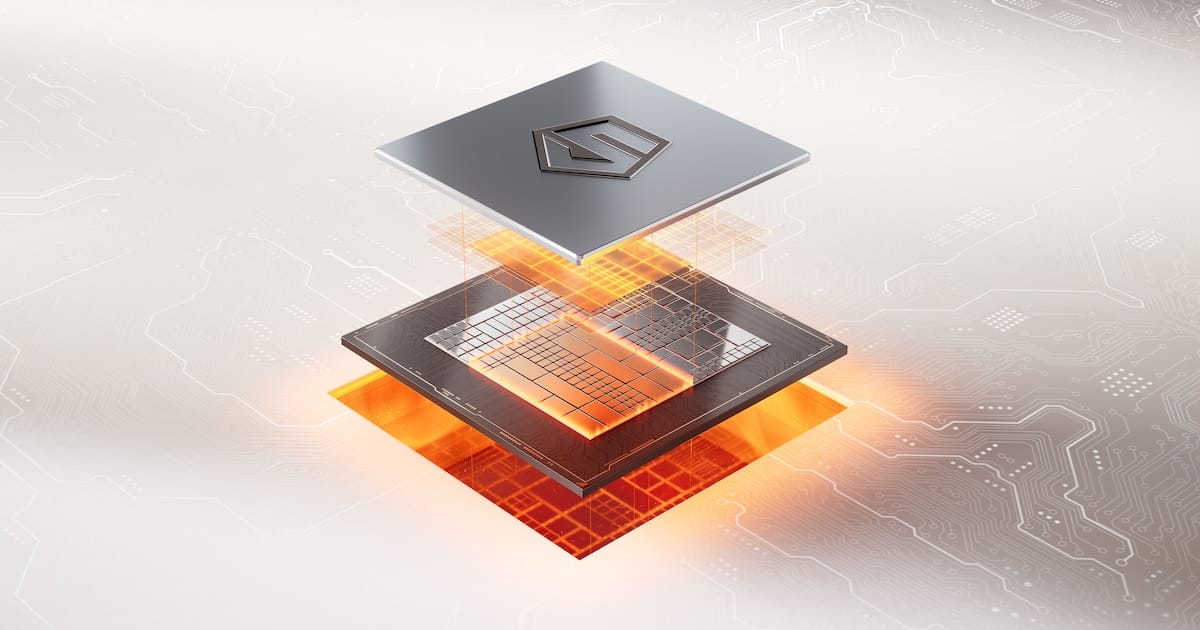
SiFive, the RISC-V chip designer, raised $400 million in a Series G at a $3.65 billion valuation on Wednesday, in what CEO Patrick Little said would be the company's final funding round before an IPO. The round was led by Atreides Management with participation from Apollo Global Management, Nvidia, Point72, and T. Rowe Price — a cap table that reads like a roster of crossover investors positioning for a public offering.
The investment thesis is that RISC-V, the open-source instruction set architecture, is moving from the embedded-systems periphery to the center of the AI data center. SiFive is positioning its CPU and AI IP solutions as alternatives to Arm-based processors for inference and data-handling workloads that sit alongside GPU clusters. As the AI infrastructure stack matures and hyperscalers look for cost advantages at every layer, the argument for open-source silicon in the data center has gotten more concrete.
Two things make this round worth watching. First, the crossover investor presence — Apollo, T. Rowe Price, and Point72 do not typically lead late-stage semiconductor rounds unless they see a public-market timeline. Second, SiFive's $3.65 billion valuation is modest by 2026 AI standards, which gives an IPO more room to price at a premium. In a market that has been burned by overpriced AI debuts, a reasonably valued chip company with a clear technical moat may be the kind of name the IPO window rewards.
Sources: SiFive Press Release | Reuters| Yahoo Finance
Power 20 Watch: The Narrative Scoreboard
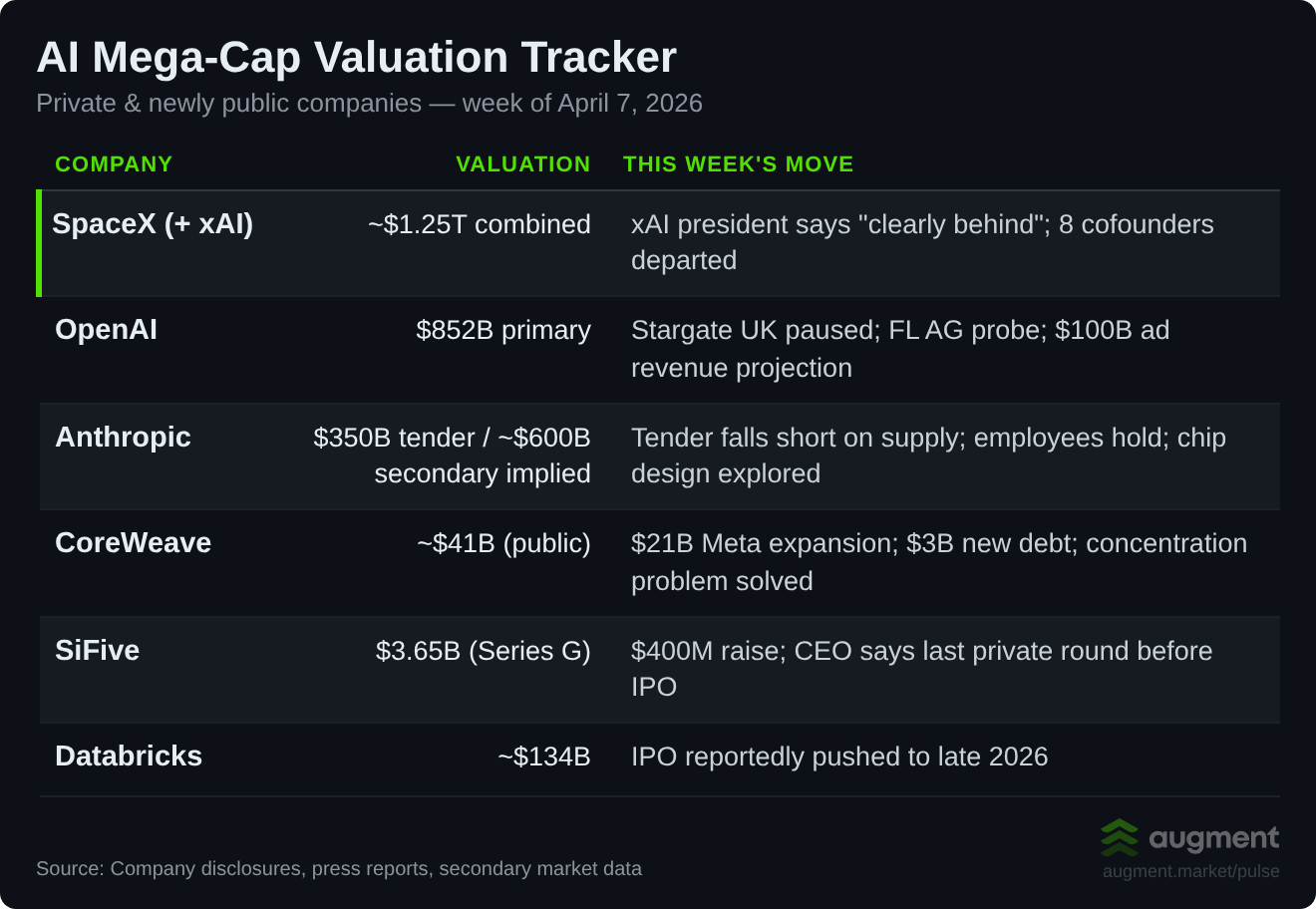
Valuations reflect most recent disclosed primary rounds, public market cap, or secondary-implied figures as reported. Not indicative of current or future market value.
Three data points from this week that land directly on the Power 20:
OpenAI is now projecting $100 billion in ad revenue by 2030. Axios reported Wednesday that OpenAI expects advertising to generate roughly $2.5 billion in 2026, quadruple to $11 billion in 2027, and reach $102 billion by 2030 — which would represent approximately 36% of the company's total revenue at that point. The ad pilot reportedly hit $100 million in ARR within two months. If the projection is even directionally correct, OpenAI is not building a subscription business with an ad supplement. It is building an ad business with a subscription supplement.
For a company valued at $852 billion on the strength of its AI subscription model, the pivot to ads as a primary revenue line changes the comparables set from "enterprise SaaS at scale" to "Google and Meta" — and the margin and capital structure implications of that shift are substantial.
xAI is reorganizing under new leadership. SpaceX SVP Michael Nicolls, who previously ran Starlink, has taken the title of xAI president and sent a memo to staff saying the AI unit is "clearly behind" the competition. Eight of xAI's original cofounders have departed since January, including engineers who led Grok Code and the Macrohard computer-use agent project. The reorganization installs new technical leads across pre-training, model factory, and post-training. For a merged entity reportedly valued at $1.25 trillion ahead of an IPO, the xAI integration remains the open question that public investors will need to price. That uncertainty has only sharpened investor interest in xAI stock ahead of a prospective listing.
Anthropic is exploring custom chip design. Reuters reported that the company is weighing whether to design its own AI chips, though plans are early-stage and no dedicated team has been assembled. This comes weeks after Anthropic signed a long-term deal with Google and Broadcom for 3.5 gigawatts of TPU capacity from 2027. If Anthropic follows through, the company would join Amazon, Google, Meta, and Microsoft in the custom-silicon cohort — and would be the first pure-play AI lab to attempt the move.
Sources: SiFive Press Release | Reuters| Yahoo Finance
Quick Takes
Chapter raises $100M Series E at $3B valuation for AI-powered Medicare navigation — Chapter tripled revenue in the past year and crossed $100 million in ARR. The company matches seniors with Medicare plans using AI, and the round was led by Generation Investment Management. A $3 billion valuation for a company that doubled its price in under a year, in a vertical that serves the demographic most underserved by technology, is the kind of non-obvious growth story that tends to look inevitable in retrospect.
Aria Networks raises $125M Series A for AI-native data center switches — Founded by Mansour Karam, who previously built Apstra (acquired by Juniper Networks in 2020), Aria is building Ethernet switches purpose-built for AI clusters. Sutter Hill Ventures and Atreides Management co-led. A $125 million Series A for a networking hardware startup is a size that reflects the infrastructure layer's appetite for specialized components beyond GPUs.
Starfish Space closes $100M+ Series B for satellite servicing — Point72 Ventures led. Starfish builds Otter spacecraft that dock with, repair, and deorbit satellites in orbit. The company holds contracts with the U.S. Space Force ($92 million across two missions), the Space Development Agency ($52.5 million), NASA ($15 million), and commercial operator SES. First launch is later this year. Satellite servicing has moved from niche concept to national security priority, and the contract backlog suggests this is revenue, not research.
Elorian emerges from stealth with $55M for visual AI— Details remain thin, but the round size for a stealth-stage visual AI company is notable. Watch for whether this targets media, enterprise, or industrial visual understanding.
Life Biosciences raises $80M Series D for longevity therapeutics— The longevity space continues to attract institutional capital. Series D sizing suggests the company is moving toward clinical-stage validation.
📈Data Point of the Day
$102 billion
That is the ad revenue OpenAI projects it will generate by 2030, according to internal documents reported by Axios. The trajectory: $2.5 billion in 2026, $11 billion in 2027, $25 billion in 2028, $53 billion in 2029, $102 billion in 2030. If that number materializes, it would represent roughly 36% of OpenAI's total revenue — making advertising, not subscriptions, the company's largest revenue line within four years. For context, Google's ad revenue in 2025 was approximately $265 billion. OpenAI's projection implies capturing roughly a third of what Google currently earns from ads, while simultaneously running a $200+ billion subscription and API business. The ad pilot reportedly hit $100 million ARR in under two months. Whether the projection is credible or aspirational, the fact that OpenAI is building its financial model around ad economics — not just enterprise SaaS — changes the comp set for anyone pricing a potential IPO.
🎓 Manual
Tender Offer (Employee)
A structured transaction in which a company arranges for outside investors to purchase shares directly from current or former employees at a predetermined price, typically at or near the company's most recent primary valuation. Unlike a secondary sale on a platform (which is negotiated between buyer and seller), a tender offer is coordinated by the company, often with board approval, a set price, and a defined window. The mechanism gives employees partial liquidity without requiring the company to go public. This week's Anthropic tender at $350 billion illustrated a dynamic that tender offers occasionally produce: investor demand exceeded employee willingness to sell, resulting in a supply-constrained outcome that signals where insiders believe the next pricing event will land.
👀 What We’re Watching
- Whether CoreWeave's Meta deal shifts the IPO comp set.CoreWeave traded as a single-customer-risk story for its first months as a public company. With $35 billion in Meta commitments and no customer above 35% of contracted revenue, the stock may begin trading on growth rate and margin expansion instead. Watch for analyst re-ratings.
- SiFive's IPO timeline and pricing. The CEO said this was the last private round. Crossover investors (Apollo, T. Rowe, Point72) do not typically enter at $3.65 billion unless they see a path to a meaningfully higher public valuation within 12 to 18 months. If SiFive files in Q3 or Q4, it would be the first pure-play RISC-V company to test public markets.
- Anthropic secondary bid-ask after the tender. Investor demand reportedly reached $6 billion; employee supply fell well short. That unmet demand needs to go somewhere. Secondary-market platforms — Augment included — may see an uptick in Anthropic inquiry volume as underallocated buyers look for alternative entry points.
- The xAI integration clock. A SpaceX IPO could file this year at a valuation above $2 trillion. The xAI piece of that story — new president, "clearly behind" memo, 8 departed cofounders — is the most uncertain variable in what would be the largest tech IPO in history. Every disclosure between now and the S-1 will be priced by secondaries.
Augment Markets Inc. is a technology company offering software and data services. Brokerage services are offered through Augment Capital LLC, an affiliated broker-dealer and member FINRA/SIPC. Investment advisory services are offered through Augment Advisors LLC, an SEC-registered investment adviser.
Important Disclosures: This material has been prepared for informational purposes only. None of the information provided represents a recommendation, an offer or the solicitation of an offer to buy or sell any security. The information provided does not constitute investment, legal, tax, or accounting advice. You should consult with qualified professionals before making any investment decisions. Investing in private securities involves substantial risk, including the potential loss of principal. Private securities are typically illiquid, have limited pricing transparency, and often require longer holding periods. These investments are available exclusively to qualified accredited investors and offer no guarantee of returns. An IPO or other liquidity event is not guaranteed. Additionally, past performance of private securities does not indicate or predict future results. Share price data are estimates only, based on proprietary data from Caplight and Augment Markets Inc. and its affiliates.

Paul leads editorial at Augment, building Pulse into the private markets' go-to intelligence source. He also develops editorial content strategies for startups and venture capital firms. Previously, he spent 15 years as a business and opinion journalist at The New York Times, Fortune, Fast Company, Reuters, and more. He believes transparency creates liquidity—and that someone should actually publish what private shares are trading for. He lives in Marin with his wife and two rescue dogs, and wishes he had more time to surf.
Learn more