

How do you avoid exorbitant fees, counterparty risk, or outright fraud when investing in pre-IPO SPVs?
The hard truth is there might not be any way to completely avoid these risks. These markets are risky, and the current frenzy for pre-IPO only exacerbates that risk. The valuations we are seeing for the top private companies are completely unprecedented, and while this creates huge opportunity for investors, it also creates incentive for bad actors.
Recently, we ourselves had firsthand experience with suspected fraud in this space. We took action to investigate and are actively working with federal law enforcement and regulators, but in this case offered to return invested capital and fees to affected investors off of our own balance sheet ahead of any potential recovery.
That being said, there are important things investors can do to mitigate counterparty risk when investing in SPVs:
1. Invest through FINRA/SEC-regulated entities or those with audited financials. Regulated broker-dealers are subject to oversight and compliance requirements that unregulated operators simply are not, and RIAs have even greater audit requirements.
2. Prioritize direct cap table placement. The gold standard is for the vehicle to be listed directly on the company's cap table. In multi-layer SPVs, you're trusting the operator's solvency and integrity. The further you are from the cap table, the more counterparty risk there is.
3. Understand the full chain of ownership before you wire. Ask for the complete legal structure: Who holds the shares? Under what entity? Who is the manager? Is there a custodian? Does the seller have appropriate legal counsel involved? Who controls the SPV's LLC agreement, and what rights do you actually have? Legitimate operators will have legible answers.
4. Scrutinize the fee structure in full. Management fees, carry, admin fees, wire fees, and custody fees can stack in ways that dramatically erode returns even on a successful investment.
5. Verify the source and provenance of the shares. Not all pre-IPO shares are equal. Understand whether you're buying from a fund, a current or former employee, or other secondary trader. Uninvestigated provenance is one of the most common sources of deals falling apart.
6. Don’t let urgency pressure you into committing. Great deal opportunities can move fast. But legitimate deals can withstand diligence. If you can’t get clear answers to important questions before wiring, think twice.
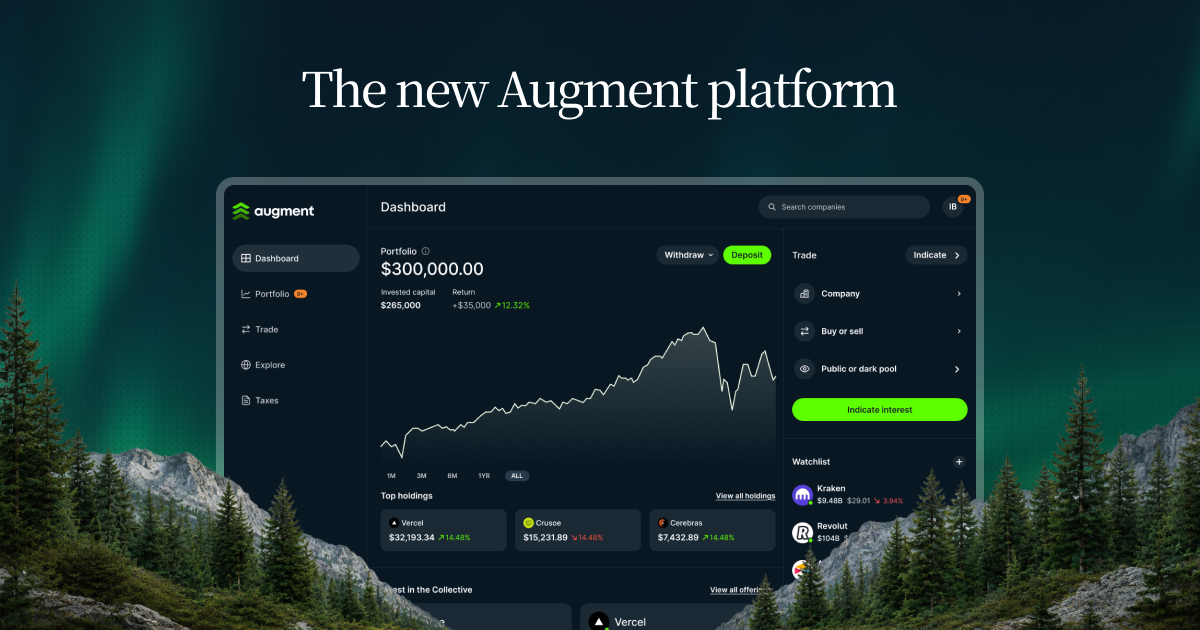
Our platform has nearly $1.5B in AUM, with the vast majority invested on cap tables or directly through registered investment advisors. We’ve also distributed $10s of millions back to investors in less than two years of operations.
With a front row seat to the rapid scaling of pre-IPO markets in just the last few years, we’ve found the gap impossible to ignore: public markets have decades of infrastructure, standards, and shared literacy that simply don’t exist for private markets yet. Closing that gap, both through better infrastructure and a more informed market, is how private markets become truly liquid, accessible, and transparent.
Augment Markets Inc. is a technology company offering software and data services. Brokerage services are offered through Augment Capital LLC, an affiliated broker-dealer and member FINRA/SIPC. Investment advisory services are offered through Augment Advisors LLC, an SEC-registered investment adviser.
Important Disclosures: This material has been prepared for informational purposes only. None of the information provided represents a recommendation, an offer or the solicitation of an offer to buy or sell any security. The information provided does not constitute investment, legal, tax, or accounting advice. You should consult with qualified professionals before making any investment decisions. Investing in private securities involves substantial risk, including the potential loss of principal. Private securities are typically illiquid, have limited pricing transparency, and often require longer holding periods. These investments are available exclusively to qualified accredited investors and offer no guarantee of returns. An IPO or other liquidity event is not guaranteed. Additionally, past performance of private securities does not indicate or predict future results. Share price data are estimates only, based on proprietary data from Caplight and Augment Markets Inc. and its affiliates.

Noel is an engineer at heart and a product builder at Augment, focused on creating tools that bring genuine joy to users. He previously scaled Rubrik’s on-prem technology to the cloud as an early employee and spent time at Google. He’s a serial builder of side projects, ranging from self-destructing notepads to crypto mining tools. He believes that engineering is a craft—and that great products are built at the intersection of technical rigor and user delight. He lives in Austin with his wife, two kids, and their Golden Retriever. He unfortunately maintains an unironic, shameless love for Nickelback.
Learn more