



A widely-pitched trade in private AI investing — buy Microsoft for OpenAI, Amazon for Anthropic, Tesla for xAI — dilutes the underlying bet by a factor of ten or more, with the Tesla version diluting xAI exposure by roughly 750x. Sunday's Microsoft-OpenAI restructuring just broke the cleanest example.
Deep Dive

The Setup
For three years, the question wealth advisors have gotten more often than any other has been a version of how do I buy OpenAI? The answer has been the same regardless of whether the advisor works at Morgan Stanley or LPL: you can't, but you can buy Microsoft. They own a chunk of OpenAI. They have the cloud. They take a slice of OpenAI's revenue.
A proxy is something that tracks the underlying. None of the AI proxy stocks — Microsoft, Amazon, Tesla — track. They never did. As of Sunday, the cleanest example no longer pretends to.
The Evidence
Three companies, three numbers.
Microsoft and OpenAI: 4–9%
On Sunday, as we covered, Microsoft and OpenAI rewrote their partnership. Before Sunday's restructuring, Microsoft had three claims on OpenAI's economic future. An equity stake in the for-profit subsidiary, capped at a contractually fixed ceiling. A 20% revenue share through 2030, now capped at an undisclosed total. Exclusive distribution on Azure, now gone. Microsoft is a $3.5 trillion company. The OpenAI-correlated value buried in its capital structure, on a generous read, is between $150 billion and $300 billion — 4 to 9% of the market cap. The other 91 to 96% is Office, Azure, gaming, LinkedIn, security, and a balance sheet large enough to absorb a doubling or halving of the OpenAI piece without registering on the chart. Microsoft held as an OpenAI proxy delivers that exposure diluted by a factor of ten — roughly one-tenth of what the pitch implies. The dilution got worse on Sunday.
Amazon and Anthropic: 2.5%
Amazon has committed up to $33 billion to Anthropic, with $13 billion already deployed. At Anthropic's $350 billion mark, Amazon's stake is between $50 and $60 billion — 2.3 to 2.7% of Amazon's $2.2 trillion market cap. A 100% doubling of Anthropic moves Amazon's implied stake by $50 billion. Amazon trades a daily standard deviation in the neighborhood of $40 billion. The exposure is invisible in the daily price action.
Tesla and SpaceX: 0.13%
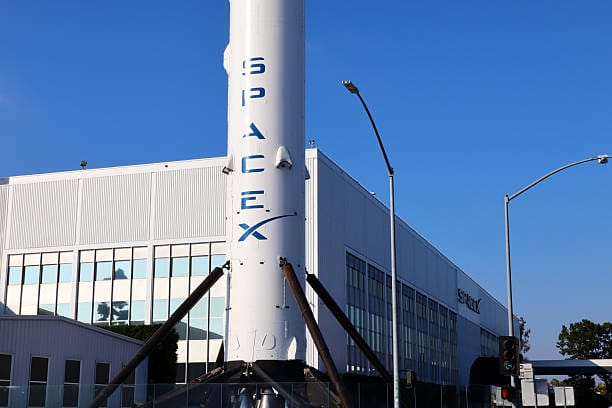
Tesla disclosed a $2 billion investment in xAI in its Q4 2025 earnings. Six weeks later, xAI merged into SpaceX in a share-for-share deal. Tesla's xAI shares converted to shares of the combined entity. The math holds either way: $2 billion in a $1.5 trillion market cap is 0.13% of Tesla. Tesla held as an xAI proxy delivers that exposure diluted by a factor of roughly 750 — three orders of magnitude thinner than the pitch implies. The xAI exposure that Tesla disclosed is now SpaceX exposure that nobody pitched.
The Distinction That Matters
The standard objection is that proxies don't have to track 1:1 to be useful — directional correlation is enough. The math says even directional correlation requires the bet to register on the chart. Tesla's xAI exposure at 0.13% is below the daily noise floor of TSLA's price action. Amazon's Anthropic exposure at 2.5% is just inside it. Microsoft's OpenAI exposure at 4 to 9% is the only one large enough to move the stock — and as of Sunday, the cap on that exposure got tighter, not looser.
The dilution factor of any "buy the parent" trade depends on the parent's market cap relative to the size of the bet. Microsoft is too big for OpenAI to matter. Amazon is too big for Anthropic to matter. Tesla is too big for xAI to matter.
Zoom is small enough. Zoom Ventures invested $51 million in Anthropic in 2023. Baird now marks that stake at $2 to $4 billion. Zoom's market cap is $26 billion. The Anthropic stake is 8 to 15% of the company — three to five times the Amazon ratio.
The Private Markets Angle
For investors who came to private AI through the public proxy trade, Sunday's restructuring is the clearest signal yet that the public pipe is closing. Direct private-AI exposure — the kind that prices off OpenAI, Anthropic, Anduril, SpaceX directly — is increasingly available only through accredited secondary platforms or institutional vehicles.
The pattern of capital moving from public incumbents to private disruptors is visible in deal data. Decagon's $4.5 billion tender reflects revenue transfer from Salesforce Service Cloud, Five9, and the rest of the customer-service stack. Anduril's $20 billion Army contract reflects budget transfer from Lockheed, RTX, Northrop.
The Counterargument
The strongest version of the proxy thesis is that public stocks don't need to track 1:1 to be useful — they need to be a story the market is willing to pay up for. Microsoft, Amazon, and Tesla have all benefited from being named in AI conversations regardless of whether the math supports it. The narrative premium is real, and as long as the narrative holds, the trade works. The counter to the counter: the narrative premium evaporates the moment a real number appears. Sunday's restructuring put a real number on Microsoft's piece of OpenAI. The premium has nowhere to hide.
📈Data Point of the Day
8%
That's the average secondary market discount on EquityZen in Q1 2026, down from 49% in early 2024 and 29% at the end of 2025. Even as the proxy trades got more dilutive, the actual private market got tighter — the spread between "what the public proxy gives you" and "what direct secondary access costs" has narrowed substantially in eighteen months. The pipe to private AI exposure isn't just closing on the public side. It's getting more competitive on the private side too.
🎓 Manual
Strategic Investor
A corporate entity that takes equity in a private company for business reasons — cloud capacity, distribution rights, IP access — rather than purely financial returns. Strategic investors typically negotiate operational rights (exclusive distribution, IP licenses, technical integrations) that financial investors don't. When those rights are unwound, as in Microsoft's April 27 restructuring with OpenAI, the strategic investor often becomes a financial investor by default.
Augment Markets Inc. is a technology company offering software and data services. Brokerage services are offered through Augment Capital LLC, an affiliated broker-dealer and member FINRA/SIPC. Investment advisory services are offered through Augment Advisors LLC, an SEC-registered investment adviser.
Important Disclosures: This material has been prepared for informational purposes only. None of the information provided represents a recommendation, an offer or the solicitation of an offer to buy or sell any security. The information provided does not constitute investment, legal, tax, or accounting advice. You should consult with qualified professionals before making any investment decisions. Investing in private securities involves substantial risk, including the potential loss of principal. Private securities are typically illiquid, have limited pricing transparency, and often require longer holding periods. These investments are available exclusively to qualified accredited investors and offer no guarantee of returns. An IPO or other liquidity event is not guaranteed. Additionally, past performance of private securities does not indicate or predict future results. Share price data are estimates only, based on proprietary data from Caplight and Augment Markets Inc. and its affiliates.

Paul leads editorial at Augment, building Pulse into the private markets' go-to intelligence source. He also develops editorial content strategies for startups and venture capital firms. Previously, he spent 15 years as a business and opinion journalist at The New York Times, Fortune, Fast Company, Reuters, and more. He believes transparency creates liquidity—and that someone should actually publish what private shares are trading for. He lives in Marin with his wife and two rescue dogs, and wishes he had more time to surf.
Learn more