


The Private Markets Ticker
Merrill Lynch - Bullish
Fifty years ago, Merrill Lynch ran an ad with a stampede of bulls and the tagline "Bullish on America." The pitch was simple: ordinary people deserved access to stocks, not just the wealthy few. It worked. Mutual funds, index funds, 401(k)s, and discount brokers followed over the subsequent decades, each wave lowering the barrier a little further until retail participation in public markets became something close to universal.
That democratization stopped at a gate. The gate said: Private. Accredited Investors Only.
The companies that moved the most—Amazon through its 1990s hypergrowth, Google from startup to search monopoly, Uber from idea to transportation giant—did most of their early compounding behind that gate, invisible to ordinary investors. By the time they listed publicly, the big multiple expansions were already priced in. Retail got the (more) mature version.
Now a new generation of financial products is trying to tear down the gate. They have tickers. They trade on the NYSE. Anyone with a brokerage account can buy them. And right now, in what may be the most consequential week in this story's short history, the experiment is getting its first real-world stress test—with one high-profile entry already stumbling at the door, and another pulling back entirely rather than walk into the same headwind.
The Cast of Characters
DXYZ — The Pioneer
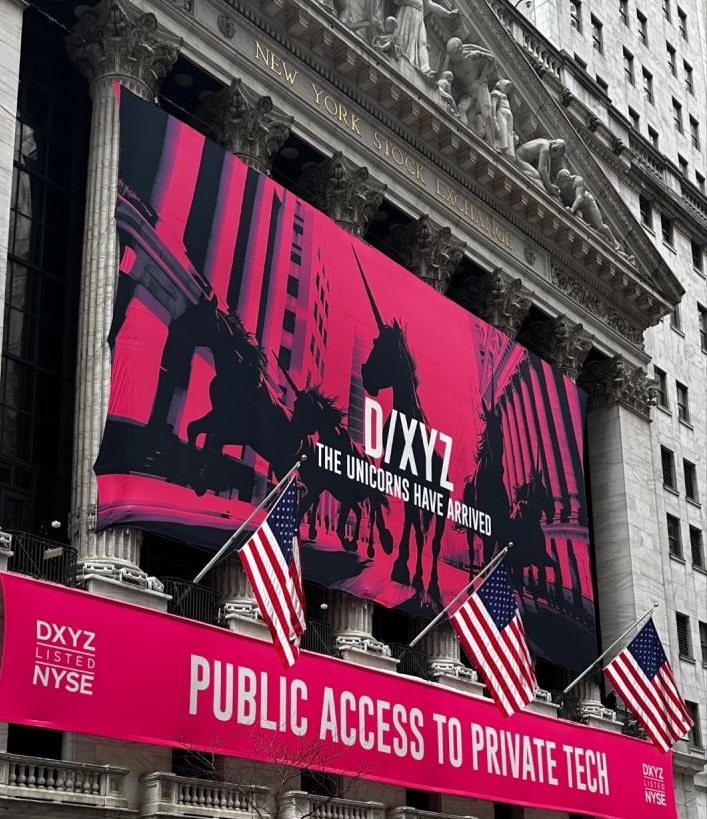
Destiny Tech100 (NYSE: DXYZ) was the first. When it listed in March 2024, it was a small closed-end fund with roughly $50 million in private company shares and an audacious premise: invest in up to 100 of the top venture-backed private companies, let anyone buy in, and provide daily liquidity on the NYSE.
What happened next became a case study in the power—and the peril—of the concept. In the fund's first month of trading, demand drove the premium to NAV above 2,000%, shattering the previous stock market record of 1,235% for a closed-end fund. At the peak, DXYZ's shares changed hands for roughly $77 each. The fund's underlying assets were worth around $5-$6 per share.
The gap between what people were willing to pay and what the portfolio was actually worth was not fraud. It was market structure: closed-end funds issue a fixed number of shares, so when demand exceeds supply, the price floats free of the underlying NAV. What the premium revealed was that the demand for private market exposure was so acute, and the supply of vehicles to access it so limited, that investors were essentially bidding up the access itself.
The premium has since compressed. DXYZ reported NAV of $19.97 per share for Q4 2025, up 210% year-over-year, as the private companies in its portfolio—Anthropic, SpaceX, and others—rose sharply. The stock was recently trading around $30, down roughly 37% over the prior year—meaning that while the NAV grew dramatically, the price fell as the premium compressed. Investors who bought at $70 for $5 of assets are not having a good time, even as the underlying business they were trying to access appreciated substantially.
That is the DXYZ lesson: the access problem is real. The arbitrage opportunity was temporary. These two things can both be true.
RVI — The Debut
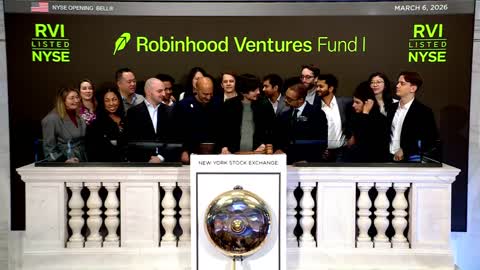
Last Friday, Vlad Tenev rang the opening bell at the NYSE. The occasion was the debut of Robinhood Ventures Fund I, ticker RVI. The offering priced at $25 per share, raising $658.4 million, with Goldman Sachs as sole bookrunner.
RVI is a closed-end fund holding a concentrated portfolio of private companies including Airwallex, Boom, Databricks, Mercor, Oura, Ramp, and Revolut, with additional companies to be added over time. The fund charged a 2% annual management fee, reduced to 1% for the first six months. No accreditation required. No investment minimum.
The fund plunged 11% on its first day of trading—opening below its IPO price and closing around $21.42. The company's president noted they were days away from closing a Stripe investment and were in negotiations for stakes in other highly valued private companies. Market sentiment on Stocktwits turned "extremely bullish" as retail investors appeared to treat the drop as a buying opportunity.
The 11% decline was not, in itself, alarming. New closed-end funds routinely trade below their IPO price after launch, as the underwriting fees and offering costs immediately reduce NAV below the offering price. What mattered more was the backdrop: the fund launched during a period of heightened volatility in public markets, and the market's willingness to pay a premium for private exposure was lower than it had been a year ago.
VCX — The One That Blinked
Fundrise had announced the upcoming NYSE listing of its Innovation Fund under the ticker VCX, targeting March 9—the same week RVI debuted. The fund holds over $650 million in net assets across more than 100,000 existing investors, with a portfolio concentrated in the highest-profile names in AI and defense tech: OpenAI, Anthropic, Databricks, SpaceX, Anduril, and Ramp.
Then RVI dropped 11% on its first day of trading.
VCX's listing has been postponed to a date to be announced.
Fundrise hasn't said why publicly, and the official framing will almost certainly involve "market conditions." That framing is accurate. But what the postponement actually reveals is more specific: Fundrise watched RVI trade below its IPO price on day one and concluded that launching a second private markets closed-end fund the following week, into the same market conditions, was not the right call.
This is rational. It's also the most honest signal this category has produced.
VCX had meaningful structural advantages over RVI heading into its planned debut. Its portfolio is weighted toward larger, more recognizable AI names. Its existing investor base of 100,000+ creates a floor of informed holders. Its management fee (1.85%, unchanged after a failed shareholder vote to raise it to 2.5%) is lower than RVI's 2%. Under normal conditions, those factors would likely have produced a better first-day outcome.
But the postponement suggests Fundrise believes "normal conditions" don't currently exist. The decision to delay rather than launch into a headwind is, in its own way, a more sophisticated read of the market than a bravado listing would have been.
What it means for the thesis: VCX will list eventually. The 100,000 existing investors aren't going anywhere—their capital is already deployed in the underlying fund. The listing is about adding exchange liquidity and expanding the investor base, not about raising new money. Fundrise can afford to wait for a better window. The question is whether the window opens before market sentiment around private market access funds has meaningfully shifted.
PRIVX — The Quiet One
Less discussed, but arguably the most structurally distinctive of the group, is The Private Shares Fund (tickers PRIVX, PIIVX, PRLVX). Rather than a closed-end fund trading on an exchange, it's an interval fund—a structure that allows any investor with a brokerage account to buy in, but limits redemptions to quarterly windows.
PRIVX is available through traditional custodial platforms such as Fidelity, Pershing, and Schwab, with a minimum investment of $2,500 and no accreditation requirement. The fund's largest holding is SpaceX, which—following SpaceX's acquisition of xAI in February 2026—now represents 18.51% of the combined position.
The interval fund structure means PRIVX doesn't trade like a stock. You can't buy and sell it intraday. But it doesn't have the closed-end fund NAV-premium problem either: because redemptions are processed at NAV during quarterly windows, there's no mechanism for the price to float absurdly above or below the underlying value. The tradeoff is liquidity: in a stressed market, if more investors want out than the quarterly redemption window can accommodate, gates can restrict withdrawals.
The Need These Products Are Filling
The size of the demand signal matters here. Understanding why requires a brief detour into how wealth creation actually worked in the last two decades of technology.
When Google went public in 2004, its valuation was roughly $23 billion. It's now worth about $3.7 trillion. Most of that appreciation happened in the public markets, available to anyone. Uber went public at roughly $76 billion and mostly traded sideways. The investors who made the extraordinary returns were the venture funds that got in at a few hundred million dollar valuations.
The staying-private-longer phenomenon is well-documented, but the numbers still land hard. Since 2000, the number of companies listed on U.S. exchanges has declined by over 30%, while the number of U.S. private equity-backed companies has grown by more than 6x. The most dynamic part of the economy—the part where the most value is created—is increasingly happening behind the accredited investor gate.
The gate itself is imperfect as a design. The accredited investor standard (net worth above $1 million excluding primary residence, or income above $200,000) was designed to ensure that investors in risky private offerings could withstand the loss. But it ends up being a wealth qualifier, not a sophistication qualifier. A recent college graduate with a computer science degree working at a hedge fund cannot buy pre-IPO SpaceX directly (with a few exceptions of course). A lottery winner with a million in the bank can.
Retail capital in private markets surged at nearly 60% compound annual growth rate over four years to reach approximately $360 billion in assets. In August 2025, President Trump signed an executive order opening the $12.5 trillion defined contribution market to alternatives, effective August 2026—a structural shift that could be the largest reallocation of capital in private markets history if it holds.
The political wind is blowing in one direction. The product innovation is responding. DXYZ, RVI, VCX, and PRIVX are all attempts to build the same thing: a bridge between public market accessibility and private market exposure.
The NAV Problem
The central technical tension in all of these products is the NAV problem, and it's worth understanding clearly.
Private companies don't have daily prices. They have valuations—usually based on the last funding round, sometimes updated quarterly by independent appraisers, always lagging and always somewhat imprecise. When you buy a closed-end fund holding SpaceX at the stated NAV, you're buying SpaceX at whatever price the fund's appraiser last calculated, not at a continuously updated market clearing price. (This is starting to change! And that’s part of the reason companies like CapLight, which collects private market data to enable price discovery, exist.)
But unless and until privately held companies have real-time published prices, this dynamic creates two risks that compound each other.
The first is valuation lag. If SpaceX's actual market price (which you can observe in the secondary market) has moved significantly since the last quarterly valuation, the NAV is stale. Buying a fund at a 20% premium to stated NAV might actually be buying at a 10% premium to true value, or a 5% discount—you don't know.
The second is premium risk. Because closed-end funds trade on exchanges, the share price can diverge significantly from NAV. If you buy at a 50% premium and the premium later compresses to 10%, you lose money even if the underlying portfolio appreciated. Again, this is what happened to many DXYZ investors who bought at peak-premium prices.
As Morningstar noted in a 2024 analysis of DXYZ, if you buy shares at a large premium, you are getting almost no exposure to the underlying private companies—you are mostly getting exposure to the premium itself. Interval funds like PRIVX avoid this specific problem, but they introduce gating risk: quarterly redemption windows that can be suspended or restricted.
Neither structure is obviously superior. They're different shapes of the same fundamental tension: private assets are illiquid by nature, and forcing them into liquid wrappers requires engineering tradeoffs somewhere.
What This Week Reveals
The most important data point from the last week wasn't RVI’s 11% drop. It was the combination of the drop and what came after: VCX, which had been scheduled to list the same week, quietly postponed to a date to be announced.
Two signals from two different companies, pointing in the same direction. When public market risk rises, capital looking for private exposure retreats. The RVI decline was the market speaking. The VCX postponement was Fundrise listening.
This matters because these two events together constitute a natural experiment that one fund alone couldn't run. RVI launched anyway, into the headwind, and fell below its offering price. VCX watched and decided the risk-reward of launching into the same conditions didn't make sense. The former tested the demand. The latter confirmed that even sophisticated operators with a stronger portfolio and a larger existing investor base concluded the moment wasn't right.
For these funds, that creates a reflexive problem that's structural, not cyclical: the moment markets get volatile—precisely when private markets might offer genuine diversification value—the public wrapper can become a liability. The NAV is stable (it only updates quarterly), but the share price can fall sharply as liquidity-seeking investors sell. The result can look like a private markets crisis when it's actually a public markets panic transmitted through the wrapper.
This is structurally different from how sophisticated institutions access private markets through traditional limited partnerships with 10-year lockups. The lockup is a feature, not a bug: it prevents the reflexive selling dynamic that can distort public-wrapper private funds. The irony is that the very thing these products are trying to eliminate—illiquidity—is part of what makes the underlying asset class function as a portfolio diversifier in the first place.
The Longer Game
$14 billion
None of this means the product category fails. It means the current generation of products are first drafts.
The demand for access to private markets is secular and structural. The allocation gap—with retail at 3-6% in alternatives versus institutional at 15-30%—represents an enormous potential reallocation of capital. The regulatory momentum is supportive. The technology to manage these structures at scale is improving.
What the current moment is testing is the pricing mechanism. Do investors understand that they are buying a claim on a NAV, and that the relationship between that claim and the share price is unstable? Do they understand that quarterly valuations lag the market? Do they know what gating risk means, and what it feels like when it activates?
The companies building these products are betting that yes, with time, investors will develop this sophistication. The financial education layer will build. The structures will improve. And in the meantime, even an imperfect wrapper provides more access than no access at all.
That's probably right, as a long-run thesis. The question is what happens in the interim, as millions of retail investors encounter their first private market volatility event through a structure that behaves unlike anything they've held before.
The Secondary Market Lens
There's one dimension of this story that deserves direct acknowledgment for Pulse readers: these funds are not the same as direct secondary market participation.
When an institutional or individual investor buys SpaceX directly in the secondary market—through a negotiated transaction involving actual share transfer, ROFR clearance, and company approval—they own SpaceX. They have a relationship with the asset. They know exactly what they paid, and they know exactly what they own.
When an investor buys RVI or VCX or PRIVX, they own units in a fund that holds claims to private companies through various structures—some direct shares, some through special purpose vehicles, some through forward contracts. The fund manager's valuation methodology determines their NAV. The market's sentiment determines their share price. They are two steps removed from the underlying asset.
This isn't necessarily worse—the diversification, accessibility, and professional management have real value. But it's different. The investors flooding into these products are not accessing the secondary market. They're accessing a wrapper around a curated version of it.
The distinction matters for how to think about what these products can and cannot do. They can provide exposure to private company growth. They cannot provide the price transparency, deal specificity, or counterparty directness of a negotiated secondary transaction.
The Bottom Line
Something consequential happened in the last two weeks. Robinhood raised $658 million from retail investors to put into private companies, then watched its fund trade 11% below its offering price on day one. Fundrise had its own fund positioned to list the same week—with a stronger portfolio, a larger existing investor base, and better fees—and chose to postpone rather than test the same market.
Two data points. One category. The experiment is live, and it's already producing information.
The questions are live with it. What's the right premium or discount for a NAV that updates quarterly? How do these funds behave when primary markets for private companies slow and the underlying valuations stagnate? What happens to the interval fund structure if everyone wants out at the same time? And when does VCX try again—and what will it tell us when it does?
These aren't rhetorical questions. They'll have empirical answers within the next few years, probably sooner if we get a sustained market stress event.
The private market access problem was always real. These products are trying to solve it. Whether they've solved it correctly, or just made it possible to lose money in a new way, is something the next market cycle will clarify. VCX's decision to wait for a better window suggests at least one player in the category is asking that question honestly.
📊 Data Point of the Day
2,000%
The peak premium to NAV reached by DXYZ in its first month of trading—the highest ever recorded for a closed-end fund. The previous record was 1,235%, set in the 1980s. DXYZ's experience is both a proof of how acute the demand for private market access has become, and a cautionary illustration of what happens when that demand concentrates in a structure with a fixed share count.
🎓 Manual
Closed-End Fund vs. Interval Fund
Both structures allow investors to hold private or illiquid assets in a registered vehicle. A closed-end fund issues a fixed number of shares at IPO and then trades on an exchange like a stock—meaning the price can diverge significantly from the underlying net asset value (NAV). An interval funddoesn't trade on an exchange; investors buy and sell directly from the fund at NAV, but redemptions are limited to periodic windows (often quarterly) and can be restricted if redemption requests exceed a set threshold. Closed-end funds offer daily liquidity with premium/discount risk. Interval funds offer NAV-priced access with liquidity constraint risk. Neither is free from tradeoffs—they've just chosen different shapes of the same fundamental problem.
Augment Markets Inc. is a technology company offering software and data services. Brokerage services are offered through Augment Capital LLC, an affiliated broker-dealer and member FINRA/SIPC. Investment advisory services are offered through Augment Advisors LLC, an SEC-registered investment adviser.
Important Disclosures: This material has been prepared for informational purposes only. None of the information provided represents a recommendation, an offer or the solicitation of an offer to buy or sell any security. The information provided does not constitute investment, legal, tax, or accounting advice. You should consult with qualified professionals before making any investment decisions. Investing in private securities involves substantial risk, including the potential loss of principal. Private securities are typically illiquid, have limited pricing transparency, and often require longer holding periods. These investments are available exclusively to qualified accredited investors and offer no guarantee of returns. An IPO or other liquidity event is not guaranteed. Additionally, past performance of private securities does not indicate or predict future results. Share price data are estimates only, based on proprietary data from Caplight and Augment Markets Inc. and its affiliates.

Paul leads editorial at Augment, building Pulse into the private markets' go-to intelligence source. He also develops editorial content strategies for startups and venture capital firms. Previously, he spent 15 years as a business and opinion journalist at The New York Times, Fortune, Fast Company, Reuters, and more. He believes transparency creates liquidity—and that someone should actually publish what private shares are trading for. He lives in Marin with his wife and two rescue dogs, and wishes he had more time to surf.
Learn more