Management fees, carried interest, and placement fees: what each one pays for, how "2 and 20" became the default, and why single-company vehicles increasingly price differently.

In private markets, the fee structure determines your outcome, as much as the investment itself does. Nearly every pre-IPO transaction charges some combination of three fees: a management fee (an ongoing annual charge), carried interest (a share of the profits), and a placement or upfront fee (a one-time charge when you invest). Two vehicles holding the exact same shares, bought at the exact same price, can deliver meaningfully different outcomes to their investors based on nothing but how those three fees are set.
Who this is for: investors evaluating the economics of a pre-IPO vehicle, typically a special purpose vehicle (SPV). Most such vehicles are limited to accredited investors as defined under Rule 501 of Regulation D. This module explains fee mechanics; it is not investment or tax advice, and any specific vehicle's economics live in its offering documents.
The shorthand you'll see most often is "2 and 20": a 2% annual management fee plus 20% of the profits. A structure written as "1/15" means 1% management and 15% carry; "0/0" means neither, and those vehicles typically charge a placement fee at investment instead.
But the shorthand leaves things out. A management fee can be charged on committed capital, invested capital, or the vehicle's net asset value (the fee base), and the same "2%" produces different dollar amounts on each. When carry gets paid depends on the waterfall: in most structures carry applies only after investors get their capital back, but hurdles (a minimum return investors must receive before carry applies), preferred returns, and clawbacks (a requirement that the manager return carry if later results mean it was overpaid) vary by deal.
The fine print also carries costs of its own. Some vehicles take a fee at the liquidity event, on the cash or shares paid out after an IPO, acquisition, or secondary sale. Because it isn't collected until years after you subscribe, an exit-stage fee is easy to miss at signing; it lives in the distribution provisions of the offering documents, not the headline "X/Y" shorthand. Administrative costs vary too: setup, fund administration, audit, tax, and legal are sometimes bundled into the management fee and sometimes billed to the vehicle as separate line items. There is no consistent market convention (platform fee guides show these charges structured differently vehicle to vehicle), which means two vehicles quoting identical headline structures can have different all-in costs.
Carry is old, much older than the modern fund. When Alfred Winslow Jones launched what is widely considered the first hedge fund in 1949, he charged a 20% share of profits and justified it with captains' lore: Phoenician merchant ships, he liked to say, kept 20% of the cargo for delivering it safely to port. The ongoing management fee attached itself later, as hedge funds, and then private equity and venture capital, institutionalized through the 1980s and 1990s. By the 2000s, 2 and 20 was the default economics across alternative assets.
2 and 20 was built for managed funds: a manager raising a blind pool, selecting a portfolio over years, doing follow-on investments, sitting on boards, and running an organization for a decade or more. The management fee paid for that ongoing work; the carry rewarded the selection and support.

When single-company SPVs became a mainstream way to access late-stage private companies, many simply imported fund-world pricing. But an SPV is structurally different from a fund: it typically buys shares of one company, holds them passively until an exit, and makes no further investment decisions. There is no portfolio to manage, no follow-on strategy, no ten-year program of active work.
The market has repriced accordingly. A 2023 TechCrunch analysis of fund terms found most venture firms don't charge the textbook 2-and-20, and the shift is more pronounced in single-deal vehicles: 2025 data from SPV platform Sydecar puts average carry at roughly 12% (well below the traditional 20%), with management fees optional and frequently zero. Structures like 1/15, 0/20, and zero-management, zero-carry vehicles with a single placement fee at investment are now common alternatives, as Augment's fee-structures guide lays out side by side. Cheaper, more automated fund administration and simple competition have both pushed in the same direction.
Each fee, in principle, compensates a specific service. A placement fee pays for sourcing, matching and execution at entry. A management fee pays for ongoing management. Carry pays for selection and performance. The evaluation question is whether the fee maps to a service being rendered.
The fee type also signals the sponsor's regulatory capacity. A placement fee is transaction-based compensation, which generally only a registered broker-dealer may receive; management fees and carry are advisory compensation, charged in an investment adviser capacity. Some sponsors call their fees "access fees" despite not having a broker-dealer license, so confirm the fee matches the sponsor's registration as well as the service. Carry adds one more gate: under the Investment Advisers Act, SEC-registered advisers may generally charge performance-based compensation only to "qualified clients", a higher bar than accredited investor (at least $1.4 million managed with the adviser, or a net worth above $2.7 million, effective June 2026).
For a managed fund doing real ongoing work, those fees have a clear answer. For a passive single-company SPV, one that buys shares and holds them until exit, an annual 2% management fee deserves a direct question: what management is being provided each year? The same logic applies to carry: 20% of the profits is compensation for selection and value-add, and it is fair to ask what selection or value-add is being compensated when a vehicle involves no investment discretion at all.
Regulators look at the same question. Investment Advisers owe their clients a fiduciary duty, and SEC examination staff have repeatedly flagged fee and expense deficiencies at private fund advisers, including fees calculated on the wrong base and charges inconsistent with what offering documents disclosed. Fees must match the service and regulatory structure.
The scrutiny runs in both directions. A fee is not automatically excessive because it exists. A manager who materially improves your access, negotiates a better entry price, or does genuine post-investment work (governance, follow-ons, company support) may be worth their economics. And every vehicle has real operating costs: legal, compliance, tax, administration. What matters is whether each fee is clearly disclosed and proportionate to the work being done.
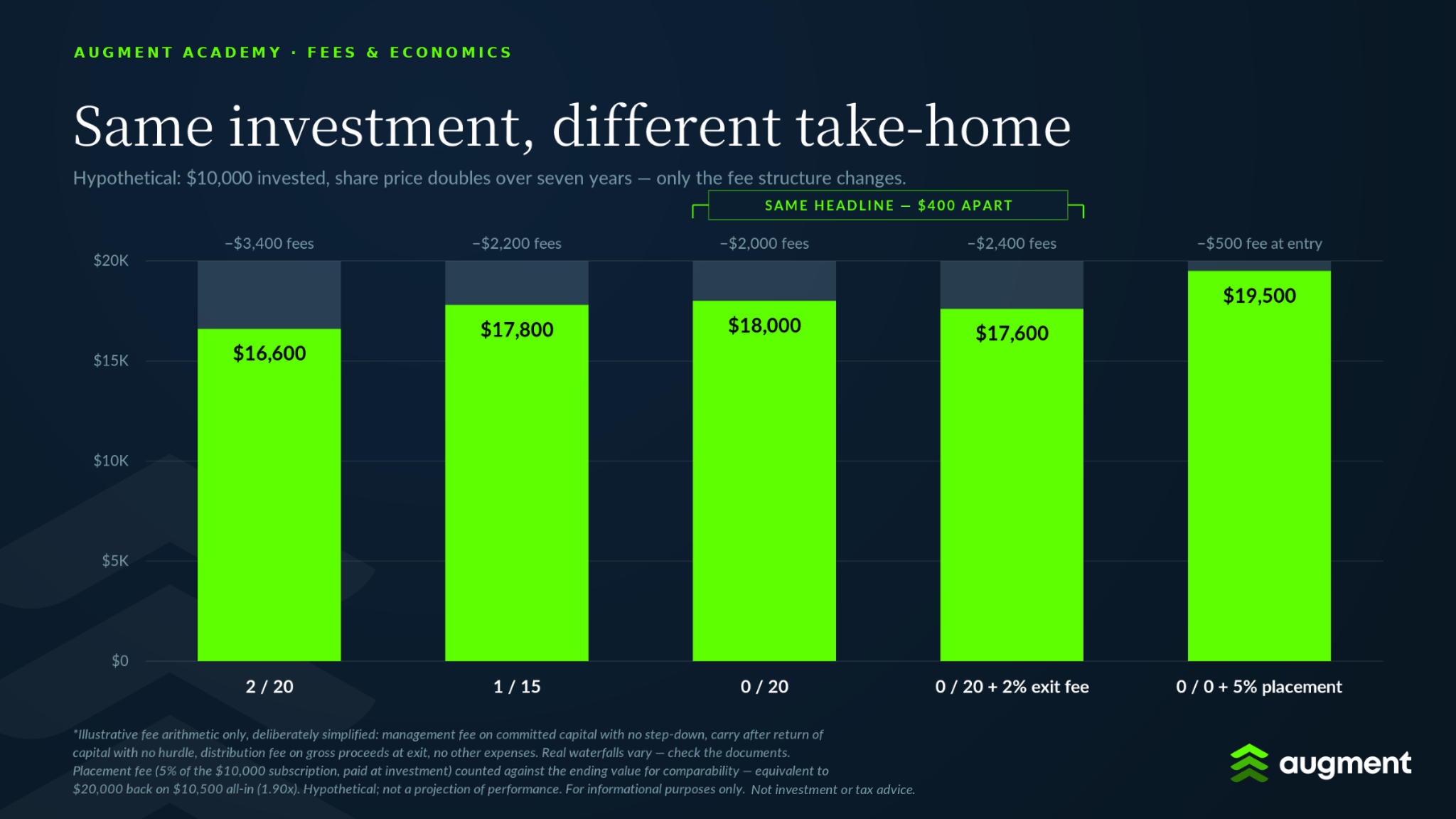
Fees compound against you. The SEC's investor-education arm has shown that even a one-percentage-point annual fee meaningfully reduces a portfolio over time. Over a seven-year private holding, the differences are material. Hold the investment constant ($10,000 in, share price doubling from $100 to $200 over seven years) and change only the fee structure:
Illustrative only and deliberately simplified: management fee on committed capital with no step-down, carry after return of capital with no hurdle, distribution fee applied to gross proceeds at exit, no other expenses. Real waterfalls vary; check the documents.
Note the two 0/20 rows: identical headline structure, $400 apart. The difference is a distribution fee that appears nowhere in the "0/20" shorthand and is only charged when the money comes back.
An upfront fee is charged in every scenario, whether or not the investment performs. If the same investment halves instead of doubles, the placement fee was still paid, while carry would be zero. Carry takes the most when the investment performs well; an upfront fee is fixed and paid regardless of outcome. Which structure costs less depends on the outcome, which is why it's worth running your own assumptions rather than treating any structure as automatically better.
Before investing, work through five items:
Then put this question to the sponsor directly:
If I invest $10,000, how much of it buys shares, what fees will I pay, and when?
A sponsor who can answer that plainly has told you most of what you need to know, and an evasive answer is a warning in itself.
Fee structures in private markets have been moving toward pricing that reflects the work performed. The 2-and-20 package made sense for managed funds doing a decade of active work; a passive single-company SPV involves much less of it, and market pricing has followed. None of the structures (2/20, 1/15, 0/20, or 0/0 with a placement fee) is free, and none is automatically best in every outcome. Read the fee section of the documents, map each fee to the service behind it, and run the math on your own assumptions before you wire anything.
A 2% annual management fee plus 20% of profits (carried interest). It has been the traditional compensation structure across hedge funds, private equity, and venture capital since the late 20th century.
The manager's share of the profits: performance compensation, generally paid only after investors get their capital back. The name traces to ship captains who kept a share of the cargo they carried.
No. These vehicles typically charge a one-time placement fee at investment, and every vehicle has operating expenses (administration, legal, tax) besides. The difference lies in when and how you pay: once at entry, rather than annually and again at exit.
It can be, when the manager provides real access you couldn't get otherwise, a better entry price, or genuine ongoing work such as governance and follow-on management. What matters is that the fee is disclosed and proportionate to that service.
Sometimes. Beyond carry, some vehicles charge a distribution or transaction fee when proceeds are paid out after an IPO, acquisition, or sale. Because these are collected at the event, years after you subscribe, they're easy to overlook at signing. Check the distribution provisions of the offering documents before you invest.
Because the vehicles, and their underlying supply vary. For supply: harder to access names closer to the cap table with preferred shares will look different than second layer vehicles with common shares. For the vehicle: a passive single-company SPV involves far less ongoing work than a managed fund, and market data shows its pricing has drifted down accordingly: average carry on one major SPV platform was roughly 12% in 2025, with management fees frequently zero.
Get started today — explore pricing, offerings, and submit your first order.
FOR QUALIFIED INSTITUTIONAL AND ACCREDITED INVESTORS ONLY: Under federal securities laws, private market investments on this platform are available exclusively to Institutional and Accredited Investors. Verification of status required before investing. Private investments involve significant risks including illiquidity, potential loss of principal, and limited disclosure requirements. "Augment" refers to Augment Markets, Inc. and its affiliates. Augment Markets, Inc. is a technology company offering software and data services, not a bank or financial institution. Cash Accounts are provided by Modern Treasury Corp. financial institution partners and through Augment's technology. Augment does not act as a money services business, provide money transmission, or serve as a custodian of funds. Funds held in your Cash Account are not FDIC insured unless expressly disclosed. Full terms available in the Augment Cash Account Agreement.Brokerage services are offered through Augment Capital, LLC, an affiliated broker-dealer and member FINRA/SIPC. “Investment accounts” are not brokerage accounts and do not hold customer funds or securities. Investment advisory services are offered through Augment Advisors, LLC, an SEC-registered investment adviser. Registration with the SEC does not imply a certain level of skill or training. Augment and its affiliates do not provide legal or tax advice; consult your attorney or tax professional regarding your specific situation. For additional information, please refer to Augment Advisors, LLC’s Form ADV Part 2A (Firm Brochure) and FINRA BrokerCheck.