The IPO lockup period and SPV distributions explained: what happens between a listing and money arriving.

An initial public offering (IPO) turns a private shareholding into publicly tradeable security, but rarely into money on the day of the event. Shares move onto a public exchange behind a lockup, and proceeds typically arrive months later: first the lockup has to expire, then the vehicle holding the shares has to distribute them.
Who this is for: accredited investors exploring the private market, and anyone holding a private position and wondering what an IPO exit may look like in practice.
A listing day puts a public price on the shares, and the distribution reaches investors months afterward: usually the shares themselves, though the holding vehicle’s operating agreement can direct the manager to sell and deliver cash instead. At the IPO, shares change status from “private, with transfer restrictions” to “public, with a lockup.” The lockup is a contractual restriction on selling for a set period after the offering, agreed between existing shareholders and the underwriters (the investment banks managing the offering); no statute or SEC rule imposes it. Behind the lockup sit the mechanics of getting the distribution out of whatever vehicle holds the shares.

Under a standard 180-day lockup, proceeds commonly reach investors six to eight months after the listing: roughly 180 days of lockup, then 30 to 60 days for the fund vehicle to sell shares or transfer them out. Not every lockup runs 180 days, and the next section walks through the variants. Layering adds time on top: when a position is held through more than one vehicle, each layer brings its own distribution step, and each layer’s operating agreement decides whether what finally arrives is cash or shares in kind. Measured from the first S-1 filing, the full journey to a distribution, cash or shares, typically runs 9 to 18 months.
Lockup agreements typically restrict insiders and investors who bought while the company was private from selling for about 180 days after the offering. The exact terms live in the company's registration statement, in a section titled "Shares Eligible for Future Sale," which anyone can read on SEC EDGAR.
The 180-day figure is a convention, and recent listings show how far practice has moved from it:
Even in a direct listing with no underwriter lockup, major holders often sign separate contractual lockups in side agreements with the company. Share prices also tend to move in the weeks before a lockup expires, as the market anticipates newly sellable shares arriving. For an investor who bought while the company was private, shares become sellable only once the lockup expires, and layering or other operational steps can push that even later. Know those timelines going in: the IPO price is not necessarily the price available when the shares can finally be sold.

These six IPOs put the first sellable moment anywhere from the first trading day to a full six months after listing. Spotify’s 2018 direct listing carried no underwriter lockup, so existing shares could trade from day one. Palantir’s 2020 hybrid direct listing released 20% of holdings on day one and held the remaining 80% until three trading days after its full-year earnings, about 141 days in. DoorDash’s phased 2020 structure opened its first window roughly 90 days after listing, once fourth-quarter earnings were out and the stock held above a set price threshold, with the rest releasing by the 180-day mark. Snowflake’s 2020 IPO allowed a partial early release at day 91 because its stock held above 133% of the IPO price, with the rest at 180 days. Rubrik’s 2024 lockup ended at day 139, at the opening of trading after its second earnings report as a public company. Reddit’s 2024 IPO used the convention: a single cliff at 180 days. Each schedule was published in the company’s prospectus before the first trade.
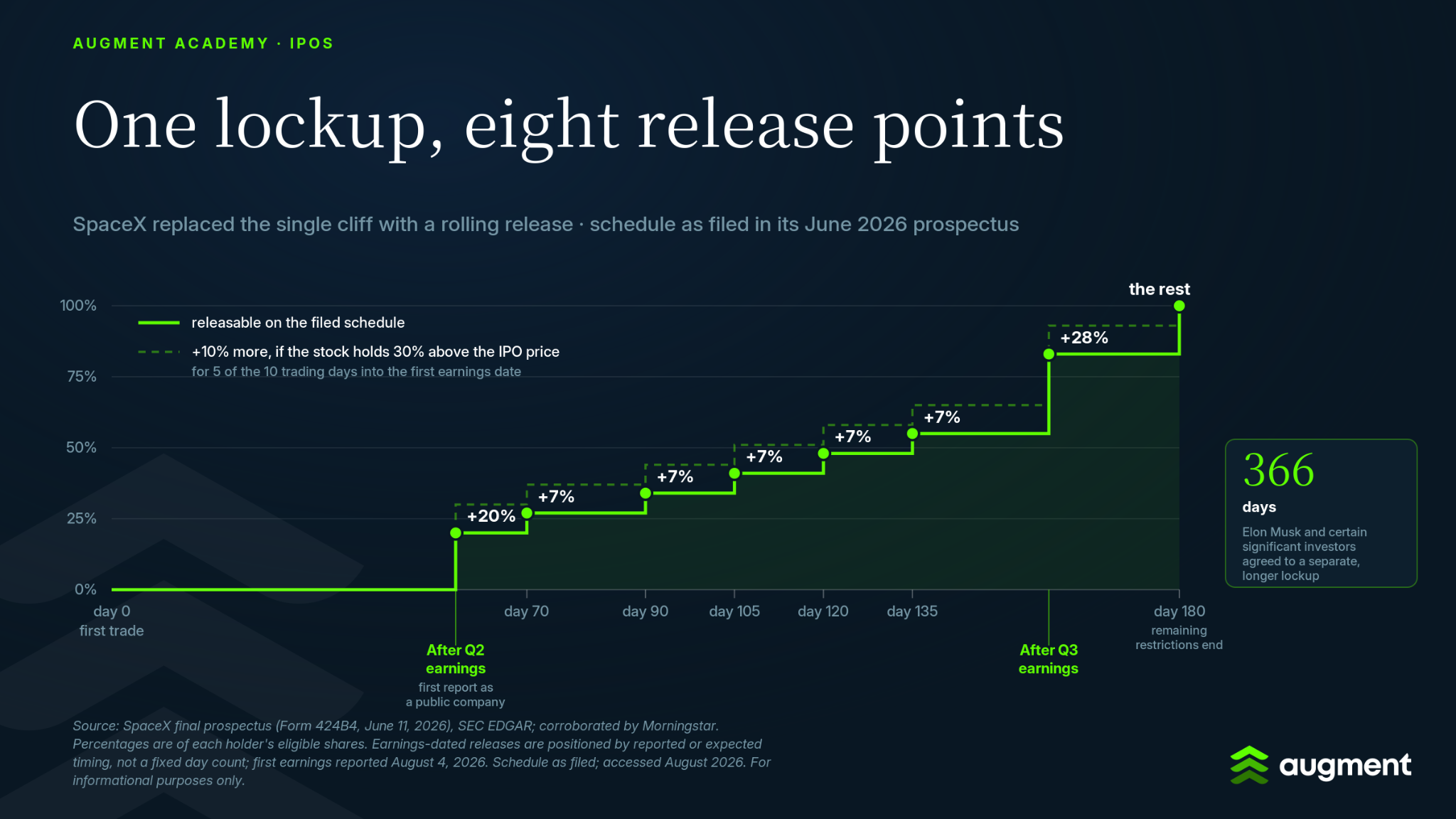
SpaceX’s June 2026 listing, the largest IPO on record, pushed the design further and replaced the single cliff with a tiered, rolling release laid out in its prospectus: 20% of eligible shares after its first quarterly earnings report as a public company, up to 10% more if the stock holds at least 30% above the IPO price into that first earnings date, up to 7% more at each of five checkpoints between days 70 and 135, up to 28% more after third-quarter earnings, and the lockup’s remaining restrictions ending at 180 days. Elon Musk and certain significant investors agreed to a longer 366-day lockup. Analysts read the tiered design as an attempt to meter the flow of insider shares rather than letting supply arrive in one wave.
For investors holding through a special purpose vehicle (SPV), a fund entity formed to hold shares of a single company, one or more layers sit between the lockup and the bank account. Whatever lockup binds the underlying shares binds the SPV, and once it expires, the SPV’s operating agreement controls what happens next. The manager may sell the shares and wire cash, or transfer the shares themselves to investors, called an in-kind distribution. The difference matters for taxes: a cash distribution locks in a gain in that year at the manager’s sale price, while an in-kind distribution defers tax until the investor sells. A separate module in this series, How Are Pre-IPO Investments Taxed? Cost Basis, Holding Periods, and QSBS, works through the timing.
Operating agreements handle this three ways: some require the manager to liquidate and distribute cash within a set window after lockup expiry, some leave the choice to the manager’s discretion, and some let each investor elect cash or shares. In layered structures, each vehicle down the chain has less control over the form of the distribution: it can only pass through what the layer above delivers, in whatever form the layer above chooses. Read that clause before committing: it decides who controls the exit price and the tax year. Execution adds time too: expect 30 to 60 days after lockup expiry for distributions to complete, and a final K-1 tax form the following spring.
It remains the convention, but variants are now common: conditional early releases (Snowflake), phased schedules (DoorDash), earnings-tied expirations (Rubrik), tiered rolling releases (SpaceX), and direct listings with no underwriter lockup at all (Spotify). The specific terms are in the company's registration statement on SEC EDGAR, so read them for any company you hold.
Yes. The SPV holds the underlying shares, so whatever lockup applies to those shares applies to the SPV, and the manager cannot distribute shares or sale proceeds during the window. Plan on receiving proceeds after the lockup ends plus the time the manager needs to execute the distribution, commonly 30 to 60 additional days.
An acquisition can happen at any point in a company's life, with no underwriter lockup; proceeds, most commonly cash, arrive under the merger agreement when the deal closes. What each holder receives depends on the share class: liquidation preferences pay preferred holders first, and common stockholders receive what remains.
It depends on the form of the distribution. Cash from the manager's sale is generally a taxable gain in the year of distribution: sale proceeds − basis = gain. Shares distributed in-kind are generally not taxable on arrival; tax comes when the investor sells. A separate module in this series, How Are Pre-IPO Investments Taxed? Cost Basis, Holding Periods, and QSBS, covers cost basis and timing. Consult a qualified tax advisor for your situation.
Get started today — explore pricing, offerings, and submit your first order.
FOR QUALIFIED INSTITUTIONAL AND ACCREDITED INVESTORS ONLY: Under federal securities laws, private market investments on this platform are available exclusively to Institutional and Accredited Investors. Verification of status required before investing. Private investments involve significant risks including illiquidity, potential loss of principal, and limited disclosure requirements. "Augment" refers to Augment Markets, Inc. and its affiliates. Augment Markets, Inc. is a technology company offering software and data services, not a bank or financial institution. Cash Accounts are provided by Modern Treasury Corp. financial institution partners and through Augment's technology. Augment does not act as a money services business, provide money transmission, or serve as a custodian of funds. Funds held in your Cash Account are not FDIC insured unless expressly disclosed. Full terms available in the Augment Cash Account Agreement.Brokerage services are offered through Augment Capital, LLC, an affiliated broker-dealer and member FINRA/SIPC. “Investment accounts” are not brokerage accounts and do not hold customer funds or securities. Investment advisory services are offered through Augment Advisors, LLC, an SEC-registered investment adviser. Registration with the SEC does not imply a certain level of skill or training. Augment and its affiliates do not provide legal or tax advice; consult your attorney or tax professional regarding your specific situation. For additional information, please refer to Augment Advisors, LLC’s Form ADV Part 2A (Firm Brochure) and FINRA BrokerCheck.