Pre-IPO investment risks explained: why you can't sell when you want, what a mark really tells you, and how deals change before they close.

A pre-IPO investment carries seven main risks:
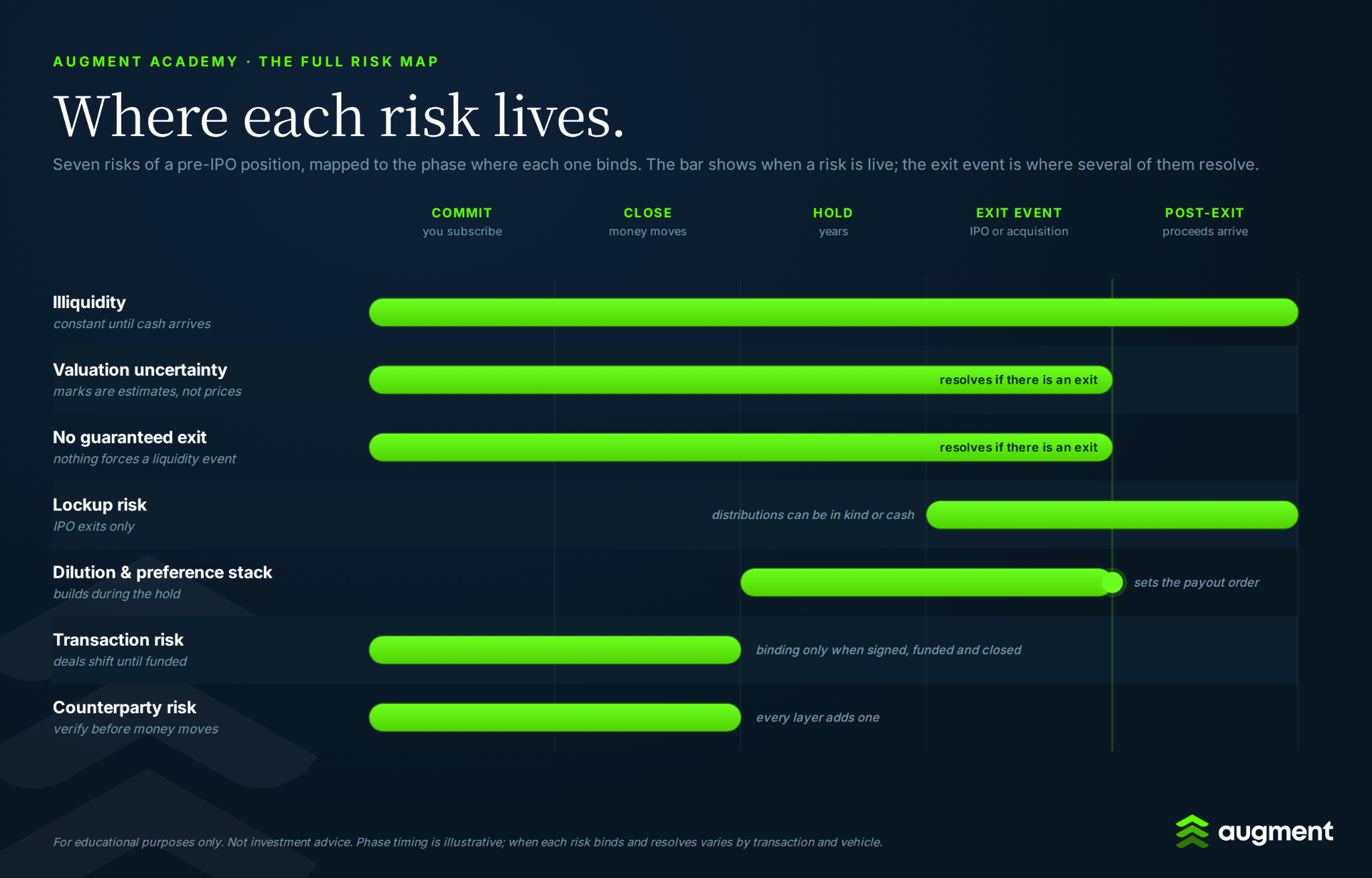
These risks are the operating conditions of the asset class. Each one is visible in advance, and each can be understood and sized before any money moves.
Most of these risks surface individually in other modules of this series, inside the mechanics where they live: share classes, sourcing, taxes, access structures. This module packages them together in one place, so you can see a fuller risk picture of a private-market transaction at once and follow the links back to any module where a risk feels like news.
One condition runs underneath several of them: information is scarce here. Private companies are not required to provide the disclosure that a registered public offering demands: no annual or quarterly reports, and no obligation to answer questions. What information does flow was negotiated years earlier, when the company’s priced rounds set information rights for those investors. A secondary buyer inherits whatever rights attach to the shares, and an SPV investor sees one step less than that: the manager receives what the company shares and chooses what to forward, so direct shareholders of record generally have more visibility than fund investors holding the same exposure. Keep that scarcity in mind as you read. It is part of why valuations are uncertain and why counterparties take work to verify.
Who this is for: investors considering exposure to private companies, directly or through a fund vehicle. Most of these investments are limited to accredited investors, as defined under Rule 501 of Regulation D.
Selling a public share can take seconds because an exchange or bulletin board displays real-time quotes, a market maker often stands ready to offer liquidity even when a stock trades more thinly, and clearing firms facilitate next day settlement. A private share has none of that infrastructure: a sale happens only when a buyer, the company, and the paperwork all cooperate. Four separate constraints apply to private company investments.
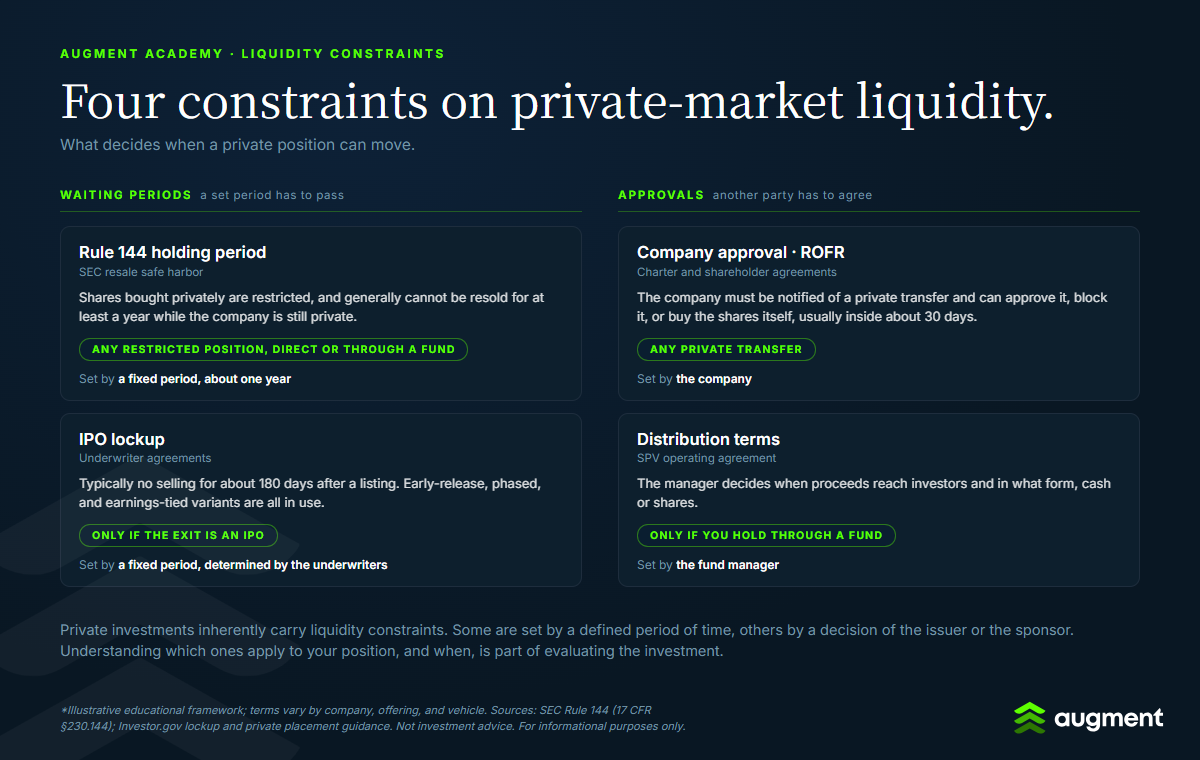
The first is securities law. Shares bought in a private transaction are restricted securities, and under Rule 144 they generally cannot be resold for at least a year when the issuer is a private company. The second is the company itself: most charters include a right of first refusal (ROFR), meaning the company must be notified of any private transfer and can approve it, block it, or buy the shares itself, typically within a window of about 30 days. The third arrives only if the company exits by IPO: the lockup. The fourth applies to anyone holding through a special purpose vehicle (SPV), a fund entity formed to hold shares of a single company: the SPV’s operating agreement restricts transfers of fund interests and gives the manager authority over when, and in what form, proceeds are distributed.
The SEC's investor bulletin on private placements states the consequence directly: these investments are highly illiquid, and investors may need to hold them indefinitely. Plan on holding for years.
Unlike a public company, a private company does not trade out in the open with visible prices. Instead, private companies are valued by a mark: a point-in-time price from a specific transaction or event. A mark can come from several places: the last priced funding round (which may be years old), a 409A appraisal (an estimate prepared for tax purposes, generally conservative by design), or third-party estimates built from observed secondary trades. Because each mark comes from a different context, with its own share class, terms, counterparties, and evaluation metrics, the sources can disagree with one another and do not represent what a buyer would pay today. In Q3 2025, venture secondary trades priced at a median implied discount of roughly 28% to the same companies’ most recent primary rounds, and that gap moves quarter to quarter, in both directions.
A paper valuation is not a realizable price, so treat any mark as a data point, not a price.
Fair value is also a moving target, and the price of exposure includes more than the share price. A mark that looks fair today can look very different in six months, up or down, as new rounds, secondary trades, and market conditions reprice the company. The structure you buy through adds its own layer of cost: some vehicles charge a single upfront fee, while others charge an annual management fee plus a share of profits (“2 and 20”), a load worth questioning on a passive single-company SPV where the manager makes no ongoing investment decisions after the shares are bought. Judging a fair price means weighing all three: the quality of the mark, how far it may move, and the all-in cost of the structure.
With companies staying private longer, there is no guarantee of an IPO. An IPO is one possible outcome among several: a company can be acquired, run periodic tender offers (company-authorized windows where eligible holders may sell a portion), stay private for another decade, or fail. The same SEC bulletin is blunt about the last case: investors in private placements should be able to afford a total loss.
Going public is a decision the company makes, on its own timeline, shaped by market conditions, its readiness, and factors an outside investor never sees. The investor controls none of it. Investing in a private company means accepting that in full: the position has to work while the company remains private, and it may never generate a return at all.
Lockup risk applies to one exit path: the IPO. Early holders usually cannot sell right away, because lockup agreements typically restrict insiders and pre-IPO investors from selling for about 180 days after the offering. An acquisition works differently: there is no underwriter lockup, and proceeds arrive under the terms of the merger agreement instead.
The 180-day figure is a convention, not a law, and recent IPOs show the range. Snowflake's 2020 IPO allowed early release after roughly 91 days if the stock held above 133% of its IPO price; Palantir's 2020 hybrid direct listing let holders sell 20% on day one, with the rest locked until its full-year earnings; DoorDash's 2020 lockup released in phases tied to price and earnings dates; Rubrik's 2024 lockup ended with an earnings release rather than a calendar date; and direct listings such as Spotify's in 2018 carried no underwriter lockup at all. Each company's terms are disclosed in its registration statement on EDGAR.
For those who invested while the company was private, the price that matters is not the IPO price. It is the price when the lockup expires and they gain access to public trading, normally months after the listing. It is not uncommon to see market movement ahead of a lockup expiring, in anticipation of the newly tradable shares coming to market. Between the lockup and the mechanics of distributing shares or cash out of a fund vehicle, proceeds commonly reach investors six to eight months after a standard-lockup IPO, sometimes longer.
Alongside the lockup calendar, investors need to understand the manager's obligations and the risk that the shares are never delivered. The vehicle's operating agreement can give the manager the authority, or even the obligation, to liquidate the position when the lockup expires and distribute cash instead, at the manager's sale price and timing. Layered structures raise this risk further, since some managers are themselves subject to decisions made by upstream parties. An investor expecting stock in their brokerage account can receive cash proceeds instead, meaning the tax is due in that year. Confirm with your manager, and read the operating and subscription agreements, so you know what to expect.
Every new funding round issues new shares, which shrinks each existing holder’s ownership percentage. On its own that is routine, and often good news, since it means the company raised capital. The sharper risk sits in the preference stack. Most professional investors in earlier rounds hold preferred stock, and preferred stockholders have priority over common stockholders when the company is sold or wound down: their liquidation preferences return their money first, before common shareholders receive anything.
Secondary buyers usually end up holding common stock, since most supply comes from employees and ex-employees, though shares sourced from early investors can be preferred. Ask which class, before committing. In a strong exit the stack barely matters, because there is enough value for everyone. In a weak exit, common absorbs most of the shortfall. Down rounds add a further wrinkle: anti-dilution provisions can issue additional shares to earlier preferred holders, shifting even more of the remaining value away from common.
A willing seller is not a done deal. Until a purchase agreement is signed, sellers are not bound: a later bid at a larger size or higher price can redirect shares that seemed spoken for, and the company’s ROFR or transfer approval can delay or unwind a transfer late in the process. A deal that looked settled on Monday can look different by Friday, through no fault of the buyer.
Demand has the same softness. Many offerings for individual investors are best-efforts offerings, which gather indications of interest (IOIs), non-binding signals of how much investors would commit, and then complete the raise against that demand without guaranteeing any amount will be sold. IOIs are how supply gets sourced, but they are a hard signal to read: aggregate interest can overstate what gets funded, because interest is not binding until the money is sent. When interested investors fall through, allocations get resized and timelines reset.
The net effect is timeline whiplash. A direct secondary purchase commonly takes 30 to 90 days including the ROFR process, while a best-efforts subscription can close in days or sit open for months depending on whether sellers surface. Both can compress or stretch with no input from the investor, and neither speed is, by itself, a warning sign. News, price moves, and company decisions reshape supply faster than any participant can control.
In a private transaction, the company whose shares you want is usually not your counterparty. You are relying on a chain of intermediaries: the seller, one or more brokers, and often an SPV manager. Each link is a party that can fail or misrepresent what it holds, and your outcome depends on every one of them performing.
Layering multiplies that exposure. Some offerings are indirect: an SPV that holds an interest in another sponsor’s SPV rather than the underlying shares. Each added layer brings another manager, another set of documents, another fee, and another point of failure, and your visibility shrinks a step at each one. Two or three layers removed, an investor often cannot independently confirm that the innermost entity holds the shares at all.
That opacity attracts bad actors, and regulators treat this market as an active fraud area. The SEC's investor alert on pre-IPO investment scams warns that promoters may charge exorbitant undisclosed markups or may not own the shares they are offering at all. In one December 2023 enforcement action, the SEC charged five unregistered brokers and four companies with raising at least $528 million in fraudulent pre-IPO offerings from more than 4,000 investors, alleging undisclosed markups as high as 150% behind a promise of "no upfront fees."

For an investor, it is important to know what kind of counterparty you are facing, because oversight comes in levels. Broker-dealers (BDs) registered with FINRA and the SEC are examined, visible, firm and individual, on BrokerCheck, and subject to conduct rules including Regulation Best Interest (Reg BI), which requires that any recommendation made to an individual investor serve that investor's best interest at the time it is made. Registered investment advisers (RIAs) owe clients an ongoing fiduciary duty across the whole relationship, a broader standard than the recommendation-by-recommendation one, are subject to SEC examination, and appear in the SEC's Investment Adviser Public Disclosure database (IAPD). Some platforms are registered as both: a dual registrant carries both sets of obligations, Reg BI when it acts as a broker and fiduciary duty when it acts as an adviser, with the operative capacity disclosed to the client, and both regulators' exams and rulebooks apply, so its cumulative oversight is higher than either registration alone. Exempt reporting advisers (ERAs), a common structure for fund and SPV sponsors, sit a level down: an ERA is not registered with the SEC and files only limited reports, though antifraud rules still reach it. Unregistered domestic brokers sit at the bottom, with no oversight at all, and that is where the enforcement record concentrates. Checking any counterparty on BrokerCheck or IAPD takes about a minute.
Unregistered does not always mean unlawful, and this market has many intermediaries who are neither broker-dealers nor advisers. Foreign finders may refer non-US investors to a FINRA member firm and be paid for the referral, expressly permitted under FINRA Rule 2040 subject to conditions. Foreign broker-dealers may work with US investors through a registered US firm under Exchange Act Rule 15a-6. And a domestic finder who only makes introductions, without negotiating terms, handling funds, or taking transaction-based compensation, can sit outside broker registration entirely. These lanes are real and common in cross-border pre-IPO deals, and they are narrow. In every one of them, the investor-facing protections attach to the registered firm in the chain. The practical question: where is the registered entity, and does the intermediary's role stay inside its lane?
Verification has limits worth respecting. Ask who holds the shares of record and how many entities sit between you and them, but know that in layered offerings you will not always get a full answer: chains of holders are sometimes obscured deliberately and often is the result of information right restrictions and other factors out of your control. Note also what registration protects: SIPC covers the custody of assets at a failed member brokerage, up to $500,000 including $250,000 for cash, and it does not cover an investment losing value. A separate module in this series, Verifying a Private Offering, covers fraud red flags and how to vet a specific offering in depth.
The risks above compound into one personal question: can you leave this money alone for five to ten years? A pre-IPO position cannot be sold on your schedule, may sit at a flat mark for years and then reprice sharply, and may return nothing. Money needed for a house or tuition inside that window does not belong here.
Ask three questions:
If any answer is no, the position is too large, or the timing is wrong. Beyond fit, each risk has a matching discipline:
An investor who does all of that has priced these risks in before committing.
You can, but an early sale means finding a buyer, and that is the hard part. Regulated platforms, including Augment, help connect sellers with eligible buyers. The obstacles this module describes still apply: transfer restrictions, the company's ROFR, fund-level limits on transferring SPV interests, and the possibility that no buyer surfaces at an acceptable price. If you hold shares as a current or former employee, a company-run tender offer is another possible sale window, and tenders have become more common: startups on one major equity platform ran 396 of them in 2025, up 62% from the year before.
Proceeds arrive under the terms of the merger agreement, with no underwriter lockup, so the acquisition path is often faster than the IPO path. What you receive depends on where your share class sits in the payout order: liquidation preferences pay preferred holders first, and this is the scenario where the preference stack matters most.
No. A lockup typically prevents selling for about 180 days after the offering, but terms vary by company: early-release triggers, phased schedules, and earnings-tied expirations are all in use, and the specific terms are disclosed in the company's registration statement (the S-1, then the final prospectus) once filed, so read them for your situation. After expiry, proceeds still have to travel: every vehicle layer between you and the shares adds its own distribution step and time, and if your vehicle distributes cash rather than shares, the manager's sale sets your price and the tax lands in that year. The price that matters is the one at distribution, which can be well above or below the IPO price.
Start with what kind of firm it is, because oversight comes in levels: FINRA-registered broker-dealers and SEC-registered investment advisers are examined and carry best-interest (Reg BI) or fiduciary obligations, and a firm registered as both carries both; exempt reporting advisers (ERAs, common among fund and SPV sponsors) file only limited reports and are not registered; unregistered brokers have no oversight at all. Look the firm and individual up on BrokerCheck and IAPD, then ask who holds the shares of record and how many entities sit between you and them. You will not always get a full answer, since ownership layers can be deliberately obscured, and a counterparty that resists these questions is telling you something.
Illiquidity is a reasonable starting point, because it interacts with all the others. If the valuation is uncertain, the exit is not guaranteed, and the deal timeline is variable, the inability to sell means you carry all of it until a liquidity event arrives. Your personal risk tolerance plays a big part in choosing your investments. Speak with a financial adviser for help on your specific circumstances.
Get started today — explore pricing, offerings, and submit your first order.
FOR QUALIFIED INSTITUTIONAL AND ACCREDITED INVESTORS ONLY: Under federal securities laws, private market investments on this platform are available exclusively to Institutional and Accredited Investors. Verification of status required before investing. Private investments involve significant risks including illiquidity, potential loss of principal, and limited disclosure requirements. "Augment" refers to Augment Markets, Inc. and its affiliates. Augment Markets, Inc. is a technology company offering software and data services, not a bank or financial institution. Cash Accounts are provided by Modern Treasury Corp. financial institution partners and through Augment's technology. Augment does not act as a money services business, provide money transmission, or serve as a custodian of funds. Funds held in your Cash Account are not FDIC insured unless expressly disclosed. Full terms available in the Augment Cash Account Agreement.Brokerage services are offered through Augment Capital, LLC, an affiliated broker-dealer and member FINRA/SIPC. “Investment accounts” are not brokerage accounts and do not hold customer funds or securities. Investment advisory services are offered through Augment Advisors, LLC, an SEC-registered investment adviser. Registration with the SEC does not imply a certain level of skill or training. Augment and its affiliates do not provide legal or tax advice; consult your attorney or tax professional regarding your specific situation. For additional information, please refer to Augment Advisors, LLC’s Form ADV Part 2A (Firm Brochure) and FINRA BrokerCheck.