How to verify a pre-IPO offering is real: the registration lookups, filings, and written questions that separate legitimate deals from fraud.

The pre-IPO frauds in recent SEC enforcement actions share a structure: the seller was not registered, the compensation was taken out of the share price rather than charged openly, or the paperwork did not describe what was actually being sold. The pre-IPO market is real and regulated, and it also draws fraud, because scarce information makes false claims hard for a buyer to test. This guide covers the patterns that recur across these cases and the checks that establish whether an offering is what it claims to be.
Who this is for: accredited investors evaluating a specific private-market offering, whether it arrived through a platform, an adviser, or a cold call. A separate module in this series, What Are the Risks of Pre-IPO Investing?, covers the structural risks of the asset class itself; this one is about whether the offering in front of you is what it claims to be.
The private market runs on scarce information. Companies that stay private are not required to publish the disclosure a registered public offering demands, there is no live ticker price to check a quote against, and demand for well-known names runs far ahead of supply. That combination lets a dishonest seller invent inventory, mark up prices, or promise timelines, with little the buyer can casually look up to contradict them. The SEC’s investor alert on pre-IPO investment scams warns that promoters may charge undisclosed markups or may not own the shares they offer at all, and the agency has called the pre-IPO space a priority area for its Division of Enforcement.
The enforcement record shows what that looks like. Across three SEC actions between December 2023 and September 2024, sellers allegedly raised >$800 million combined:
These are allegations in the SEC's civil cases. In two of the three, defendants have since pleaded guilty to criminal charges in parallel proceedings. In every case, registration was the weak point: sellers operating outside broker registration, or claims of it that a few minutes on a public database would have disproven.
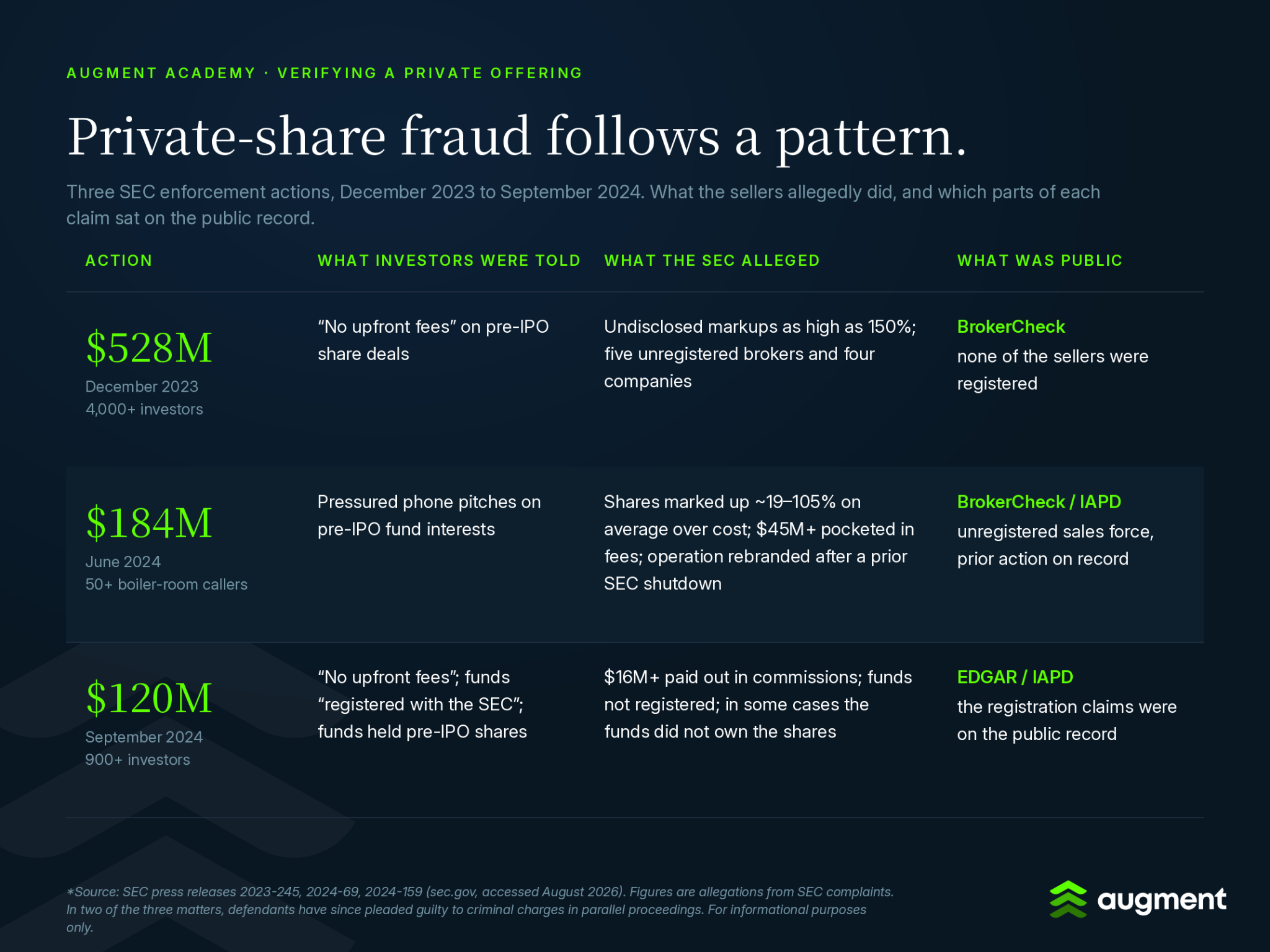
These patterns recur across the cases. Some are visible from the pitch itself; others take a question or two to surface.
A workable verification pass takes well under an hour, and every tool in it is free.
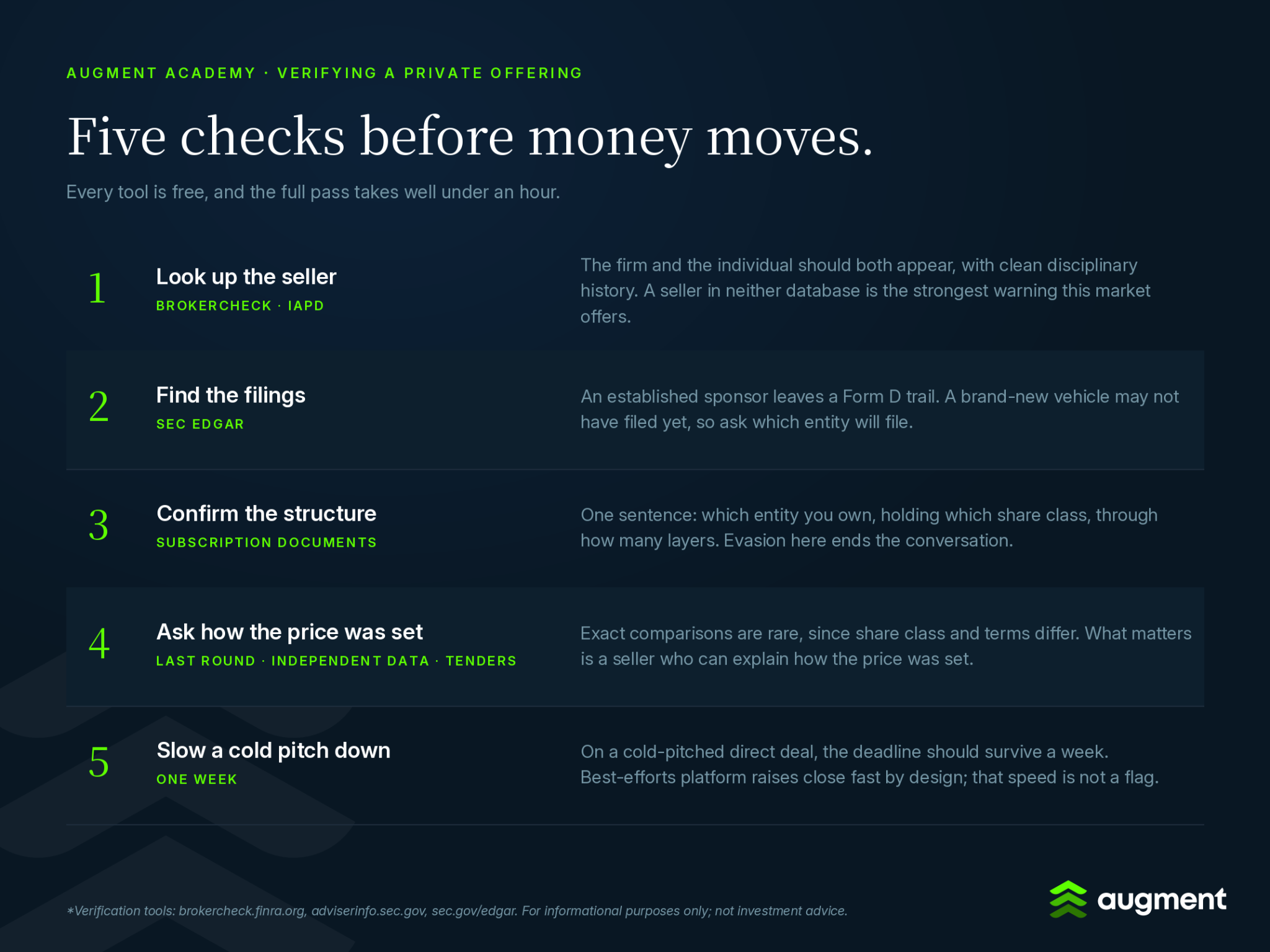
A genuine offering shows the same features every time. The counterparty appears on BrokerCheck or IAPD and its people do too. You are asked to verify accredited status before you can commit. The structure, share class, and fees are spelled out in the subscription documents rather than in verbal assurances, and questions about them get written answers. The offering names the entity you would hold an interest in, and that entity has filings on EDGAR.
Passing every check above establishes that a real offering exists. Whether it is a good investment is a separate evaluation, covered in the guide to what to look for before investing in late-stage private companies and in this series’ modules on structure (What You’re Actually Buying) and risk (What Are the Risks of Pre-IPO Investing?).
If you believe you have been targeted, document everything and report it through the SEC’s tips, complaints, and referrals portal.
Look up the firm and the individual on FINRA’s BrokerCheck and the SEC’s Investment Adviser Public Disclosure database. Registered firms and their people appear with license and disciplinary history; someone actively selling securities who appears in neither is one of the strongest warning signs. Brokers are required by federal law to register.
No. Lawful roles exist and are common in this market: foreign finders who refer non-US investors to a registered firm, and connectors who only make an introduction to an actual seller without negotiating terms or handling money. The risks module in this series, What Are the Risks of Pre-IPO Investing?, covers those lanes. In every lawful lane, investor protections attach to the registered firm in the chain, so ask which registered entity stands behind the transaction and verify that firm.
It depends on the structure. A direct purchase of secondary shares takes roughly 30 to 90 days including the company’s ROFR window, so a 48-hour deadline on that kind of deal signals manufactured urgency. Subscription-based, best-efforts offerings on established platforms fill on demand and can legitimately close in days.
Keep every email, deal page, and record of the pitch, and file a report at the SEC’s TCR portal. If the firm is a FINRA member, FINRA arbitration may be available. Time limits apply to legal claims, so consider consulting counsel promptly.
Get started today — explore pricing, offerings, and submit your first order.
FOR QUALIFIED INSTITUTIONAL AND ACCREDITED INVESTORS ONLY: Under federal securities laws, private market investments on this platform are available exclusively to Institutional and Accredited Investors. Verification of status required before investing. Private investments involve significant risks including illiquidity, potential loss of principal, and limited disclosure requirements. "Augment" refers to Augment Markets, Inc. and its affiliates. Augment Markets, Inc. is a technology company offering software and data services, not a bank or financial institution. Cash Accounts are provided by Modern Treasury Corp. financial institution partners and through Augment's technology. Augment does not act as a money services business, provide money transmission, or serve as a custodian of funds. Funds held in your Cash Account are not FDIC insured unless expressly disclosed. Full terms available in the Augment Cash Account Agreement.Brokerage services are offered through Augment Capital, LLC, an affiliated broker-dealer and member FINRA/SIPC. “Investment accounts” are not brokerage accounts and do not hold customer funds or securities. Investment advisory services are offered through Augment Advisors, LLC, an SEC-registered investment adviser. Registration with the SEC does not imply a certain level of skill or training. Augment and its affiliates do not provide legal or tax advice; consult your attorney or tax professional regarding your specific situation. For additional information, please refer to Augment Advisors, LLC’s Form ADV Part 2A (Firm Brochure) and FINRA BrokerCheck.