Direct ownership, SPVs, private funds, registered funds, and listed vehicles, the five pre-IPO investment vehicles compared, and how to tell which one a deal page is offering.

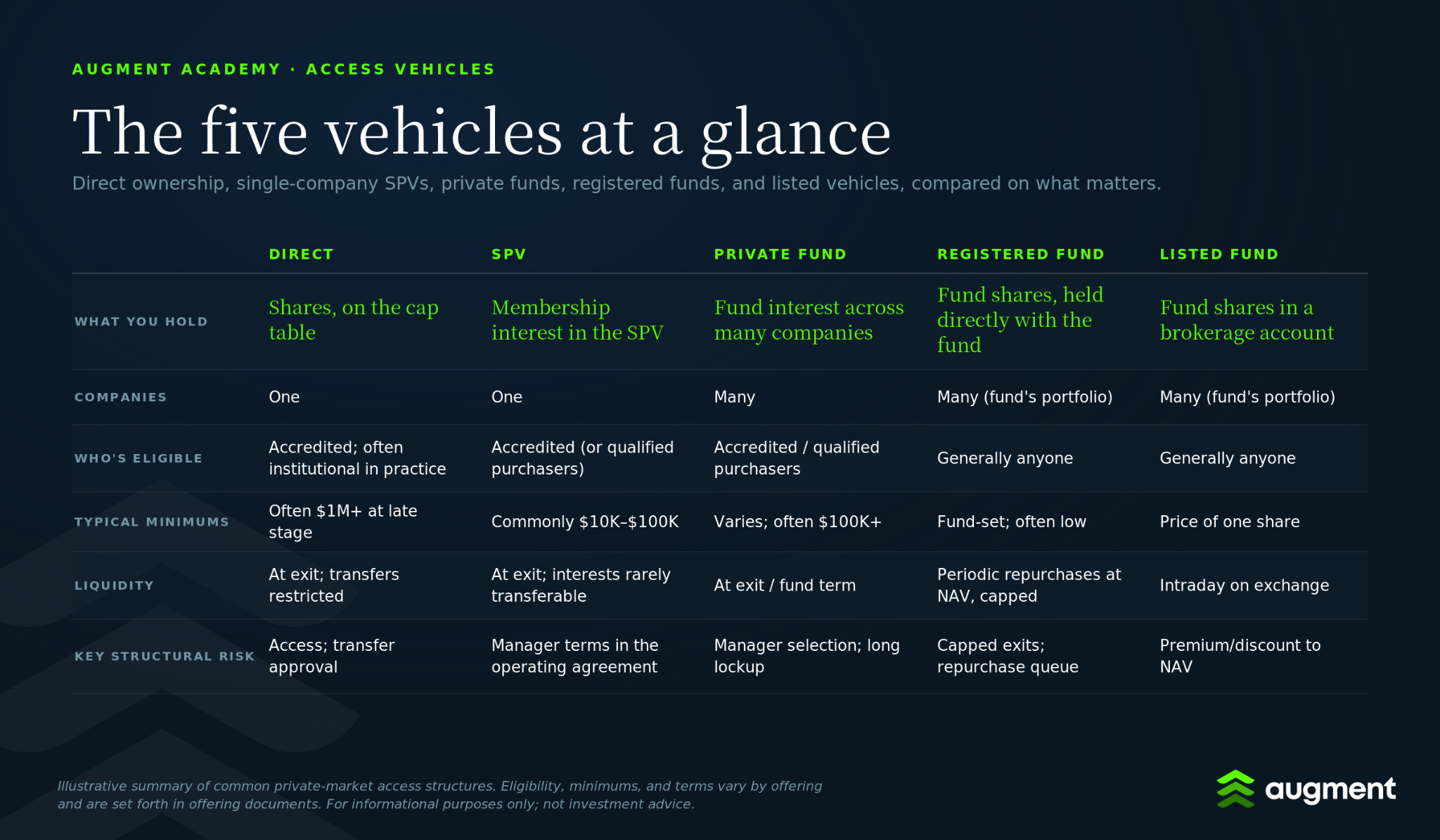
There are five basic vehicles for getting exposure to a company while it remains private: owning shares directly, investing through a single-company SPV, buying into a multi-company private fund, holding a registered fund that repurchases your shares at NAV, or holding a listed fund through an ordinary brokerage account. Each of these vehicles has different delivery mechanisms and ownership rights in addition to different eligibility rules, minimums, and paths to liquidity. It is important to fully understand what is being presented and what level of ownership and risk you are willing to accept.
Who this is for: investors new to private markets who want to understand the access structures before evaluating any specific offering. Most pre-IPO vehicles in the U.S. are limited to accredited investors, as defined under Rule 501 of Regulation D. The notable exceptions are the registered and listed fund categories, covered below.
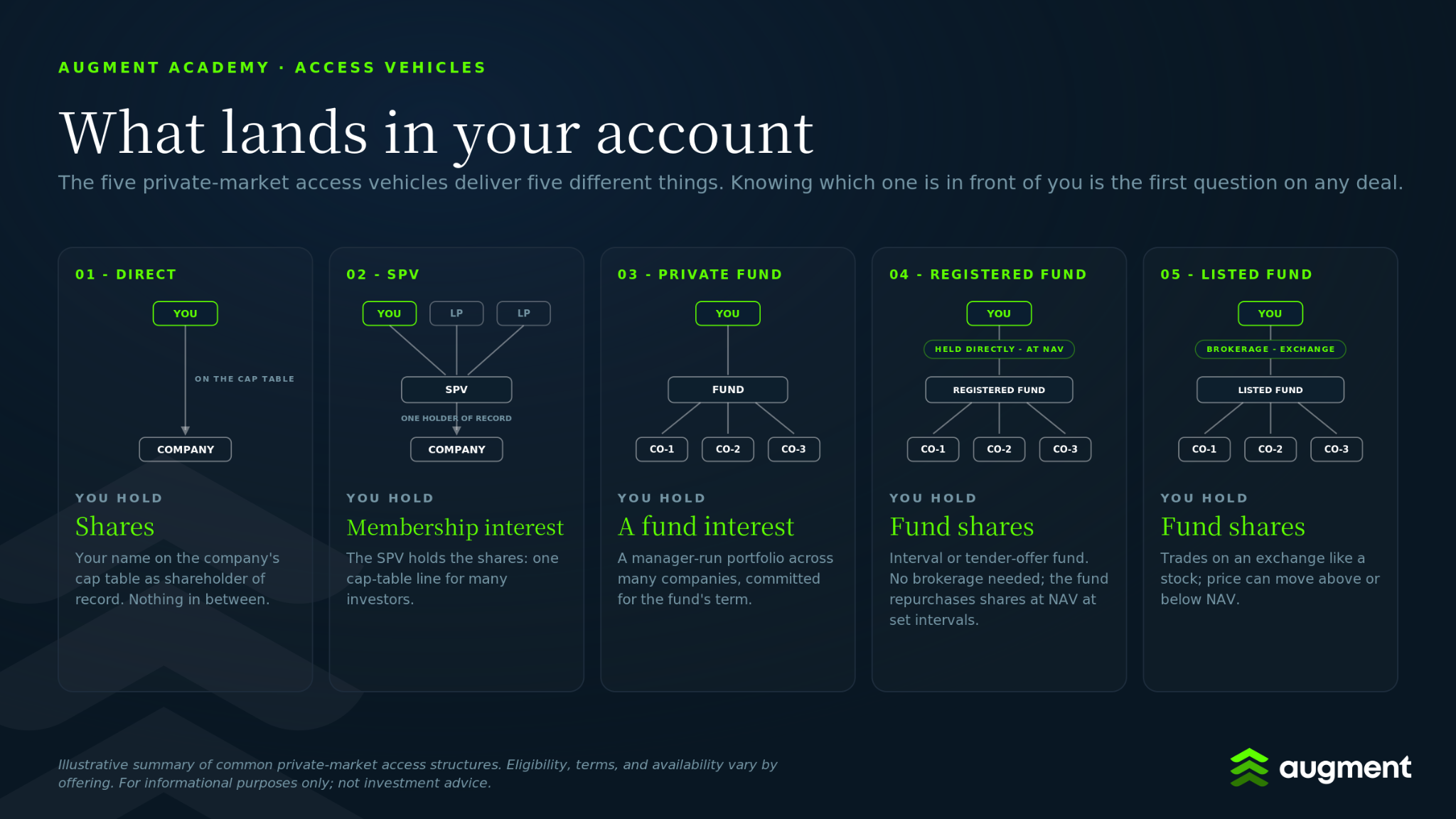
Direct access means your name (or your entity's) ends up on the company's cap table as a shareholder of record. In practice there are three ways into direct ownership: participating in a primary round (buying newly issued shares from the company, largely invitation-only at the late stage), buying in a company-run tender offer (a company-organized window where existing holders sell at a single price), or a direct secondary (a negotiated purchase from an existing shareholder, subject to the company's right of first refusal and other potential approvals or restrictions). The transaction types are covered in a separate module in this series, Primary vs. Secondary: The Two Ways Capital Enters a Private Company. Whatever the direct structure, you end up owning shares in the company.
Direct ownership is the cleanest structure, but it is also the most restrictive. Late-stage companies generally prefer institutional counterparties, and direct secondaries on sought-after names routinely carry minimums of $1 million or more. For most individual investors, direct is not the practical entry point.
A special purpose vehicle (SPV) is a single-purpose legal entity, typically a Delaware LLC, that pools capital from a group of accredited investors to hold shares of one private company. You don't own the shares directly. You own a membership interest in the vehicle (the LLC equivalent of an LP interest, and the formal term for ownership in an LLC). The SPV, in turn, either sits on the company's cap table as a single shareholder of record or gets its exposure through other vehicles, such as other SPVs or derivatives.
There is a reason that SPVs are the primary method of accessing pre-IPO companies. Under Section 12(g) of the Securities Exchange Act, a private company with $10 million or more in assets must register and begin public-style reporting once its shares are held by 2,000 or more holders of record, so companies actively keep their cap tables small. An SPV with fifty investors counts as one holder. That, plus pooled minimums (often $10K–$100K instead of $1M+), is why the SPV became the standard bridge between individual investors and late-stage companies.
Most SPVs rely on an exemption from Investment Company Act registration: Section 3(c)(1) (up to 100 beneficial owners, all accredited) or 3(c)(7) (no owner cap under the exemption itself, though funds stay under 2,000 holders of record to avoid Exchange Act registration; all investors must be "qualified purchasers", generally individuals with $5 million+ in investments or entities managing $25 million+ in investments on a discretionary basis). The offering documents will say which applies. What governs your economics, fees, distributions, exit mechanics, is the SPV's operating agreement, which is worth reading before signing; a separate module in this series, What You're Actually Buying in a Pre-IPO Deal, covers what you're buying in an SPV in depth.
A private fund, a venture fund or a multi-company private-markets fund, pools capital across many companies rather than one. You hold a fund interest, the manager selects the investments, and capital is typically committed for years, with the classic economics being a management fee plus carried interest (a share of profits). The trade is diversification and professional selection in exchange for less control: you can't choose the companies, and your money is locked to the fund's timeline.
For individual investors, the practical differences from an SPV are concentration and choice. An SPV is a deliberate, single-name position you pick; a fund is a portfolio you delegate. Both are generally limited to accredited investors or qualified purchasers, and neither offers ready liquidity before the underlying companies exit.
Yes, through the two registered fund categories, the newest of the five. Both are SEC-registered funds that hold private-company shares, and neither generally requires accredited status. The difference is how you buy and sell:
Both categories solve eligibility and minimums, but the assets inside are still illiquid, hard to price, and concentrated in a handful of private names. You buy and sell differently, but the underlying asset is the same.
Some offerings marketed as "pre-IPO access" deliver none of the above. A forward contract is a promise from a counterparty to deliver shares (or their cash value) at a future date, often "at IPO." Until that settlement, you own no shares and no fund interest, only a claim against the counterparty, and delivery depends on factors outside your control. Language like "settlement at IPO" or "shares delivered at public offering" signals this structure. Forwards have a different risk profile than share or fund ownership, and they deserve their own diligence. Here, who your counterparty is matters more than in any other structure.
The working rule for any deal page: ask what lands in your account at closing. Shares, a membership interest, a private fund interest, registered fund shares, or listed fund shares are the five answers that map to the five vehicles. Anything else, ask in writing.
For accredited investors, single-company SPVs are the most common practical route, have pooled minimums and a structure late-stage companies accept. For non-accredited investors, listed funds and unlisted registered funds (interval or tender-offer funds) that hold private companies are generally the only route.
For direct purchases, SPVs, and private funds, yes, generally, under Rule 501 of Regulation D (some vehicles require the higher qualified-purchaser standard). Registered and listed funds are the exception: listed funds trade through ordinary brokerage accounts, and interval or tender-offer funds can be bought directly from the fund, with no accreditation requirement in either case.
A single-purpose entity, usually a Delaware LLC, that pools accredited investors' capital to hold shares of one private company. Investors own membership interests in the vehicle; the SPV is the shareholder of record. It exists largely because companies limit how many holders sit on their cap table.
No. Interval and tender-offer funds are unlisted. You buy shares at NAV directly from the fund or through a platform, and you sell by participating in the fund's periodic repurchase offers, not by trading on an exchange.
Because the fund's share price is set by supply and demand, while its private holdings are valued only periodically. When demand for scarce exposure runs ahead of the underlying value, the fund trades at a premium; when it fades, a discount. The gap can be large in both directions.
No. A forward is a contractual right to receive shares (or cash) later, typically from a specialized counterparty. You hold no shares unless and until settlement occurs, and settlement depends on the counterparty's ability to deliver.
Get started today — explore pricing, offerings, and submit your first order.
FOR QUALIFIED INSTITUTIONAL AND ACCREDITED INVESTORS ONLY: Under federal securities laws, private market investments on this platform are available exclusively to Institutional and Accredited Investors. Verification of status required before investing. Private investments involve significant risks including illiquidity, potential loss of principal, and limited disclosure requirements. "Augment" refers to Augment Markets, Inc. and its affiliates. Augment Markets, Inc. is a technology company offering software and data services, not a bank or financial institution. Cash Accounts are provided by Modern Treasury Corp. financial institution partners and through Augment's technology. Augment does not act as a money services business, provide money transmission, or serve as a custodian of funds. Funds held in your Cash Account are not FDIC insured unless expressly disclosed. Full terms available in the Augment Cash Account Agreement.Brokerage services are offered through Augment Capital, LLC, an affiliated broker-dealer and member FINRA/SIPC. “Investment accounts” are not brokerage accounts and do not hold customer funds or securities. Investment advisory services are offered through Augment Advisors, LLC, an SEC-registered investment adviser. Registration with the SEC does not imply a certain level of skill or training. Augment and its affiliates do not provide legal or tax advice; consult your attorney or tax professional regarding your specific situation. For additional information, please refer to Augment Advisors, LLC’s Form ADV Part 2A (Firm Brochure) and FINRA BrokerCheck.