Pre-IPO investment taxes work mostly like taxes on any capital asset; what changes is the paperwork. This module covers cost basis, holding periods, K-1s, and why the QSBS exclusion usually doesn't apply to secondary buyers.

A pre-IPO investment is generally taxed like any other capital asset: you owe tax when a gain is realized, not while the value rises on paper, at a rate that depends on how long the position was held. What's different in private markets is the plumbing: a Schedule K-1 instead of a 1099, exit proceeds that can arrive as cash or as shares with different tax timing, and a well-known tax exclusion (QSBS) that sounds like it should apply but usually doesn't.
Who this is for: investors who hold or are considering exposure to private companies, directly or through a fund vehicle. Most of these investments are limited to accredited investors, as defined under Rule 501 of Regulation D. This module is an educational framework, not tax advice; the treatment of any specific situation belongs with a qualified tax professional.
For the most part, when a gain is realized: when the shares are sold, or when the vehicle holding them sells and distributes proceeds. There is no annual tax on unrealized appreciation. A private position that triples in marked value generates no tax until something is sold.
Two features of private-market structure complicate that clean picture.
First, most individual investors hold private companies through a special purpose vehicle (SPV): a fund entity formed to hold shares of a single company, usually a limited liability company taxed as a partnership. A partnership doesn't pay tax itself; its income passes through to investors each year on a Schedule K-1. That means a K-1 can report taxable income in a year when you received no cash, though a passive single-company vehicle typically generates little or none until the position is sold.
Second, the rate depends on the holding period. Gain on an asset held more than one year is long-term, taxed at 0%, 15%, or 20% depending on taxable income; one year or less is short-term, taxed at ordinary income rates. Higher earners may also owe the 3.8% net investment income tax (NIIT) once modified adjusted gross income exceeds $200,000 (single) or $250,000 (married filing jointly), which brings the top federal rate on a long-term private-market gain to 23.8% before state tax.
Cost basis is what you're treated as having paid for the investment. It sets the size of the taxable gain later: sale proceeds − basis = gain.
For a direct purchase of shares, basis is generally the purchase price plus costs of purchase, such as commissions and transfer fees. For an SPV interest, your starting basis is generally your capital contribution, and it then adjusts each year with the K-1: income allocated to you increases it; distributions and allocated losses decrease it. The adjustment exists to prevent double taxation: income you've already paid tax on through a K-1 raises your basis so the same dollars aren't taxed again at exit. For a passive single-company vehicle the annual movement is usually small, since there's rarely much income before the position is sold. Whether a particular fee is added to basis depends on how the vehicle treats it; that's a question for the sponsor and your tax professional at subscription, not at exit.
Basis matters more in private markets because no one is required to track it for you the way a public-market custodian does. Private positions are often held for years, paperwork accumulates across capital calls, distributions, and K-1s, and an investor who can't substantiate basis at exit risks paying tax twice on the same gain. Keep the subscription documents, every K-1, and every distribution statement for the life of the position and beyond.
The tax clock starts when you acquire the investment, and more than one year makes the gain long-term. Three private-market wrinkles:
When a liquidity event finally happens, an SPV generally exits one of two ways, and the difference is mostly about timing and control.

A cash distribution means the vehicle sold the shares: the gain passes through in the year of the sale, all at once. You cannot spread it across years, pair it with losses in a different year, or wait for a lower-rate year. A cash gain can also be recognized before the paperwork arrives. Partnerships must furnish K-1s by the return's due date, March 15 for calendar-year partnerships or September 15 on extension, and private vehicles commonly take the extension. A K-1 that arrives after April 15 is normal; investors in these vehicles routinely file personal extensions, and a large gain late in a year can create an estimated-tax obligation before the following April.
An in-kind distribution means you receive the shares themselves. Generally no tax is due at that moment; you sell on your own schedule and recognize gain then.
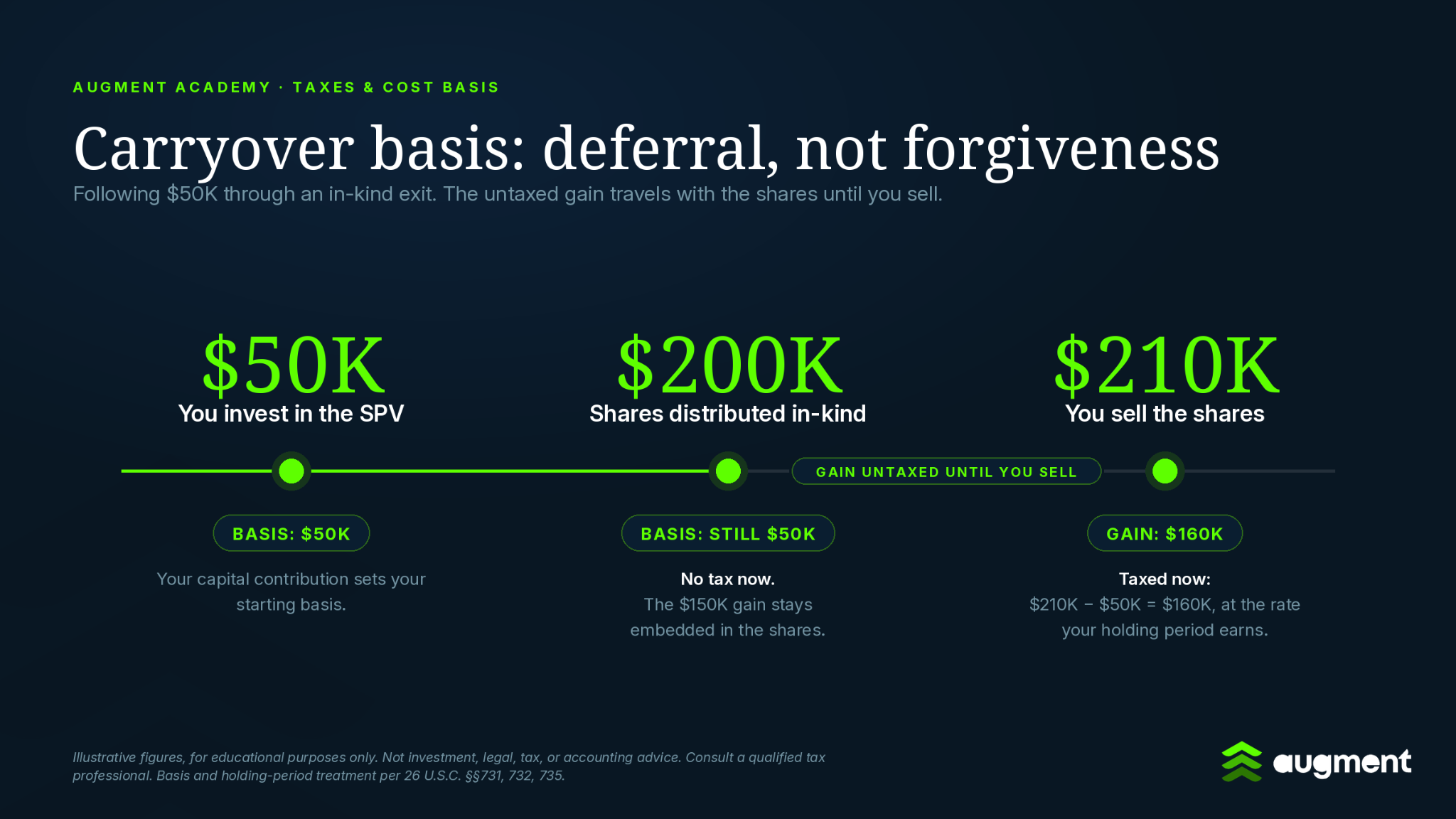
That opens strategies unavailable on the cash path: staged sales across tax years, charitable gifts of appreciated shares, and, under current law, a stepped-up basis for heirs. The tradeoff is market risk: until you sell, you hold a concentrated single-stock position that can fall as easily as rise. Which path applies is set by the vehicle's operating agreement (the fund's governing contract). It's worth reading before subscribing, not after.
Qualified small business stock (QSBS) is a federal tax break that can eliminate some or all of the capital-gains tax on certain startup stock. It comes up often in private markets, so it's worth being precise about who gets it.
Section 1202 rewards putting money into a company early and directly: founders, employees who exercised options, investors who bought into a funding round. Two requirements do most of the work:
A pre-IPO secondary buyer typically fails both tests. The employee selling shares to you may well have QSBS treatment on their own gain; as the buyer, you almost certainly do not.
For investors who do qualify, the terms are generous. Under the One Big Beautiful Bill Act, signed July 4, 2025, stock acquired after that date can exclude 50% of the gain after a three-year hold, 75% after four years, and 100% after five, capped at $15 million per company (or 10× basis, if greater); stock acquired earlier keeps the prior rules ($50 million asset ceiling, $10 million cap, and a single five-year threshold).
The practical rule: if marketing for a secondary opportunity hints at QSBS benefits, ask for the basis of the claim.
Expect capital-gains treatment and a K-1 rather than a 1099. Track your cost basis yourself, from subscription onward. Know before you invest whether exit proceeds arrive as cash (one tax year, no control) or in-kind (deferral and flexibility, with market risk). Don't count on QSBS unless a tax professional confirms it applies to your specific acquisition. And because gains can be recognized before cash or paperwork arrives, bring your tax advisor in ahead of the liquidity event.
Usually not much before an exit. There's no tax on unrealized appreciation, and a passive single-company vehicle typically generates little annual income. But a K-1 can pass through taxable income in a year without a distribution, so review it each year rather than assuming zero.
Generally yes: for gain passing through a partnership, the character is determined by the fund's holding period in the shares, not by how long you've held your fund interest. Confirm the specifics with a tax professional.
Generally no. Section 1202 requires the stock to have been originally issued to the taxpayer; a secondary purchase, whether direct or through an SPV, breaks that requirement, and most late-stage companies exceed the gross-asset ceiling regardless.
That's common, not a red flag. Partnerships on extension have until September 15 to furnish K-1s, and private vehicles routinely use it. Investors holding SPV interests typically file a personal extension.
Rule 144 is a securities-law clock that determines when restricted shares may legally be resold. The tax holding period determines whether a gain is short- or long-term. They run independently and answer different questions.
Get started today — explore pricing, offerings, and submit your first order.
FOR QUALIFIED INSTITUTIONAL AND ACCREDITED INVESTORS ONLY: Under federal securities laws, private market investments on this platform are available exclusively to Institutional and Accredited Investors. Verification of status required before investing. Private investments involve significant risks including illiquidity, potential loss of principal, and limited disclosure requirements. "Augment" refers to Augment Markets, Inc. and its affiliates. Augment Markets, Inc. is a technology company offering software and data services, not a bank or financial institution. Cash Accounts are provided by Modern Treasury Corp. financial institution partners and through Augment's technology. Augment does not act as a money services business, provide money transmission, or serve as a custodian of funds. Funds held in your Cash Account are not FDIC insured unless expressly disclosed. Full terms available in the Augment Cash Account Agreement.Brokerage services are offered through Augment Capital, LLC, an affiliated broker-dealer and member FINRA/SIPC. “Investment accounts” are not brokerage accounts and do not hold customer funds or securities. Investment advisory services are offered through Augment Advisors, LLC, an SEC-registered investment adviser. Registration with the SEC does not imply a certain level of skill or training. Augment and its affiliates do not provide legal or tax advice; consult your attorney or tax professional regarding your specific situation. For additional information, please refer to Augment Advisors, LLC’s Form ADV Part 2A (Firm Brochure) and FINRA BrokerCheck.