The pre-IPO market explained: what it is, how it works, and why more of a company’s growth might happen while they remain private.

The pre-IPO market is where investors buy and sell shares of private companies while they remain private. It lets accredited investors gain exposure to late-stage private companies, the kind that may list on a stock exchange someday, without waiting for the listing. Access has historically been limited to institutions and the well-connected, but a mix of regulation, technology, and companies staying private far longer has opened it up.
Who this is for: this guide is written for accredited investors, broadly, people who meet the income or net-worth thresholds (or hold certain professional licenses) set by the U.S. Securities and Exchange Commission. Pre-IPO investments are generally available only to accredited investors. You can check the official criteria on the SEC’s investor education site, Investor.gov: Accredited Investors.
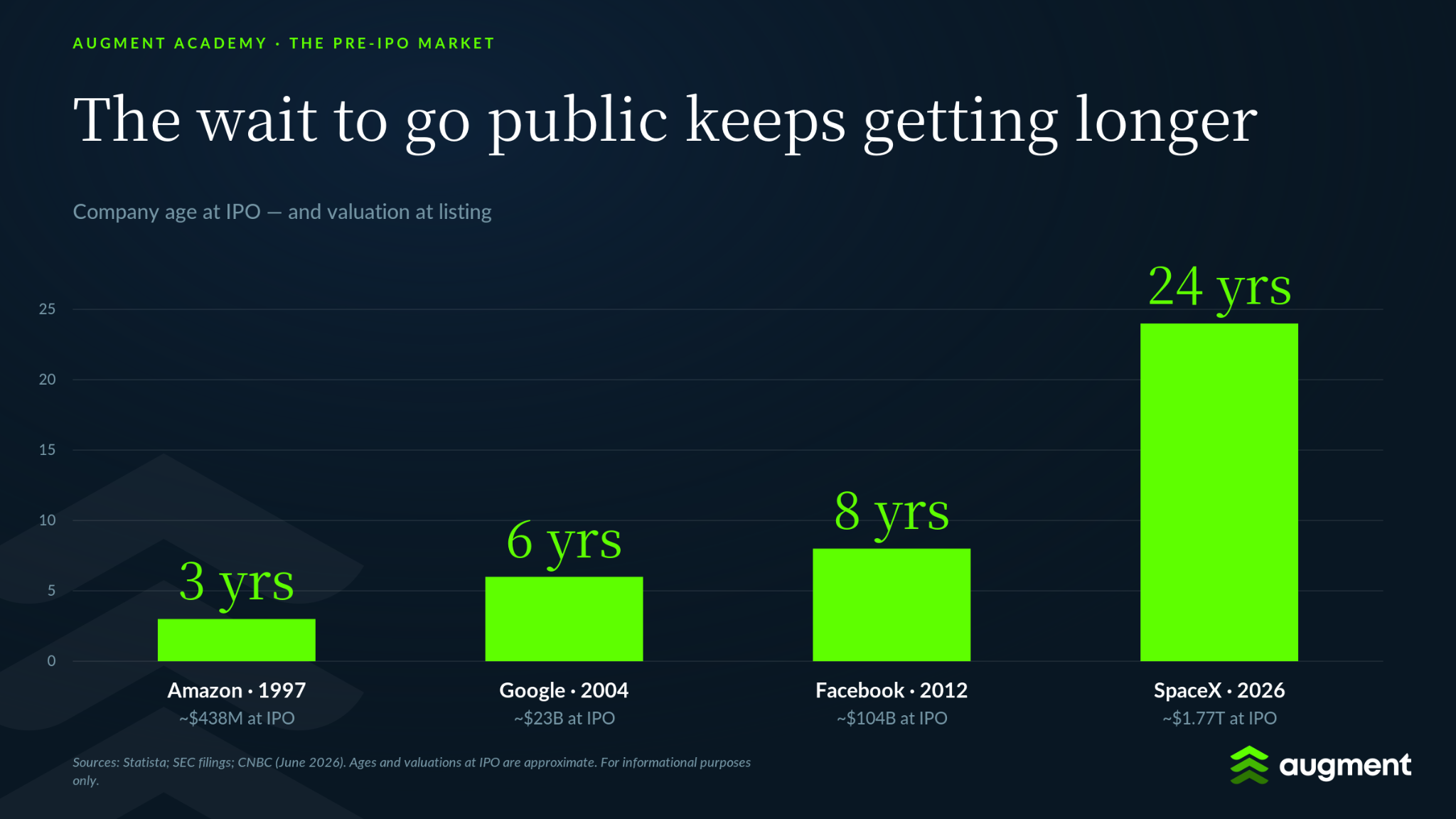
When Amazon went public in 1997, it was about three years old and worth roughly $438 million. Google in 2004 was six years old, valued near $23 billion. Facebook in 2012 was eight years old, at about $104 billion. When SpaceX went public in June 2026, in the largest IPO in history, at a valuation near $1.77 trillion, it was about 24 years old.
That gap is the whole story. Companies that once raced to go public within a few years now stay private for a decade or two, which means much of their growth happens before any public listing. For most of SpaceX’s existence, the only way for an outside investor to gain exposure was the pre-IPO market. It’s what gives outside investors a way in during that long private stretch.
An IPO (initial public offering) is the first time a company sells its stock to the public. “Pre-IPO,” then, simply means before that, and a pre-IPO company is a private company that might go public someday.
One thing to hold onto: “pre-IPO” describes a stage, not a promise. A private company might eventually go public, like SpaceX did in 2026. It might be acquired instead, stay private indefinitely or even go out of business. No exit is guaranteed for any private company.
Pre-IPO is also not the same as early-stage venture capital. It generally refers to later-stage, more established private companies, businesses with real revenue and a clearer path to a public listing, rather than early bets on an unproven idea.
The difference is less about size than about two things: who can own the shares, and what the company has to disclose.
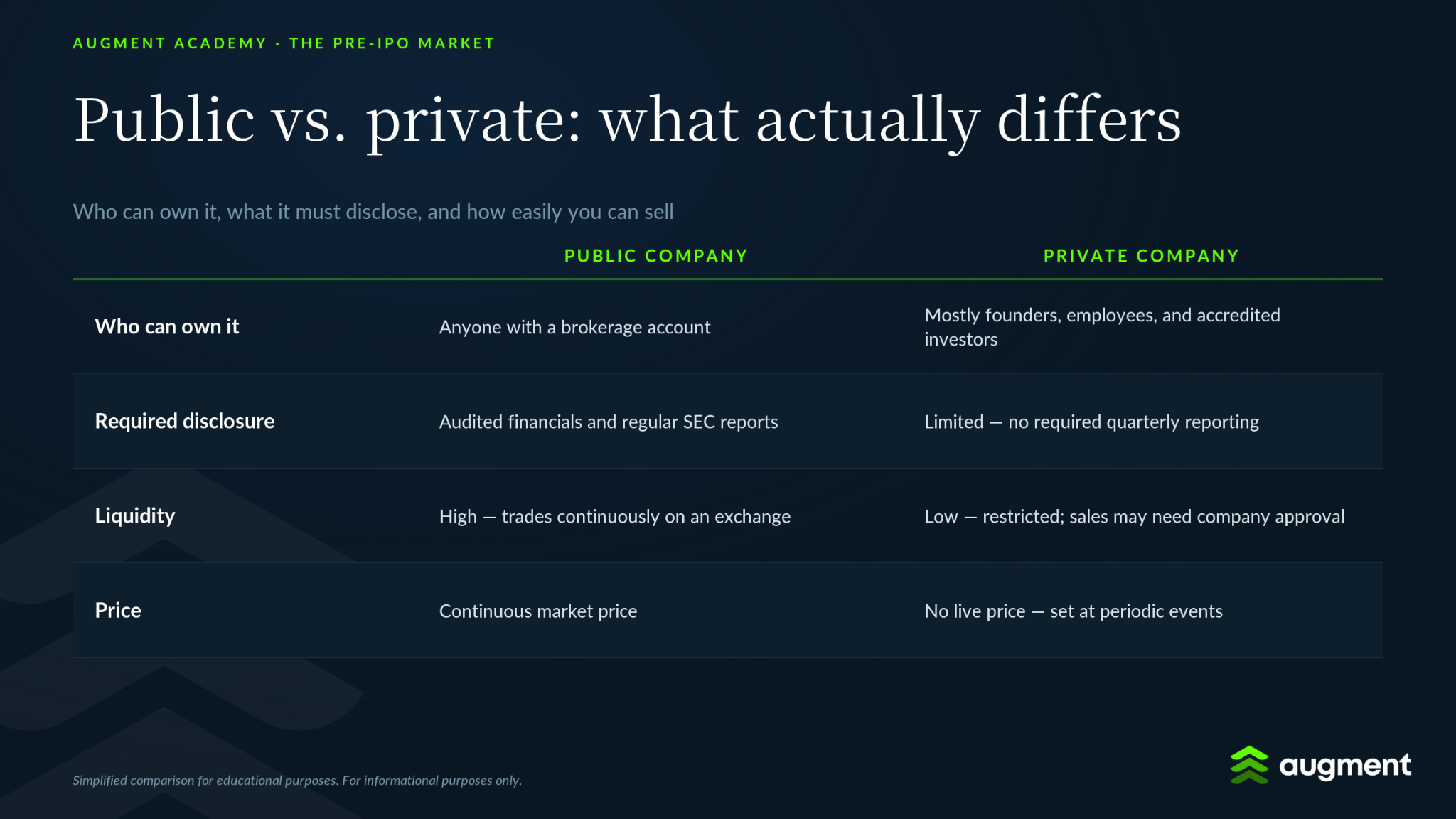
Private companies can offer access to growth early, but the shares are illiquid, harder to value, harder to sell, and carry materially more risk.
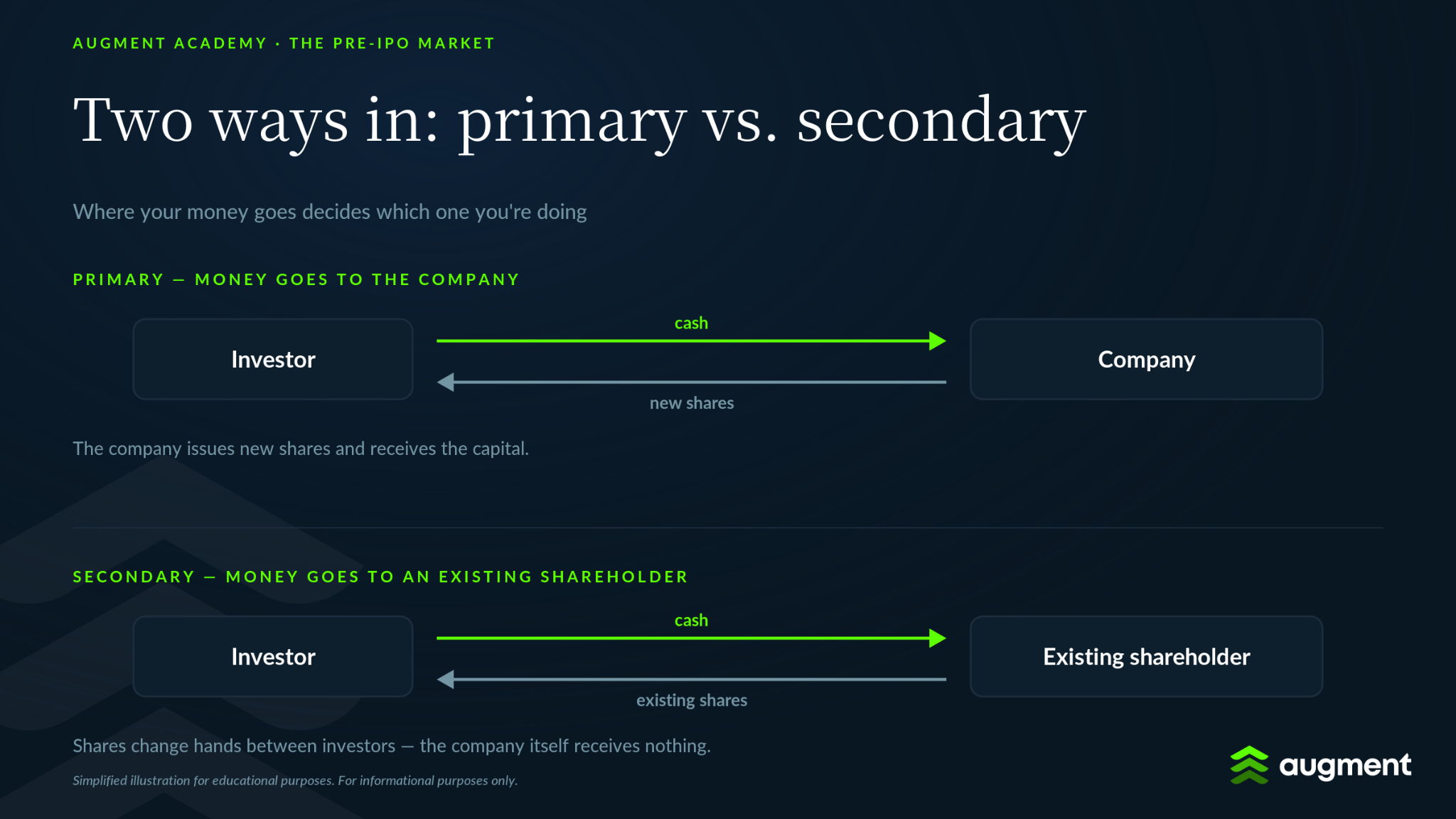
Two more terms used throughout this series and covered in Primary vs. Secondary: The Two Ways Capital Enters a Private Company: A primary transaction is when your money goes to the company for newly issued shares. A secondary transaction is when you buy existing shares from someone who already owns them, like an early employee or investor seeking liquidity. But one of the biggest differences is how money is exchanged and with whom.
Three forces explain the shift.
1. Regulation made staying private easier and going public costlier. The JOBS Act of 2012 (Jumpstart Our Business Startups Act) raised the shareholder count that forces a company into public reporting: under Section 12(g) of the Securities Exchange Act of 1934, a company with over $10 million in assets once had to register upon reaching 500 holders of record, but the JOBS Act lifted that to 2,000 holders (or 500 who aren’t accredited) and excluded many employees paid in stock. Meanwhile, the Sarbanes-Oxley Act of 2002 made being public more expensive, one more reason to wait.
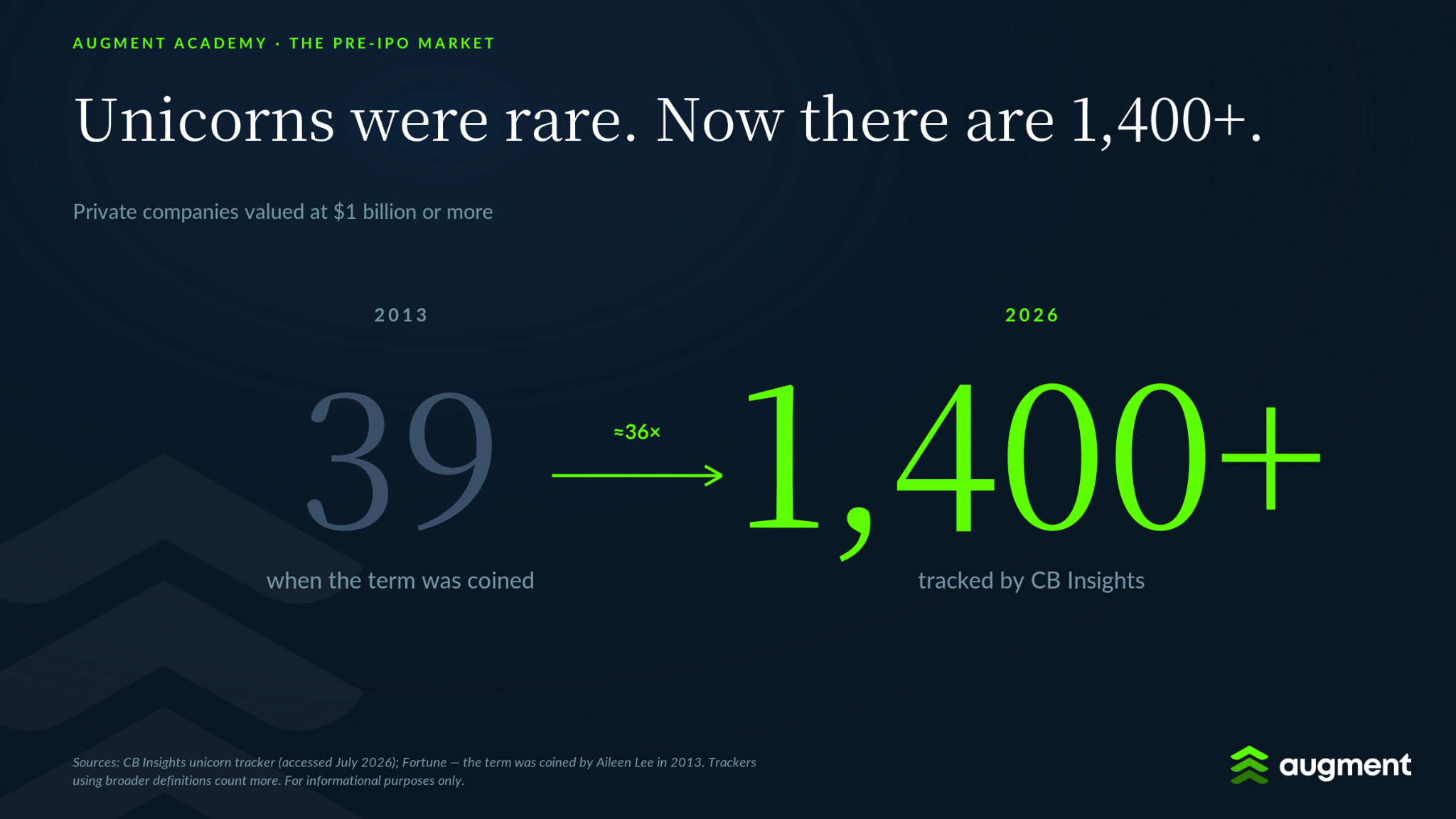
2. There’s far more private capital available. When a company can raise billions privately, the urgency to IPO fades. The clearest sign is the rise of the unicorn, a private company valued at $1 billion or more. When the term was coined in 2013, there were 39. By 2026, CB Insights tracked more than 1,400 (other trackers, using broader definitions, count more).
3. Private investing became normal. Large private companies have run repeated employee tender offers, company-organized programs that let existing shareholders sell some stock, and secondary sales by employees and early investors have become routine in the late-stage market.
For years, access to private shares belonged to institutions and the well-connected. That’s shifting fast, on two fronts.
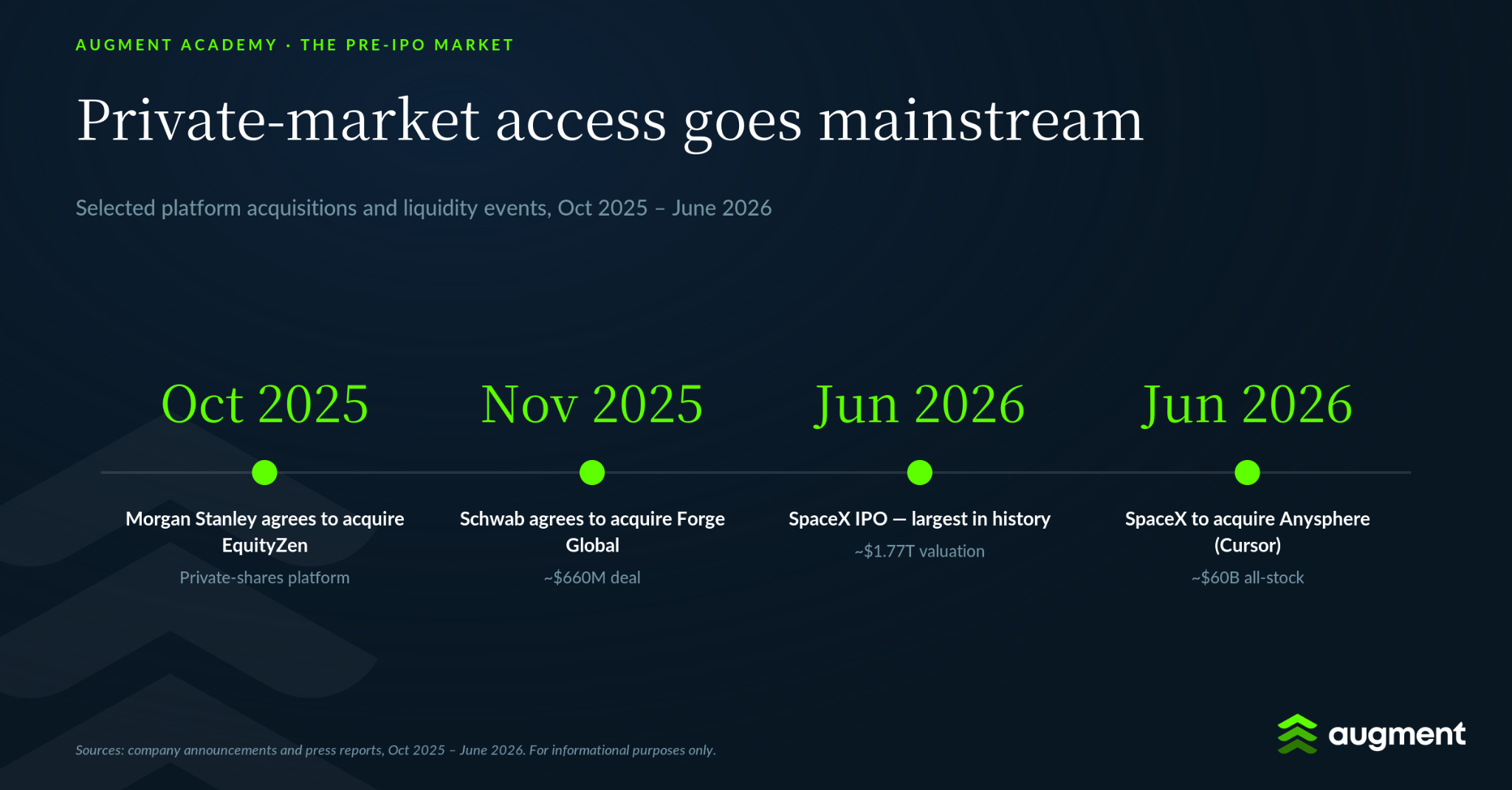
First, the mainstream platforms are moving in. In November 2025, Charles Schwab agreed to acquire Forge Global, a private-markets platform through which investors had traded more than $17 billion in private shares, in a deal valued around $660 million. Weeks earlier, Morgan Stanley agreed to acquire the private-shares platform EquityZen. And in early 2026, Robinhood launched a listed fund built to give retail investors exposure to private companies.
Second, headline liquidity events have put a spotlight on the value created while companies are still private. SpaceX’s record 2026 IPO is the clearest example, but exits don’t only come through IPOs. Days after listing, SpaceX announced it would acquire Anysphere, the maker of the AI coding tool Cursor, in an all-stock deal valued at roughly $60 billion, reported as one of the largest acquisitions of a venture-backed startup on record. Events like these can highlight the potential interest in high-growth companies during earlier stages.
The point isn’t that any one platform or company is right for you, that depends entirely on your situation, but that private-market access is becoming a more visible, mainstream part of investing.
The features that make private investing appealing are inseparable from its risks:
These aren’t reasons to avoid the pre-IPO market, they’re reasons to approach it thoughtfully and with appropriate sizing. Two other modules in this series go further: What Are the Risks of Pre-IPO Investing? covers risk in depth, and How to Tell a Legitimate Pre-IPO Offering From a Scam covers how to tell a legitimate offering from a fraudulent one.
The pre-IPO market is the market for private company shares while they remain private. It exists at scale because companies now stay private far longer than they once did, driven by lighter registration requirements after the JOBS Act of 2012, abundant private capital, and a culture where private secondary transactions are routine. Access once limited to institutions is steadily reaching the platforms accredited investors already use, and headline events like SpaceX’s 2026 IPO have only raised the market’s profile. The opportunity is real, and so are the risks of illiquidity, uncertain valuation, and the absence of any guaranteed exit.
It means before a company’s initial public offering. A pre-IPO company is a private company that may go public someday, but is under no obligation to.
Generally only accredited investors, as defined by the SEC (based on income, net worth, or certain professional licenses). You can review the official criteria at Investor.gov.
No. Early-stage venture capital backs young, often pre-revenue companies. Pre-IPO generally refers to later-stage, more established private companies with real revenue, though both are private-market investments and carry meaningful risk.
No. Some go public (SpaceX did in June 2026), some are acquired (SpaceX itself acquired Cursor-maker Anysphere that same month), and some stay private indefinitely. No exit is guaranteed for any private company.
Yes. Private shares are illiquid, valuations can be uncertain or stale, information is limited, and a company can decline in value or fail, you can lose some or all of your investment.
Get started today — explore pricing, offerings, and submit your first order.
FOR QUALIFIED INSTITUTIONAL AND ACCREDITED INVESTORS ONLY: Under federal securities laws, private market investments on this platform are available exclusively to Institutional and Accredited Investors. Verification of status required before investing. Private investments involve significant risks including illiquidity, potential loss of principal, and limited disclosure requirements. "Augment" refers to Augment Markets, Inc. and its affiliates. Augment Markets, Inc. is a technology company offering software and data services, not a bank or financial institution. Cash Accounts are provided by Modern Treasury Corp. financial institution partners and through Augment's technology. Augment does not act as a money services business, provide money transmission, or serve as a custodian of funds. Funds held in your Cash Account are not FDIC insured unless expressly disclosed. Full terms available in the Augment Cash Account Agreement.Brokerage services are offered through Augment Capital, LLC, an affiliated broker-dealer and member FINRA/SIPC. “Investment accounts” are not brokerage accounts and do not hold customer funds or securities. Investment advisory services are offered through Augment Advisors, LLC, an SEC-registered investment adviser. Registration with the SEC does not imply a certain level of skill or training. Augment and its affiliates do not provide legal or tax advice; consult your attorney or tax professional regarding your specific situation. For additional information, please refer to Augment Advisors, LLC’s Form ADV Part 2A (Firm Brochure) and FINRA BrokerCheck.