Primary vs. secondary market transactions explained: where your money goes, what shares you receive, and why that one difference shapes every private-market deal.

In a primary transaction, a private company issues new shares and the investor's money goes to the company. In a secondary transaction, an existing shareholder sells shares they already own, and the money goes to that seller, the company receives nothing. Almost everything else about a private-market deal, who sets the price, what security you receive, how long closing takes, flows from that one distinction.
Who this is for: investors who are new to private markets and want to understand how a pre-IPO deal is actually structured. Pre-IPO investments in the U.S. are generally limited to accredited investors, as defined under Rule 501 of Regulation D, see the accredited investor entry in our glossary.
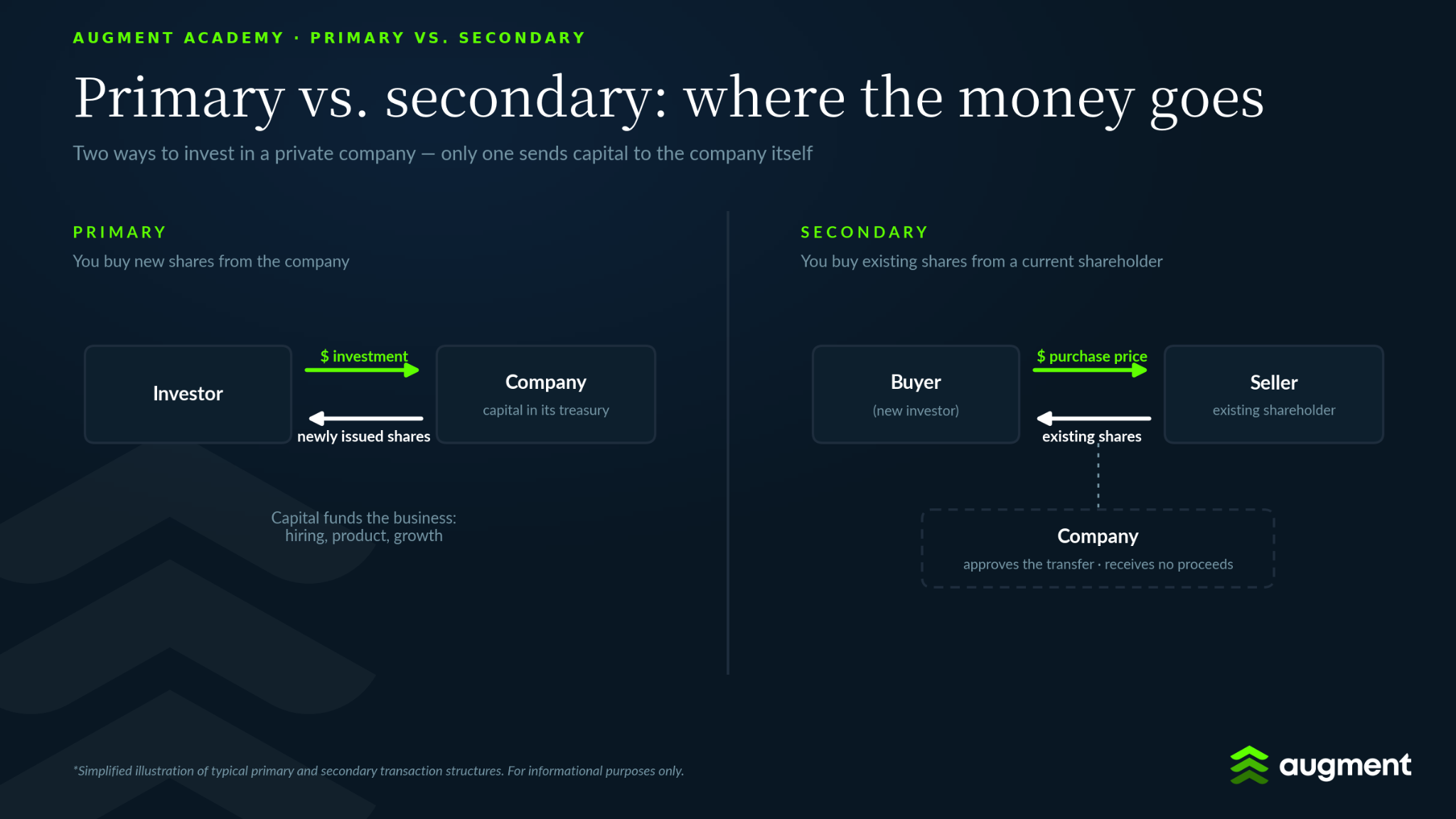
A primary is a transaction with the company itself. The company needs capital, creates new shares, and sells them, this is what most people mean by "fundraising" or a "Series A / Series E round." A lead investor negotiates the price and terms with the company, other investors in the round buy at that same price, and the cash lands in the company's treasury. Under U.S. law, primary issuance is governed by the Securities Act of 1933; private companies typically rely on exemptions such as Regulation D, and the issuer files a Form D notice with the SEC within 15 days of the first sale.
In a primary round, investors typically receive newly issued preferred stock, a new series with negotiated rights such as a liquidation preference (the right to be paid back before common shareholders in an exit). From term sheet to close usually takes roughly 60 to 120 days.
By the time a round is reported in the press, it has usually been negotiated for months and the allocation is largely filled. Genuine primary access is by invitation. If a deal is marketed to individual investors as "primary access," the structure is often something else, an SPV interest or another indirect structure, so it pays to read the offering documents closely.
A secondary is a transaction between shareholders. An existing holder, often a current or former employee, an early venture fund returning capital to its investors, or another early shareholder, sells shares to a new buyer. The company typically must approve the transfer, but it is not a party to the economics: the seller keeps the proceeds. (Secondary trading is the domain of the Securities Exchange Act of 1934, the statute that also created the SEC.)
Secondaries are how most individual investors encounter the pre-IPO market, typically through brokers, secondary platforms, or SPV sponsors. A special purpose vehicle, or SPV, is a fund entity formed to hold shares of a single company on behalf of a group of investors, covered in depth in a separate module in this series, What You're Actually Buying in a Pre-IPO Deal.
Timelines shown are for the transaction itself, negotiated directly between the parties. Individuals investing through a best-efforts offering, subscribing alongside other investors as a sponsor gathers demand, typically see a different, often significantly shorter timeline. See the closing-timeline section below.
In a primary, you receive the new class being issued. In a secondary, you receive whatever class the seller held, and that is often not the class from the latest headline round. Buy from a former employee who exercised stock options and you get common stock, which sits below every series of preferred in the payout order at an exit. Buy out an early Series A investor and you get Series A preferred, with rights negotiated years earlier.
That's why a price quoted as a "discount to the last round" means little on its own. "Series E preferred at 25% off the Series E price" and "common stock at 25% off the Series E price" are different securities with different rights, even though the headline discount is identical. Careful deal pages always name the share class; if one doesn't, ask in writing.
Secondary trades tend to price at a discount to the company's most recent primary round, the median discount sat around 27–28% as of the third quarter of 2025, though individual deals ranged from no discount on in-demand names to 40% or more. Four factors do most of the work:
One important caution: a discount is not an expected return. It compensates the buyer for subordination, illiquidity, limited information, and time risk — it is a reference point, not a margin of safety.
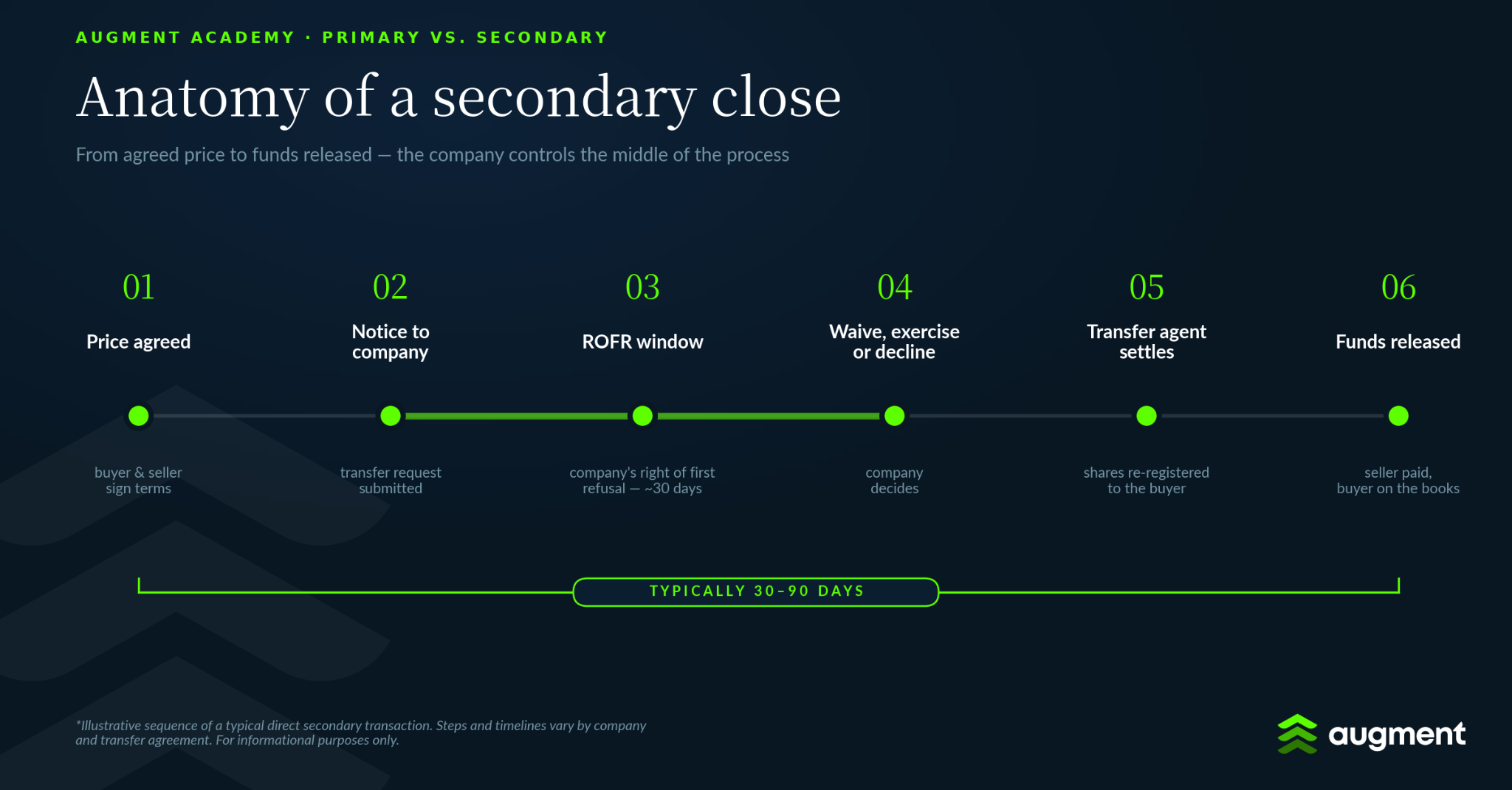
Most private companies hold a right of first refusal (ROFR), a contractual right to buy the shares themselves, on the same terms, before an outside buyer can. A typical process: buyer and seller agree on price, the seller notifies the company, and a ROFR window, commonly around 30 days, opens. The company then waives its right (the deal proceeds), exercises it (the company or its designee buys the shares instead), or declines the transfer. Only after that do shares move through the transfer agent (the official record-keeper of who owns the company's shares) and funds change hands.
ROFR is the main reason a direct secondary on a healthy company rarely closes in under 30 days, and why extreme urgency, like a pressured "48-hour close," is inconsistent with how a direct trade normally works. Recognizing legitimate deal mechanics is one of the better protections an investor has; a separate module in this series, How to Tell a Legitimate Pre-IPO Offering From a Scam, covers red flags in depth.
Before you take those numbers as your own expectation, note what they cover: the 30-to-90-day window describes a direct trade, one buyer purchasing from one seller, with the company's ROFR process in the middle. Many individual investors participate instead through a best-efforts offering, in which a sponsor or placement agent gathers indications of interest (non-binding signals of how much investors want to commit) and completes the raise based on that demand and funding, without guaranteeing any amount will be sold. From the investor's seat, that timeline looks very different, it varies widely and is often significantly shorter, from days to weeks, because you are subscribing to an offering, not negotiating a bilateral share transfer. A fast subscription close in that context is the structure working as designed, not a warning sign; the urgency caution above applies to direct secondaries specifically. The access structures themselves are covered in a separate module in this series, How You Get Access: The Five Ways to Invest in Pre-IPO Companies.
Despite the headlines that primary mega-rounds attract, most of the volume accessible to individual investors is secondary, and the secondary market has grown into a major channel. Global secondary transaction volume reached about $240 billion in 2025, up 48% year over year and a record. In venture specifically, an estimated $106.3 billion traded through US secondaries in 2025, approaching the $119.6 billion that VC-backed public listings returned the same year. For most of the prior decade, secondaries were a small fraction of public-exit value; that gap has nearly closed as companies stay private longer.
[IMAGE PLACEHOLDER 3 of 3]
No. In a secondary, the proceeds go to the selling shareholder. The company typically approves the transfer but is not a party to the economics. Only a primary issuance sends capital to the company.
Two structural reasons: the seller is asking for liquidity in a market with little of it, and the shares sold are often a more junior class than the last priced round. Class, time since the round, market conditions, and seller motivation determine the size, the median sat around 27–28% in the third quarter of 2025.
A company's contractual right to buy shares a holder wants to sell, on the same terms, before an outside buyer can. The ROFR window, commonly around 30 days, is the main reason a direct secondary takes 30 to 90 days to close.
It depends on the structure. A direct secondary between one buyer and one seller typically takes 30 to 90 days, largely because of the company's ROFR process. Subscribing to a best-efforts offering, where a sponsor gathers investor demand and closes the raise against it, varies widely and is often significantly shorter, from days to weeks.
In the U.S., these offerings are generally limited to accredited investors under Rule 501 of Regulation D. Primary rounds are additionally invitation-only in practice; secondaries are typically reached through brokers, platforms, or SPV sponsors.
Get started today — explore pricing, offerings, and submit your first order.
FOR QUALIFIED INSTITUTIONAL AND ACCREDITED INVESTORS ONLY: Under federal securities laws, private market investments on this platform are available exclusively to Institutional and Accredited Investors. Verification of status required before investing. Private investments involve significant risks including illiquidity, potential loss of principal, and limited disclosure requirements. "Augment" refers to Augment Markets, Inc. and its affiliates. Augment Markets, Inc. is a technology company offering software and data services, not a bank or financial institution. Cash Accounts are provided by Modern Treasury Corp. financial institution partners and through Augment's technology. Augment does not act as a money services business, provide money transmission, or serve as a custodian of funds. Funds held in your Cash Account are not FDIC insured unless expressly disclosed. Full terms available in the Augment Cash Account Agreement.Brokerage services are offered through Augment Capital, LLC, an affiliated broker-dealer and member FINRA/SIPC. “Investment accounts” are not brokerage accounts and do not hold customer funds or securities. Investment advisory services are offered through Augment Advisors, LLC, an SEC-registered investment adviser. Registration with the SEC does not imply a certain level of skill or training. Augment and its affiliates do not provide legal or tax advice; consult your attorney or tax professional regarding your specific situation. For additional information, please refer to Augment Advisors, LLC’s Form ADV Part 2A (Firm Brochure) and FINRA BrokerCheck.