How to evaluate a private company offering step by step: authentication, structure, fees, risk, and exit, distilled from the Augment Academy series.

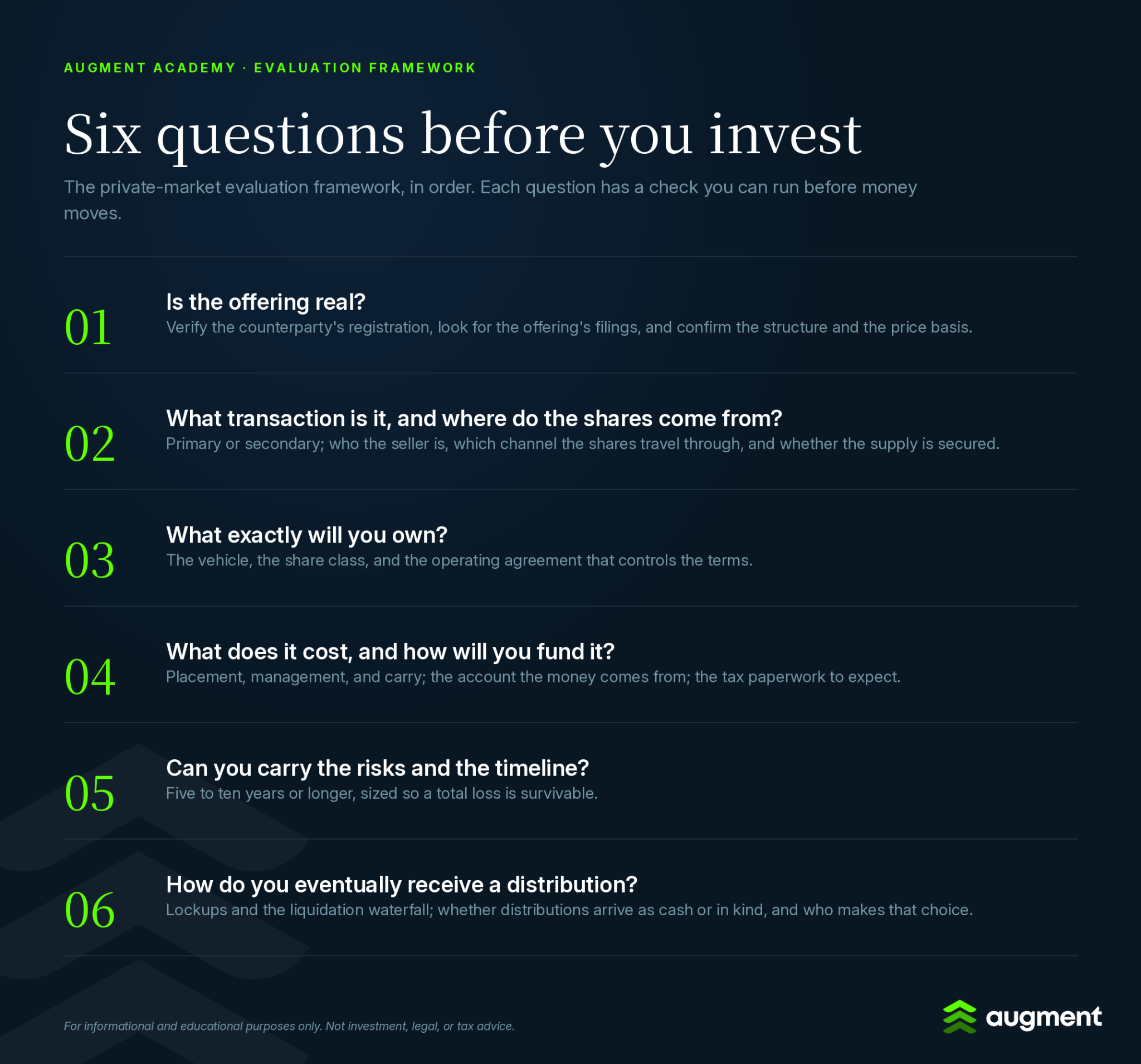
Evaluating a private investment comes down to six questions: Is the offering real? What transaction is it, and where do the shares come from? What exactly will you own? What does it cost, and how will you fund it? Can you carry the risks and the timeline? And how do you eventually receive a distribution?
Each question has its own module in this series, where the mechanics live in full. This one puts them in working order: the sequence to run on a live deal, what a good answer looks like at each step, and the key terms in one place at the end.
Three SEC enforcement actions between December 2023 and September 2024 covered more than $830 million raised from investors, and in each the SEC alleges the sellers were unregistered or misrepresented their registration. Take a look at Verifying a Private Offering for the deep dive, or the quick summary below:
A deal that passes these checks is likely real. Whether it deserves your money is the work of the next five questions.
Determine the deal type first: primary or secondary. A primary transaction sends your capital to the company for newly issued shares. A secondary hands it to an existing holder for whatever class that holder owned. The distinction, covered in Primary vs. Secondary: The Two Ways Capital Enters a Private Company, drives the share class, the price logic, and the timeline.
Then ask about supply. As Where Pre-IPO Shares Come From lays out, nearly all shares available to individual investors already belong to someone, the company usually holds a right of first refusal (ROFR) over the transfer, and a willing seller plus an agreed price does not equal a closed transaction. Ask who the seller is, which channel the shares travel through, and whether the counterparty holds the stock or is still gathering interest.
Deal pages tend to lead with the company's name; your account will hold something more specific. The vehicle question comes first: direct shares, an interest in a single-company SPV (special purpose vehicle), a private fund stake, or a registered fund position, compared in How You Get Access: The Five Ways to Invest in Pre-IPO Companies. The working rule from that module: ask what lands in your account at closing. A "settlement at IPO" promise is a forward contract, a claim against the counterparty rather than ownership and is contingent on the company going public, which may never happen.
Then the security itself, the subject of What You're Actually Buying in a Pre-IPO Deal:
Fees decide what you keep, and the structure of the fee matters as much as the size. Fees & Economics: What Pre-IPO Investing Actually Costs provides the checklist: the management fee and its base, the carry and its waterfall, the quiet administrative line items, anything charged at exit, and the wrapper. Ask the sponsor one question before subscribing: if I invest $10,000, what gets deployed, what fees will I pay, and when? Expect a plain, specific answer.
Funding is its own decision. A taxable account is the default path; retirement money can work through a self-directed IRA but adds custodial mechanics, prohibited-transaction rules, and the deal-level 25% cap on benefit-plan investors, per Funding Your Pre-IPO Investment: Which Account Do You Use?. If you plan to invest retirement money, tell the sponsor early.
Taxes follow the funding choice. Expect a Schedule K-1 rather than a 1099, keep your own basis records for the life of the position (sale proceeds − basis = gain), and treat any QSBS (qualified small business stock) suggestion on a secondary with skepticism: buying from an existing holder typically fails the original-issuance test, as How Are Pre-IPO Investments Taxed? Cost Basis, Holding Periods, and QSBS explains. Always consult a tax professional on your specific circumstances.
The defining risks of this market are visible in advance. What Are the Risks of Pre-IPO Investing? names seven: illiquidity, valuation uncertainty, no guaranteed exit, lockup risk, dilution and the preference stack, transaction risk, and counterparty risk. Three of its self-assessment questions do the sorting work:
Treat any mark as a data point rather than a price, and size the position so a total loss is survivable. If any of the three answers is no, the discipline is to pass, whatever the name on the deal page.
Liquidity events pay on their own schedule. After an IPO, a lockup (conventionally 180 days, though structures vary widely) plus distribution mechanics mean proceeds commonly reach investors six to eight months after the listing. An acquisition pays through the liquidation waterfall instead, most commonly in cash. What Happens After an IPO covers both paths.
For SPV investors, one clause decides a lot: whether the vehicle distributes cash or shares in kind. The operating agreement sets the mechanics, and most leave the choice to the manager rather than the investor. That determines who controls the exit price and which tax year the bill lands in. Read the clause before committing, not after.
The test of a framework is a live deal page, open in front of you, with an allocation described as limited. You are ready when you can:
If one of these still feels shaky, the linked module is the review; every claim above traces back to one of them.
The full Augment Glossary carries the complete reference, alphabetized and cited. These are the terms this series leans on most:
The private market rewards process over enthusiasm. Companies may do much of their growing while they remain private, which is part of why this market exists, and the structures that provide access to it are knowable: every fee, share class, transfer restriction, and distribution clause in this series sits in a document you can request before wiring anything. The six questions are the request list.
Speed alone proves little in either direction. Pooled vehicles and best-efforts offerings commonly open and close within days, and that is the structure working; pressure to wire on a cold-pitched direct purchase is a warning sign, and the enforcement record shows the cost of skipping the free checks. Verify the counterparty, confirm the structure and the share class, price the fees against the work being done, match the money to the timeline, and know how you receive a distribution.
Ask what you're buying at closing: shares, a membership interest, or a contractual promise like "settlement at IPO." Confirm the share class too, and whether a distribution in cash or in kind is an option or a requirement at exit.
Run the seller through FINRA BrokerCheck and the SEC's IAPD, look for the issuer's Form D on EDGAR (a brand-new vehicle may not have filed yet; Form D follows the first sale), confirm which entity you are subscribing to and what it holds, and ask how the price was set.
Plan on five to ten years, and accept that it could run longer or end without an exit: companies can stay private indefinitely or fail. Even after an IPO, lockup and distribution mechanics commonly add six to eight months before proceeds arrive; from first S-1 filing to distribution generally runs 9 to 18 months.
It names the issuing vehicle, the share class, the fee schedule including any upfront placement fee, and the transaction mechanism. Marketing that names only the underlying company leaves every question that matters unanswered.
Get started today — explore pricing, offerings, and submit your first order.
FOR QUALIFIED INSTITUTIONAL AND ACCREDITED INVESTORS ONLY: Under federal securities laws, private market investments on this platform are available exclusively to Institutional and Accredited Investors. Verification of status required before investing. Private investments involve significant risks including illiquidity, potential loss of principal, and limited disclosure requirements. "Augment" refers to Augment Markets, Inc. and its affiliates. Augment Markets, Inc. is a technology company offering software and data services, not a bank or financial institution. Cash Accounts are provided by Modern Treasury Corp. financial institution partners and through Augment's technology. Augment does not act as a money services business, provide money transmission, or serve as a custodian of funds. Funds held in your Cash Account are not FDIC insured unless expressly disclosed. Full terms available in the Augment Cash Account Agreement.Brokerage services are offered through Augment Capital, LLC, an affiliated broker-dealer and member FINRA/SIPC. “Investment accounts” are not brokerage accounts and do not hold customer funds or securities. Investment advisory services are offered through Augment Advisors, LLC, an SEC-registered investment adviser. Registration with the SEC does not imply a certain level of skill or training. Augment and its affiliates do not provide legal or tax advice; consult your attorney or tax professional regarding your specific situation. For additional information, please refer to Augment Advisors, LLC’s Form ADV Part 2A (Firm Brochure) and FINRA BrokerCheck.