Every private share you can buy already belongs to someone unless you participate in a primary round. Who sells pre-IPO shares, how that supply reaches investors, and why it is limited and never guaranteed.

With rare exceptions, the shares available to investors in the pre-IPO market are not new. They already belong to someone, usually a current or former employee or an early investor, and they only become available when that holder decides to sell and the company permits the transfer. That single fact explains most of what feels unusual about private-market supply: why a sought-after company can have plenty of demand and no shares to buy, why deals take time to assemble, and why no platform can promise inventory in a specific name.
Who this is for: investors new to private markets who want to understand where deal supply originates before evaluating any specific offering. Most pre-IPO vehicles in the U.S. are limited to accredited investors, as defined under Rule 501 of Regulation D.
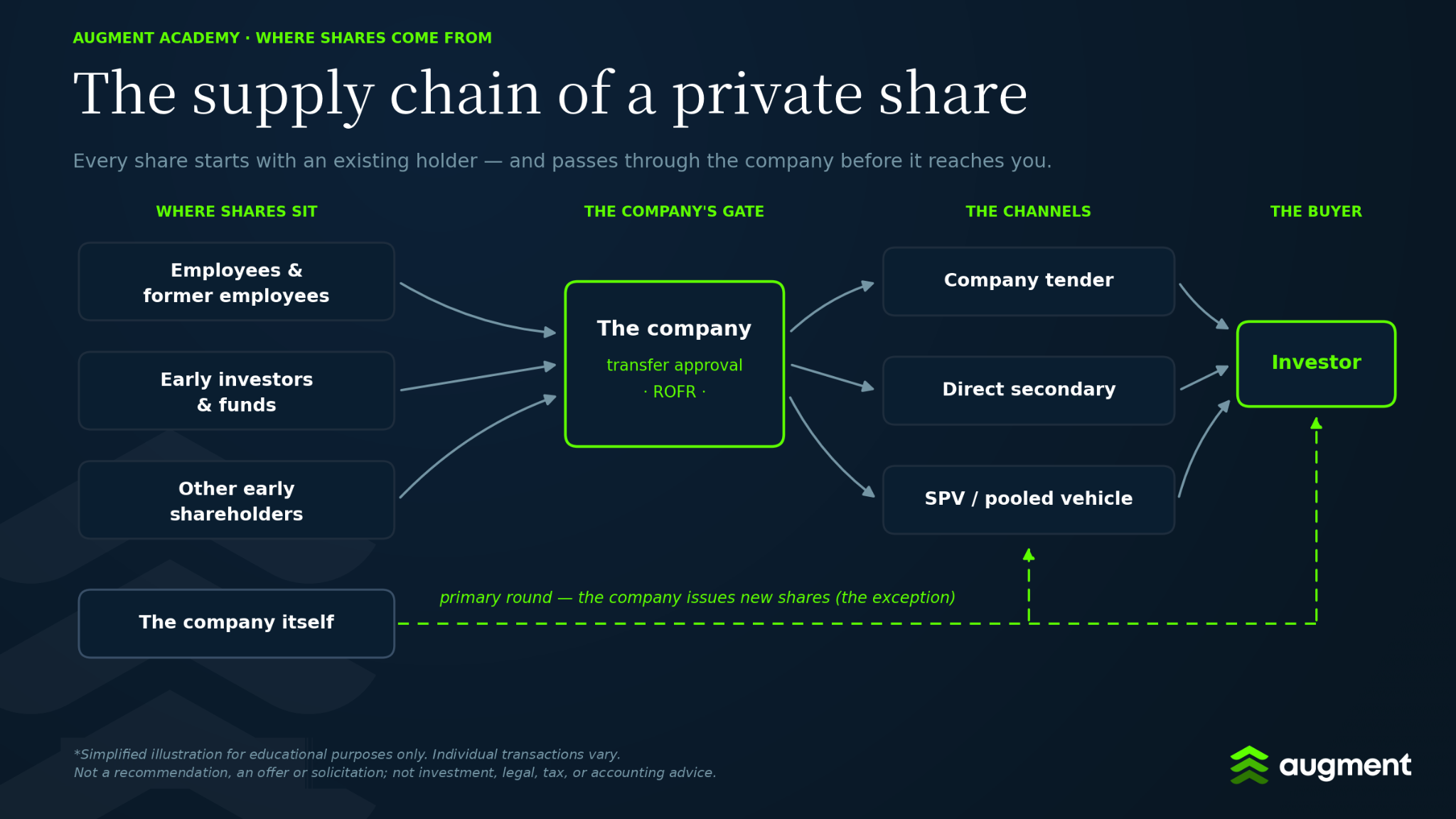
A private company's shares sit with a fairly short list of holders: founders, employees, advisors, and the investors who funded its earlier rounds. Supply reaches the market when one of them wants liquidity.
Most of the common stock that reaches the secondary market comes from current or former employees: equity compensation is how they're paid, and selling some of it is how paper value becomes money they can use. The rest of the table is just as circumstantial, a fund hitting the end of its life or rebalancing a portfolio, so a sale usually says more about the seller's timing than about the company.
The exception to "shares come from existing holders" is a primary round, where the company itself issues brand-new shares to raise capital. At the late stage those rounds are negotiated with, and largely filled by, institutional leads. For individual investors, nearly all accessible supply is secondary or through a fund/SPV that has primary round access.
Three main channels move existing shares from holders to new investors:
The access structures themselves (direct ownership, SPVs, funds, and listed vehicles) are compared in a separate module in this series, How You Get Access: The Five Ways to Invest in Pre-IPO Companies.
Scarcity in this market is built into how private companies operate. Three constraints account for most of it:
The float is small and gated. Like public companies, private companies have a finite number of shares outstanding. However, for private companies, most shares are held by insiders who aren't selling. And unlike a public stock, what does trade moves only with permission. Most private companies hold a right of first refusal (ROFR), meaning the company can step in and buy the shares itself before an outside buyer does, and most also hold approval rights over every transfer. The company isn't the only possible gatekeeper, either: certain investors, typically major holders from earlier rounds, negotiated ROFR rights of their own and can step into or block a sale independently of the company.
Companies actively manage their cap tables. Under Section 12(g) of the Securities Exchange Act, a private company with $10 million or more in assets must register and begin public-style reporting once it has 2,000 or more holders of record. Late-stage companies commonly manage their holder count to stay below that line, which means they tend to prefer fewer, larger, institutional holders and may decline transfers that would fragment the cap table. A willing seller and an agreed price do not equal a closed transaction.
Sellers have to show up. Even where a company permits transfers, supply appears only when holders choose liquidity. Demand follows no such schedule: the most sought-after private companies often attract far more buyer interest than there are sellers, and that imbalance can persist for years. The secondary market has grown substantially (global secondary volume reached about $240 billion in 2025, up roughly 48% year over year), but the gates described above still govern every transfer. This is why access is often a harder problem than capital in this market.
Knowing where shares originate isn't enough on its own; each source differs in how accessible it is. The pool of sellable shares is smaller than the pool of shareholders, for two reasons.
Some issuers restrict employee transfers outright. Where employee transfers are locked down, the practical pool of available shares shrinks, and what liquidity exists tends to run through company-organized tenders.
Holder type shapes transferability. Shares held by venture funds and institutions tend to transfer more easily than employee common: they come in larger blocks, and institutional investors often negotiated transfer rights when they invested. So the type of holder behind a deal, and the sourcing model that reached them, tells you how cleanly the shares can move.
Issuer posture also shifts with the company’s current focus: managing the pricing signals, keeping its cap table tidy, retaining employees, or preparing for a funding round or liquidity event. Supply loosens or tightens accordingly. Underneath all of this sits issuer control: the company decides which shares move, when they move, and who receives them, and its priorities at any given time are part of the supply equation.
Sourcing is a relationship business. The sponsors and platforms that consistently find supply are often the ones with standing relationships with founders, early venture investors, and the companies themselves. Well-connected sponsors are more likely to see good supply. Sponsors without those relationships have a much harder time sourcing, and that gap persists because relationships take years to build.
For an investor, the visible trace of a sponsor's connectedness is layering: how many steps sit between you and the company's cap table. A direct cap-table position is the benchmark. One layer (a single SPV holding the shares) is the practical reality for most individuals, and in the handful of most contested names it is often the price of entry: when demand is extreme, even well-connected sponsors work through vehicles. But the same distance reads differently in a less contested name. If shares in a company are not scarce and a sponsor still can't get near the cap table, the layering warrants more questions about the manager's sourcing than about the market. Weigh the layers against the demand for the name, and remember each added layer also adds cost and counterparty risk.
In practice, no platform, broker, or sponsor can promise you shares of a specific company, unless they already own the stock. It helps to know the four ways an apparently available deal can fall through, or turn out never to have existed.
The company can take the deal away. In a direct secondary, the ROFR process means the company (or its designee) can step in and buy the shares on the agreed terms, or decline the transfer outright. The buyer did nothing wrong; the deal simply ends.
The seller can change their mind. Until a purchase agreement is signed, a seller is not contractually obligated to sell: a set price and a verbal agreement bind no one. Sellers ultimately choose who they sell to, and a last-minute bid at a larger size or a higher price can redirect shares that seemed spoken for. Scenarios like these are not uncommon, and they add real variability: a deal that looked settled on Monday can look different by Friday, through no fault of the buyer or the platform.
Broker inventory isn't always real. Multiple brokers sometimes market the same parcel of shares, and occasionally shares that no one can deliver. Before money moves, ask for written confirmation that the seller exists and the broker has a contractual arrangement, and verify any counterparty through FINRA BrokerCheck. Legitimate offering documents name the share class and the mechanism.
Many offerings gather demand before shares are secured. Sponsors gauge demand with indications of interest (IOIs): non-binding signals of how much investors would commit to a potential deal. IOIs are a general tool, used to size demand for a deal before anyone commits capital, and expressing one is often how supply gets sourced. A related concept is the best-efforts offering, a common structure for individual investors in which the sponsor completes the raise against whatever demand and funding actually arrive, without guaranteeing any amount will be sold. An allocation can come together in days or not materialize for months, depending on whether sellers surface or when the company closes its funding round.
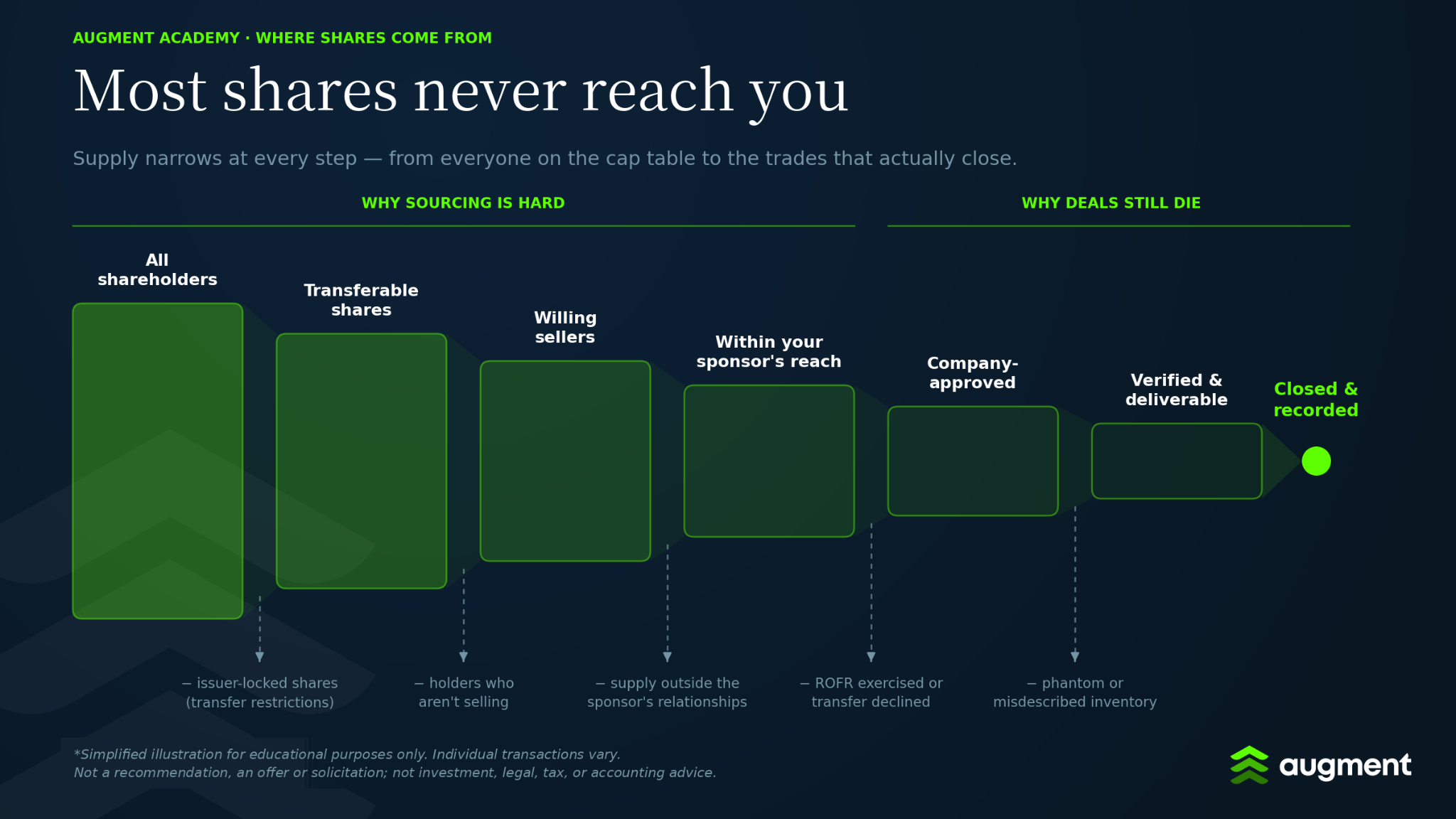
Supply in the pre-IPO market originates with people and funds who need liquidity, passes through a company that controls its own cap table, and reaches investors through a handful of channels that each work on their own clock. Expect scarcity in sought-after names and timelines driven by process rather than urgency, and treat any guarantee of inventory, or pressure to move faster than the structure allows, as a reason to slow down and ask questions in writing.
Mostly current and former employees converting equity compensation into cash, and early investors, often venture funds returning capital at the end of their life. Most selling reflects the seller's personal or fund timeline, not a view on the company.
Because supply requires a willing seller and the company's permission. Private companies hold transfer-approval rights and usually a right of first refusal, and they deliberately keep their shareholder count low, so even strong demand can mean zero available supply.
Unless the sponsor has taken a warehoused position, no. Inventory in any specific name depends on sellers surfacing and the company or intermediary investors approving transfers. Verify where the shares currently sit as well as the counterparty through FINRA BrokerCheck.
A non-binding signal of how much an investor would commit to a potential offering. Sponsors aggregate IOIs to establish demand and then source supply against that demand.
Control. Restricting transfers lets a company manage who sits on its cap table, keep its holder count below the public-reporting threshold, manage the pricing signals, and channel liquidity into company-run tenders/primaries that it organizes itself.
No. Scarcity explains why access is hard; it says nothing about whether a price is attractive or a company will succeed. Evaluating the investment itself (share class, price versus the last round, company fundamentals) is a separate exercise covered throughout this series.
Get started today — explore pricing, offerings, and submit your first order.
FOR QUALIFIED INSTITUTIONAL AND ACCREDITED INVESTORS ONLY: Under federal securities laws, private market investments on this platform are available exclusively to Institutional and Accredited Investors. Verification of status required before investing. Private investments involve significant risks including illiquidity, potential loss of principal, and limited disclosure requirements. "Augment" refers to Augment Markets, Inc. and its affiliates. Augment Markets, Inc. is a technology company offering software and data services, not a bank or financial institution. Cash Accounts are provided by Modern Treasury Corp. financial institution partners and through Augment's technology. Augment does not act as a money services business, provide money transmission, or serve as a custodian of funds. Funds held in your Cash Account are not FDIC insured unless expressly disclosed. Full terms available in the Augment Cash Account Agreement.Brokerage services are offered through Augment Capital, LLC, an affiliated broker-dealer and member FINRA/SIPC. “Investment accounts” are not brokerage accounts and do not hold customer funds or securities. Investment advisory services are offered through Augment Advisors, LLC, an SEC-registered investment adviser. Registration with the SEC does not imply a certain level of skill or training. Augment and its affiliates do not provide legal or tax advice; consult your attorney or tax professional regarding your specific situation. For additional information, please refer to Augment Advisors, LLC’s Form ADV Part 2A (Firm Brochure) and FINRA BrokerCheck.