Common stock, preferred stock, or an SPV interest: the share class and structure behind a private-market deal determine what you're paid at exit. Confirm it before you commit.

In a private-market deal, "shares" is never the whole answer. What you actually acquire is a specific security: common stock, a particular series of preferred stock, or, often for individual investors, an LP interest in a special purpose vehicle (SPV) that holds the shares. The class determines your place in line if the company is one day sold or goes public, which is why two investors paying the same per share price can end up with very different outcomes.
Who this is for: investors evaluating a specific pre-IPO opportunity who want to know exactly what would land in their account. Most private-market vehicles in the U.S. are limited to accredited investors, as defined under Rule 501 of Regulation D.
A share of a public company is interchangeable with every other share of its class. That interchangeability is what makes a live market price possible. A private company's capitalization table (its cap table, the ledger of who owns what) is different: it typically carries several distinct securities at once, each created at a different time on different terms. And equity isn't even the front of the line. Any debt the company owes (bank loans, venture debt) is repaid before equity of any kind sees a dollar.
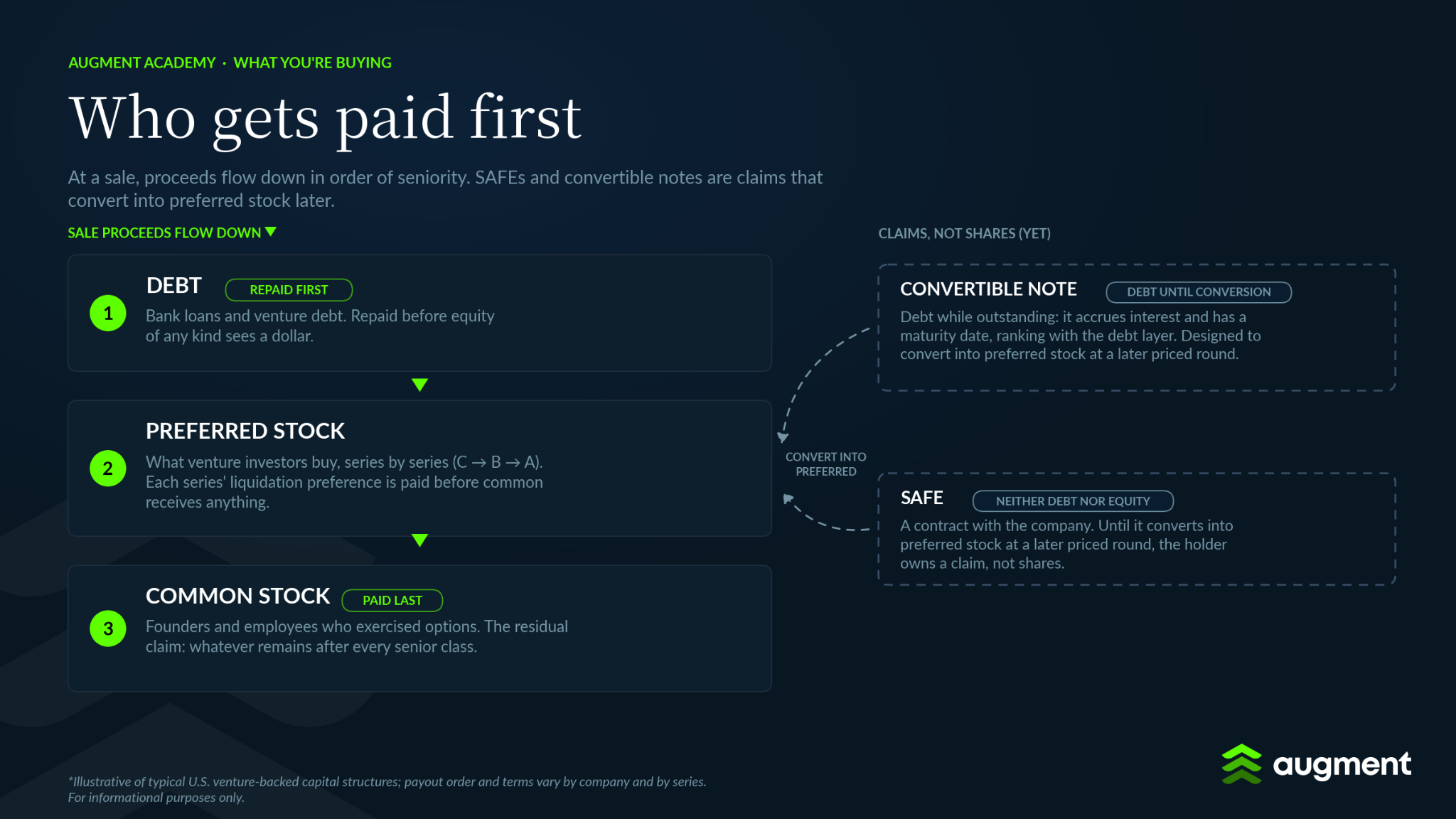
Common is the default class and the bottom of the stack. It usually carries one vote per share and no fixed dividend. In an acquisition, common stock receives only what remains after debt and every preferred series is satisfied. A traditional IPO, in contrast, converts every preferred share into common (typically automatically, under the company's charter), extinguishing those protections at the moment of listing; what typically trades publicly is common, sometimes in dual-class form with different voting rights. The main exceptions are terms designed to apply on the way in, such as down-round anti-dilution and IPO ratchets. So the class you hold matters most in a sale priced below the preference stack. After a successful IPO, the protections are gone and the classes converge.
Preferred is what professional investors negotiate for, and the negotiated terms carry much of its value. The ones that matter most:
| Term | What it does |
|---|---|
| Liquidation preference | A multiple of the original investment (1x is standard) paid out before common receives anything |
| Participation | Whether preferred also shares in the remainder after taking its preference ("participating") or must choose one or the other ("non-participating") |
| Conversion | The right to convert to common: preferred takes whichever is larger at exit, its preference or its as-converted share |
| Anti-dilution | Adjusts the conversion ratio if the company later issues shares at a lower price |
| Protective provisions | Series-level vetoes over major actions like a sale or a new senior series |
In practice, a liquidation preference stack sits ahead of common. If a company has raised $200 million in preferred and sells for $220 million, common holders may split only what's left, far less than the headline price suggests.
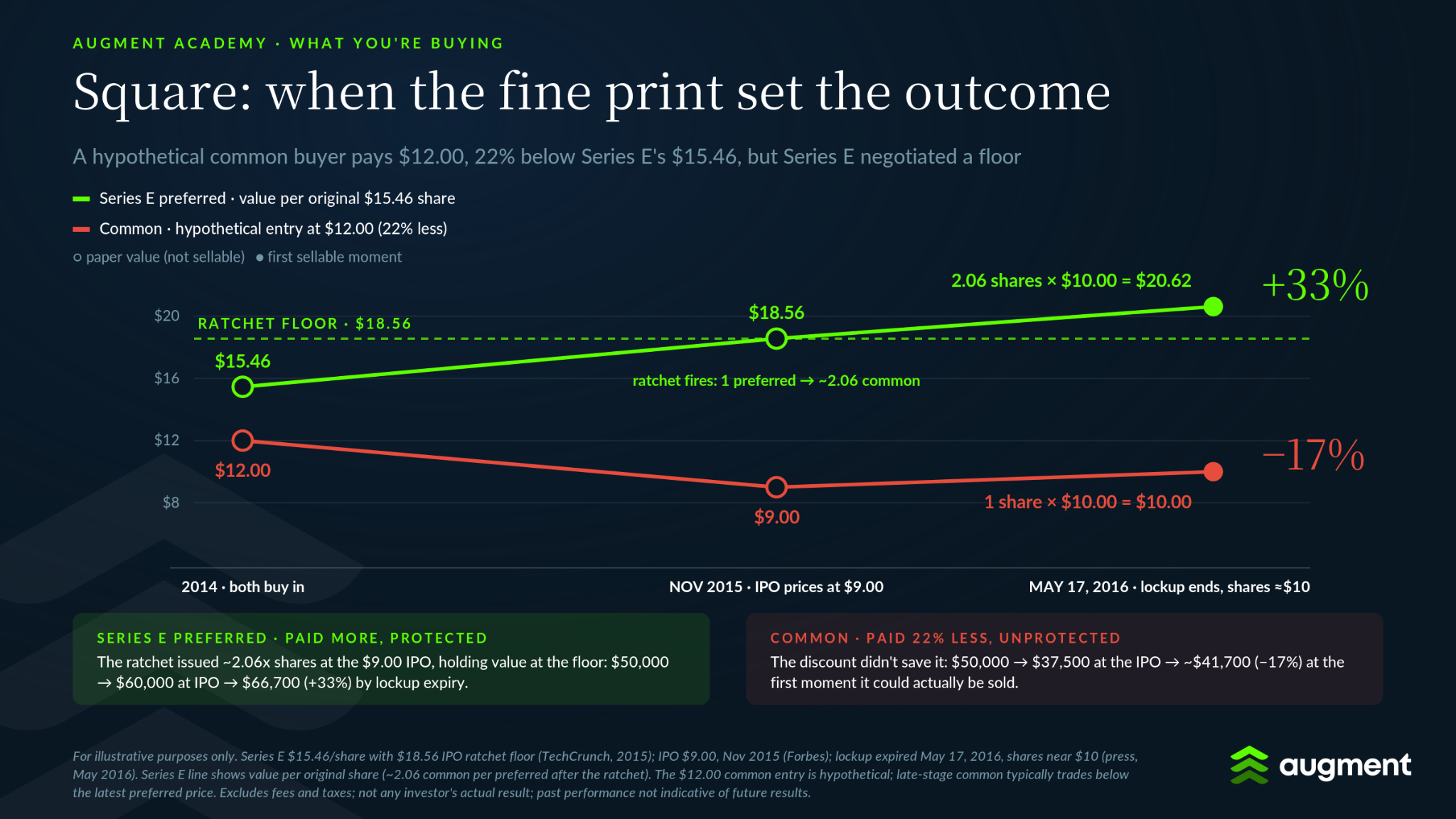
Anti-dilution terms carry real consequences as well. When Square went public in November 2015 at $9.00 per share, below the $15.46 its 2014 Series E investors had paid, a "ratchet" clause in the Series E terms guaranteed those investors a minimum return, and the company issued them roughly 10.3 million additional shares, worth about $93 million, diluting earlier investors and common holders. The case is dated, but it shows how the terms attached to a class can move real money between shareholders.
The liquidation waterfall is the order in which exit proceeds flow: debt first, then each preferred series in seniority, then common. Where the sale price lands relative to the preference stack decides the outcome.
Consider an illustrative company with $40 million of 1x non-participating preferred outstanding and 55 million total shares, 30 million of them common:
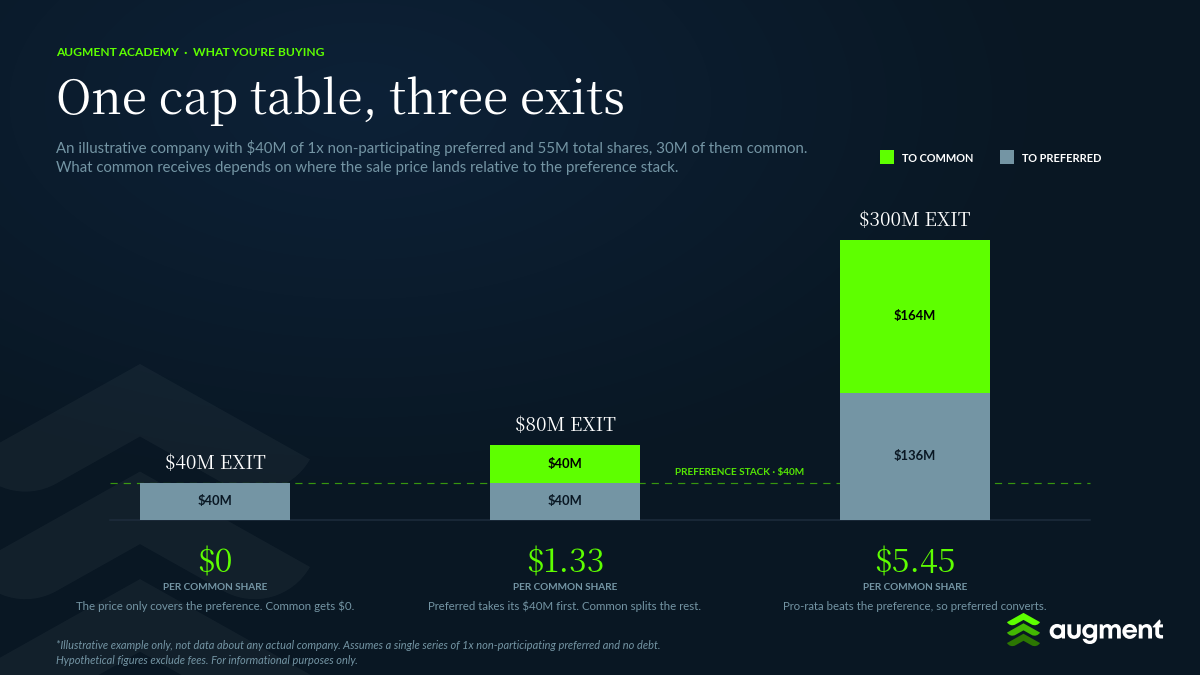
The company and cap table are identical in all three cases, yet common's outcome ranges from zero to full participation depending on the exit price. This is why the size of the preference stack ahead of common is a standard diligence question.
New private-market investors often mistake a headline valuation for a market price. When a company raises at a $10 billion valuation, that number describes the most senior preferred issued in that round, with its preference, anti-dilution, and vetoes attached. The common stock that typically surfaces in secondary transactions is a junior security, even at the same nominal per-share price.
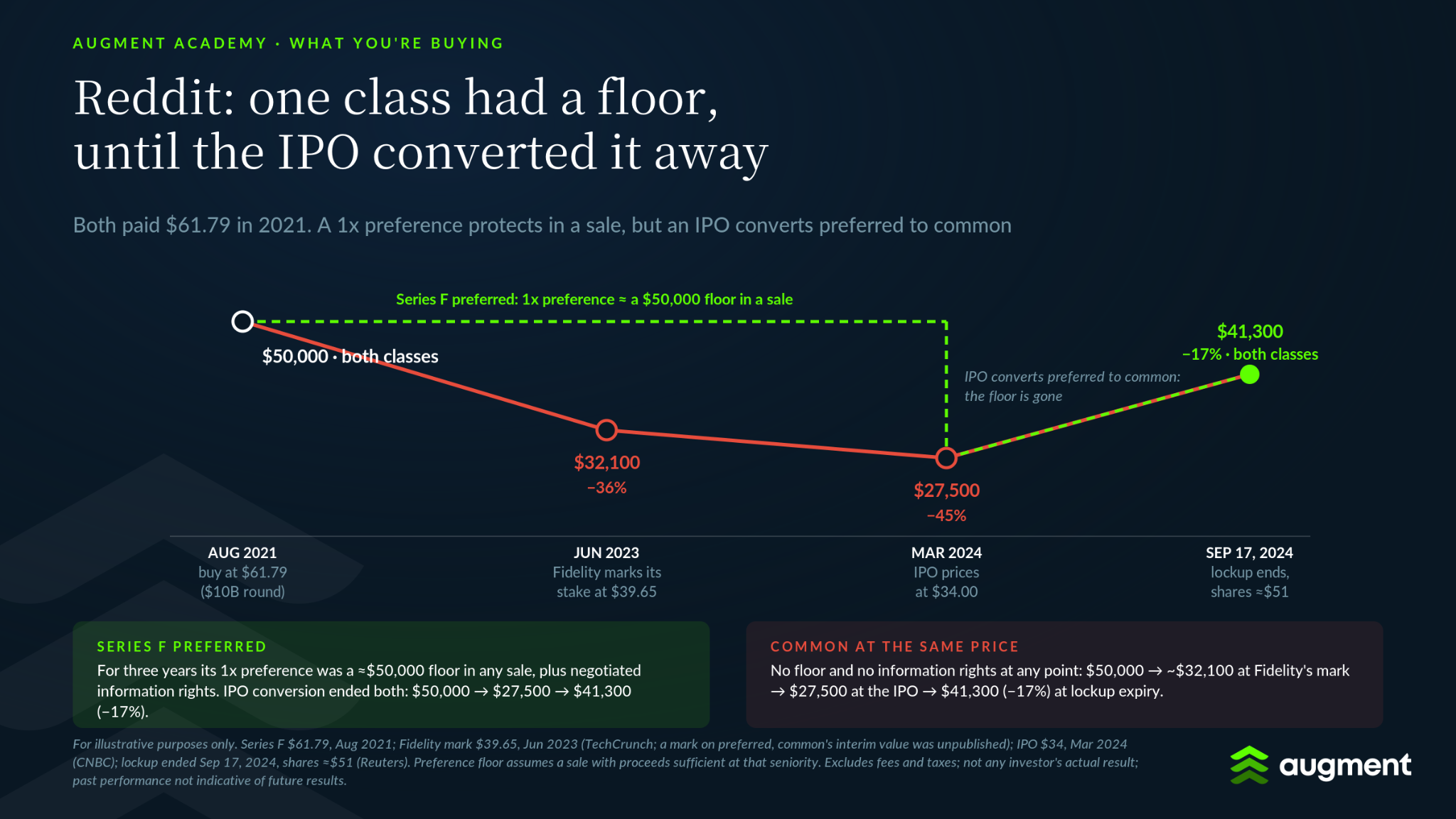
In 2021, Reddit raised a $10 billion valuation at $61.79 per share; when it went public in March 2024 at $34 per share, the IPO valued the company around $6.5 billion. The 2021 number described senior preferred with its protections attached, while what changes hands in secondary transactions is usually common. Not always, though: when the seller is a VC fund or another early investor, the shares on offer can be preferred, carrying whatever rights that series negotiated. Visibility in between was thin. One of the few public reference points came from Fidelity, a 2021 investor whose funds publicly report their portfolio marks, and which by mid-2023 had cut its per-share valuation of Reddit to $39.65. "Discount to last round" means little until you know which class each price refers to, and for most private holders there is no ticker to check in the meantime.
For most individual investors, the practical route into a private company is a single-company SPV. Here the answer to "what am I buying?" changes again. You do not own the shares. You own an LP (limited partner) interest in the vehicle; the SPV holds the shares and appears on the company's cap table as a single shareholder of record.
That has three consequences:
Most SPVs rely on an exemption from Investment Company Act registration: Section 3(c)(1) (up to 100 beneficial owners, all accredited) or 3(c)(7) (limited to "qualified purchasers," generally individuals with $5 million or more in investments). The offering documents will identify which applies. The vehicle structures themselves are covered in a separate module in this series, How You Get Access: The Five Ways to Invest in Pre-IPO Companies; the point here is that an SPV interest is one more layer between you and the shares, and the documents define exactly what that layer does.
Private-market diligence has a structural constraint public-market investors never face: there is no required disclosure package. Under Regulation D, the specific disclosure requirements apply when an offering includes non-accredited purchasers. When it is limited to accredited investors, the issuer isn't obligated to furnish financial statements at all. Anti-fraud rules still apply, so whatever is said must be true, but nothing forces a company or a seller to say much. Accreditation legally presumes you can evaluate the deal, and demand the information, yourself.
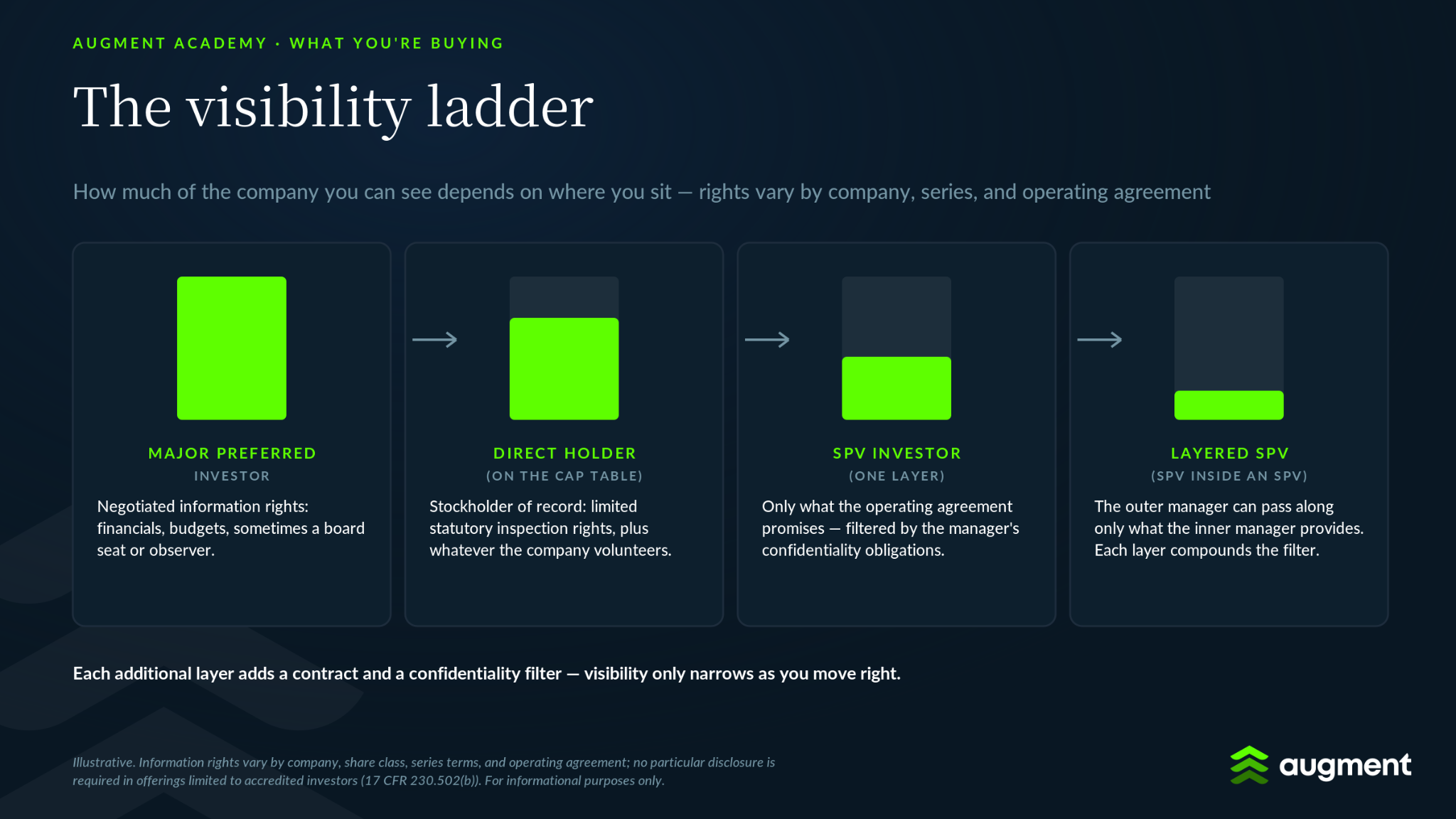
That matters at the point of entry, because of who set the price you're referencing. The investors in the last preferred round negotiated access (financials, budgets, sometimes a board seat) before they wrote their checks. A buyer entering months later through a secondary typically sees a deal page and a headline mark made by people who knew more than you can. This asymmetry is one reason late-stage secondaries have often traded at a meaningful discount to the last round (a median of roughly 27–28% in late 2025, by one dataset), though the discount reflects several factors: the class being sold, the seller's circumstances, and what each side can know. In private markets, what you're entitled to know comes from your position and your contracts rather than from disclosure rules.
How much you can see depends on where you sit:
The practical entry test is knowing which answers you're entitled to, and refusing to proceed without them. Some things are public record you can check yourself: for corporations, preferred terms (preference stack, participation, anti-dilution) live in the charter, a state filing anyone can order from Delaware, and a sponsor's registrations are often public: FINRA BrokerCheck for broker-dealers and their representatives, and the SEC's Investment Adviser Public Disclosure database for registered and exempt-reporting investment advisers. Not every sponsor is required to register, but which registrations exist, and in which capacity the sponsor is acting, is checkable before you commit. Some things the sponsor owes you: the exact class being bought, whether the structure is direct or layered, and the operating agreement's fee, distribution, and reporting terms. And some things, like current financials and interim marks, may be unknowable from where you sit; a seller claiming certainty about them is itself a signal. If even the public-record and sponsor-owed tiers can't be answered, the information problem alone is disqualifying.
The right of preferred stockholders to receive a set multiple of their investment (typically 1x) from exit proceeds before common stockholders receive anything. The sum of all preferences is the "preference stack."
No. SPV investors own LP interests in the vehicle; the SPV owns the shares and is the shareholder of record on the company's cap table. Investors' economic rights come from the SPV's operating agreement.
Because common is paid last. In a sale at or below the preference stack, preferred recovers its investment first and common takes only the residual, which can be substantially less per share, or zero. The gap can narrow as a company potentially gets closer to a liquidity event such as an IPO. An IPO converts preferred into common and extinguishes those protections, so the two classes' prices tend to converge as a listing becomes more likely. The exception is terms built to fire at the IPO itself, like a ratchet, which can hand preferred additional shares in a down-priced listing.
No. RSUs are non-transferable promises between a company and its employees; they aren't shares and can't be sold to you. What trades in secondaries is stock: common that employees hold after exercising options, or preferred held by earlier investors. An offer marketed as "RSU exposure" is really a forward contract on shares the employee expects to receive someday, a structure that plan documents often prohibit and that carries its own counterparty risk, covered in How You Get Access: The Five Ways to Invest in Pre-IPO Companies.
Check the offering documents. For preferred terms, the Certificate of Designations is a public state filing (Delaware filings are searchable); for SPVs, the operating agreement and offering documents identify the class held.
Get started today — explore pricing, offerings, and submit your first order.
FOR QUALIFIED INSTITUTIONAL AND ACCREDITED INVESTORS ONLY: Under federal securities laws, private market investments on this platform are available exclusively to Institutional and Accredited Investors. Verification of status required before investing. Private investments involve significant risks including illiquidity, potential loss of principal, and limited disclosure requirements. "Augment" refers to Augment Markets, Inc. and its affiliates. Augment Markets, Inc. is a technology company offering software and data services, not a bank or financial institution. Cash Accounts are provided by Modern Treasury Corp. financial institution partners and through Augment's technology. Augment does not act as a money services business, provide money transmission, or serve as a custodian of funds. Funds held in your Cash Account are not FDIC insured unless expressly disclosed. Full terms available in the Augment Cash Account Agreement.Brokerage services are offered through Augment Capital, LLC, an affiliated broker-dealer and member FINRA/SIPC. “Investment accounts” are not brokerage accounts and do not hold customer funds or securities. Investment advisory services are offered through Augment Advisors, LLC, an SEC-registered investment adviser. Registration with the SEC does not imply a certain level of skill or training. Augment and its affiliates do not provide legal or tax advice; consult your attorney or tax professional regarding your specific situation. For additional information, please refer to Augment Advisors, LLC’s Form ADV Part 2A (Firm Brochure) and FINRA BrokerCheck.